Scott H Young

The Critical 7 Rules To Understand People


My headline might sound overreaching. Clearly a rule can’t define something as complex as human behavior. But despite this, I’ve found most people tend to make the same mistakes. These mistakes are frequent enough that they create conflicts later. Remembering these seven rules will help you avoid these mistakes.

People Skills is About Being Nice, Friendly and Interesting, Duh!

Most the books I’ve read on dealing with people either make two claims:

  • Incredibly obvious stuff that most sensible people understand; even if they haven’t always mastered it. Things like be nice, be considerate, etc.
  • Bizarre and complex theories that may explain some behavior, but is difficult to generalize.

Between these two I’ve found there seems to be a gap of information that is can be applied generally, but isn’t always obvious. These frequent mistakes tend to cause most people conflicts, social errors and emotional upsets.

The Seven

Here are the seven rules I’m talking about:

Rule One: Never blame malice for what can easily be explained by conceit.

People don’t care about you. This isn’t because people are mean or hurtful, but simply because they are mostly focused on themselves. Consider this hypothetical pie-chart showing the variety of thoughts a typical person has:
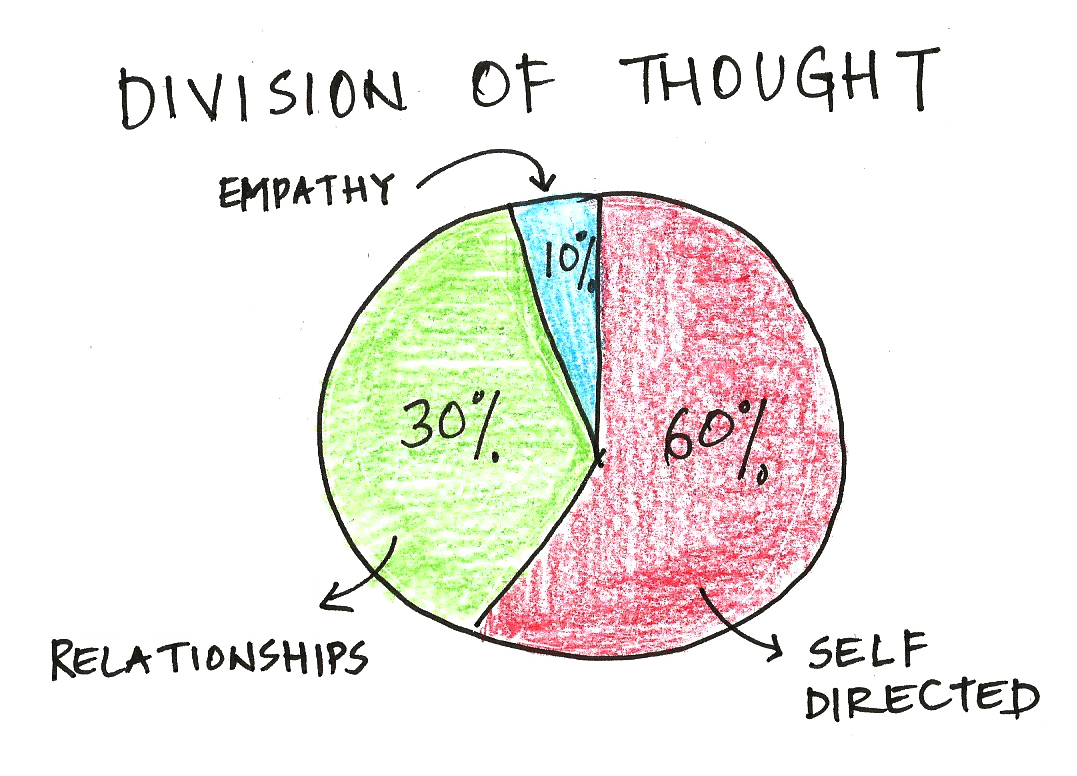
Thought Chart

In this example, 60% of thoughts are self-directed. My goals. My problems. My feelings. Another 30% are directed towards relationships, but how they affect me. What does Julie think of me? How will boss evaluate my performance in the next review? Do my friends like me or see me as irritating?

Only 10% in this model is time spent in empathy. Empathy is the rare event where one person actually feels the emotions, problems and perspective of another person. Instead of asking what Julie thinks of me, I ask what is Julie thinking.

Within that 10%, most people then divide attention between hundreds of other people they know. As a result, you would occupy a fraction of a percentage in most peoples minds, and only a couple percentage points in a deeply bonded relationship. Even if you are in another persons thoughts, it is how your relationship affects them, not you.

What does this mean?

  • Embarrassment doesn’t make a lot of sense. Since others are only focusing a small portion of there thoughts onto judging you, your self-judgement is overwhelmingly larger.
  • People who appear to be mean or hurtful don’t usually do it intentionally. There are exceptions to this, but generally the hurt you feel is a side-effect, not the principle cause.
  • Relationships are your job to maintain. Don’t wait to be invited to parties or for people to approach you.

Rule Two: Few Social Behaviors are Explicit
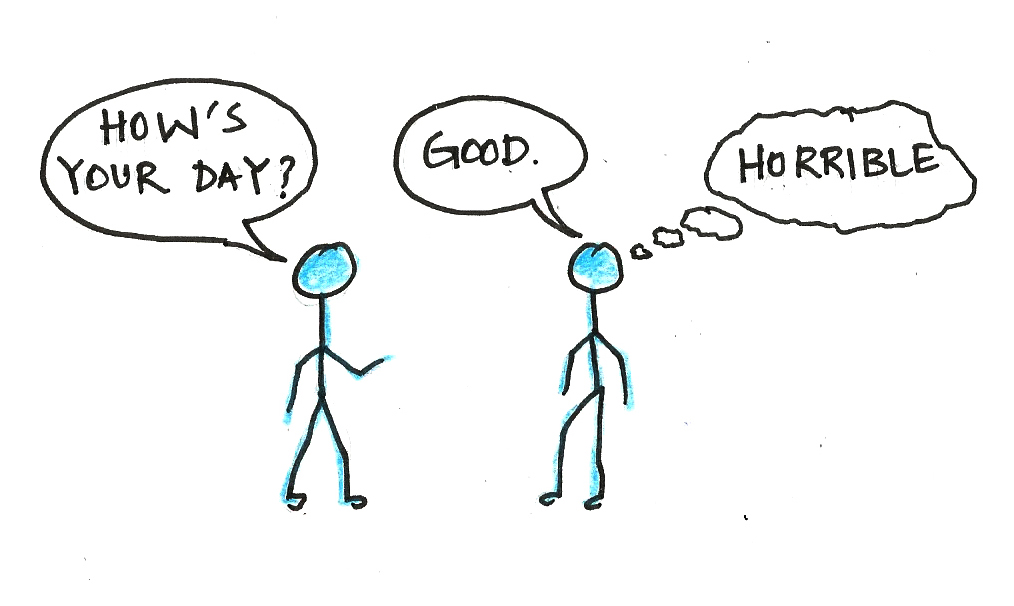
Basically this rule means that most the intentions behind our actions are hidden. If a person is feeling depressed or angry, usually the resulting behaviors distort their true feelings. If I feel you snubbed me, I might hold my tongue but ignore you later.

The old joke is that women use words like, “fine,” and, “go ahead,” when they really feel the opposite. But I’ve noticed men do this too in polite situations, although often not in the same way.

The application of this rule is that you need to focus on empathy, not just hearing a person. Demonstrate trust, build rapport and learn to probe a bit. By focusing on empathy you can usually break away these subversions and get to the heart of the issue faster.

The other application of this rule is that most the time you feel something, nobody else knows about it. So don’t get angry when people aren’t responding to you. If you deceive your thoughts with your actions, don’t get angry when you fool people.

Rule Three: Behavior is Largely Dictated by Selfish Altruism
To say everyone is completely selfish is a gross exaggeration. That ignores all the acts of kindness, sacrifice and love that make the world work. But I would argue that most (not all, but most) behavior does work from the principles of selfish altruism.

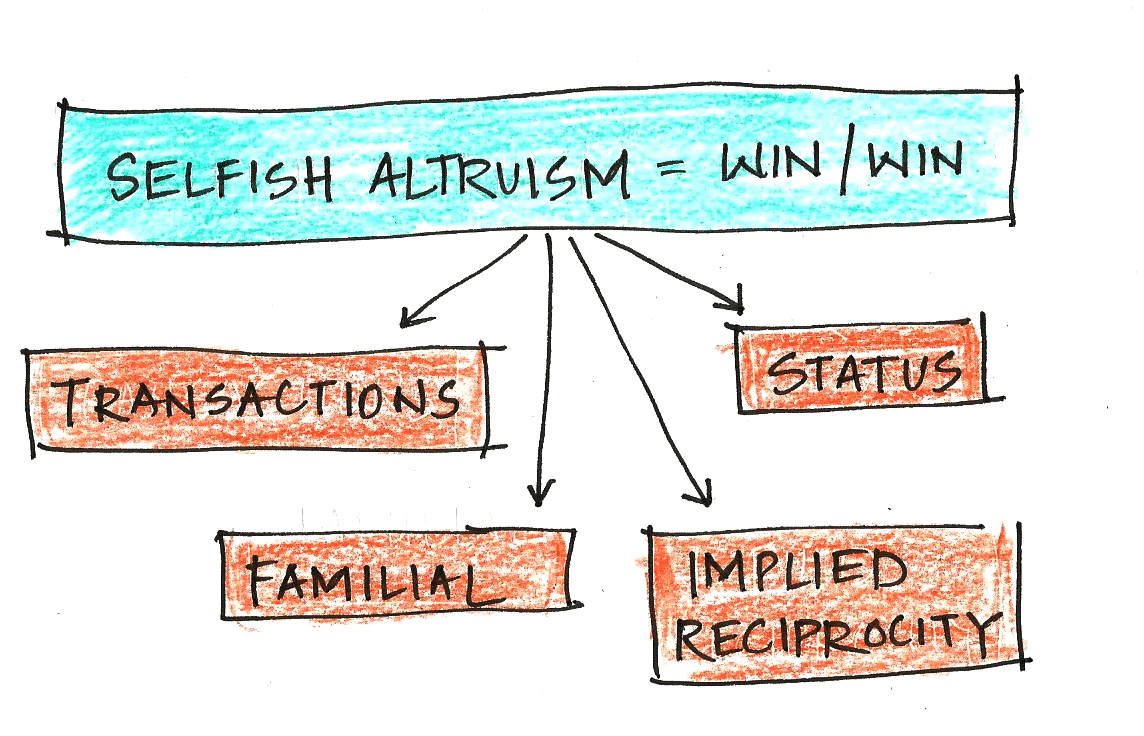
Selfish altruism is basically win/win. It is where helping you directly or indirectly helps me. There are a couple main categories where this applies:

  1. Transactions - If I purchase a car, both myself and the dealer benefit. I get a vehicle, which I want. The dealer gets money to improve his lifestyle. This is the predominant form of selfish altruism between people who don’t have emotional bonds.
  2. Familial - Blood is thicker than water. We are designed to protect people who share our genes. This can sometimes shift towards extremely close friends and loved ones.
  3. Status - Helping someone is a sign of power. Many species of primates will offer assistance as a sign of dominance. People act similarly, offering aid to boost their self-esteem and reputation.
  4. Implied Reciprocity – Many relationships are based on the idea that if I help you, one day you will help me as well.

Occasionally behavior falls outside this group. Nameless heroes dying for causes that don’t help their bloodline. Volunteers devoting their time towards humanitarian missions. But these are the minority, whereas most actions can be explained by some form of selfish altruism.

How do you apply this rule? You understand the motives of people and appeal to them as if they were selfish. Find ways to help people within these four categories. Don’t expect people to offer aid outside of selfish altruism, it isn’t impossible, but it isn’t likely.

Rule Four: People Have Poor Memories
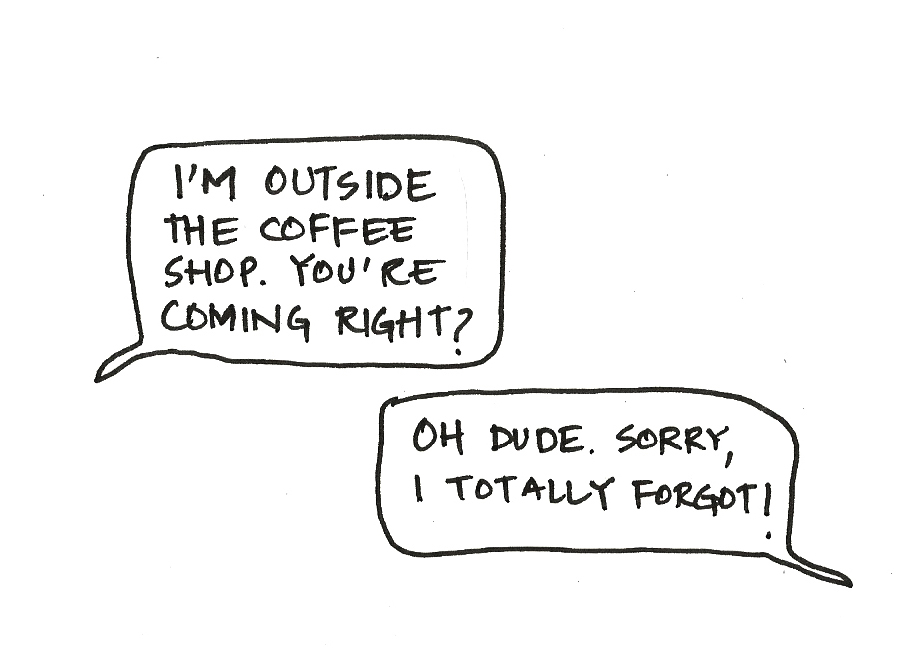
Ever been told someone’s name at a party and then forgot it later? Another rule of human behavior is that people have trouble remembering things. Especially information (as you’ll recall in rule one) that doesn’t apply to themselves. People are more likely to remember your similarities than your differences (unless they were emotionally incensed by them).

Recently I even broke this rule. I made arrangements to talk to a person I hadn’t met before on the phone. Even with my normally foolproof system of calendars and to-do lists, a few spontaneous schedule changes caused me to miss the call. I quickly apologized and made a new arrangement.

But the fact is most people don’t have organized GTD systems. People are forgetful by nature, so once again, don’t assume malice or disinterest if something is forgotten. The other side of this rule is that you can demonstrate reliability by having a good memory or system (if it doesn’t fail you).

Rule Five: Everyone is Emotional
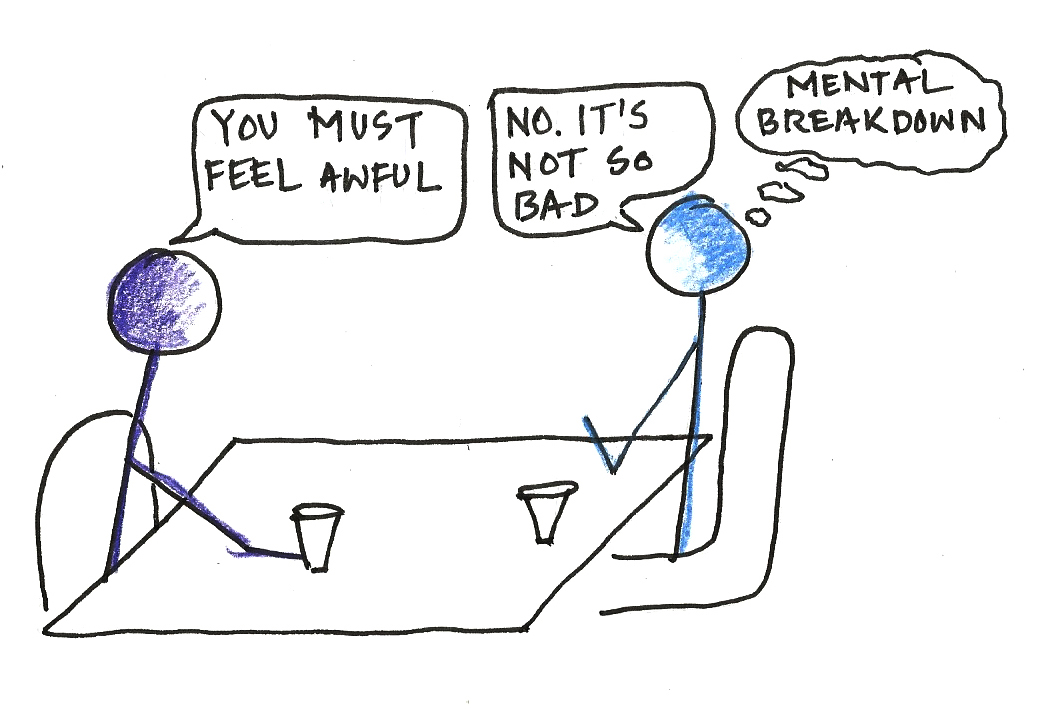
Perhaps this is an exaggeration. But the core of the message is that people tend to have stronger feelings about something than they let on. People who regularly have outbursts of anger, depression or flamboyant enthusiasm are generally frowned upon in most cultures. This especially applies to men (for women trying to figure us out).

The application of this rule is to not assume everything is fine just because someone isn’t having a nervous breakdown. We all have our individual problems, angst and upsets that are normally contained. You don’t need to call people out on their private deception, but being sensitive to those underlying currents gives you an advantage in trying to help.

The alternate application of this rule is similar to rule two. People generally assume everything is fine unless you just had a blowup.

Rule Six: People are Lonely

This is another broad generalization. But it is amazing how many people who seem to have it all, suffer from bouts of loneliness. As social animals, I believe people are especially sensitive to any threats to becoming ostracized. In Neanderthal times, exile meant death, so loneliness and the desire to be with other people is a strong one.

The application of this rule is that loneliness is fairly common, so in that sense, you really aren’t alone. I used to be bothered when I felt alone or an outsider in a social group. Although I’m still human, I’ve found recognizing this feeling to be fairly common as a way to minimize it.

Rule Seven: Did I Mention People Are Self-Absorbed?
This may sound like a reiteration of rule one, but I believe the applications extend beyond relationships and your emotional state. The fact that people tend to be too concerned about themselves to give you much attention, that people tend to be lonelier, more emotional and feel differently than they let on applies to how you view the world.

If anything this perspective should make you more proactive and independent. Once I started really learning these rules, it made far more sense that I needed to take charge. By placing your individual happiness in the hands of another person (or people), you ignore all these rules and do so at your own peril.

I like to take an optimistic, but realistic view of people. People who are generally try their best, but make mistakes and suffer from unintended self-absorption. In other words, they are basically like you.


Print Friendly
StumbleUpon It!

This website is supported, in part, by affiliate arrangements (usually Amazon). Affiliate relationships are always marked by bolded links.


151 Responses to “The Critical 7 Rules To Understand People”

  1. Chris says:

    You mention reading up on people skills and finding the info was either too basic, or too bizarre and complex. Can you give some examples of the later?

    I agree people are generally too self-focused to be thinking all day about what’s wrong with you. In my experience it’s mainly insecure people who will dwell negatively on others. They have to mentally tear other people down to feel secure about themselves. Or they’re paranoid that everyone hates *them* that they
    get the other people first”

    The fifth point about poor memory also ties into this. People are so benignly interested in their own lives that you can slip under the radar if you aren’t immediately relevant to them.

  2. Scott Young says:

    Chris,

    I’ve flipped through advice from different dating experts. All interesting, but many of the theories are complex and have questionable value in broader settings.

    Kudos on the great articles for your site though. Might I recommend switching to full feeds and allowing comments instead of an article system?

    -Scott

  3. Hi Scott,

    Nice post – I really like the pie chart, although I suspect you are bing too kind with just 60% of thoughts being self directed!

    It was as a result of ariving at similar realisation to yourself that I came up with my snarky definition of an egocentric bore: Someone who is more interested in himself than he is in me.

    You’ve really hit the nail on the head here though – the surest way to be interesting to people is by being interested in them.

    Best,

    Rowan

  4. Chris says:

    Yeah, those “dating experts” can be a can of worms. Some people even hurt their chances by trying to apply certain “dating expert” theories in a broader setting. e.g., they’re treat all guys as if they’re dating competitors, etc, because that’s the only extent that males are mentioned in that material. You know what I’m talking about if you’ve read it…

    I had a bunch of reasons when I first put up the site to go with the articles all on the homepage. For the most part I like the system, but it does mess up the RSS feeds. Maybe I can figure out a way to set up feeds for html pages manually?

  5. Brenton Scott says:

    Good points Scott, I found myself thinking those same things at times when dealing with some people.

    As for the dating advice, I agree that they are way too complex and tend to say that how the relationship progresses depends on the parter rather than yourself. I found this to false and I also found that just being myself (confident, flirting with the idea of sex in a witty way and wanting friendship rather than sex) got me more meaningful relationships than any of those crap advice I read from so-called dating experts.

    But I think the point in the end is that everybody wants (and expects) something that benifits them. Dealing with that reality saves us allot of hurt and confusion.

  6. Ashley says:

    Scott, I always enjoy your blog, but this has to be one of the best blog posts I have ever read.

    Ashley

  7. Scott Young says:

    Chris,

    I’m not exactly sure. I just know that forcing the extra click to view an article may be enough to get a proportion of your readers to navigate away. Attention is extremely limited in feed readers, so you need to be careful.

    Other than that, keep up the great work.

    -Scott

  8. David says:

    Liked the post Scott. What’s interesting is how your phrasing of rule one is slightly different than mine, and how it shades things : Never blame malice for what can easily be explained by ignorance.

    Ignorance vs conceit.

    Guess it reflexes on how one views default humanity. For myself, empathy is a learn-able skill which means that it’s possible to increase its percentage in the pie chart. Most people I think aren’t taught to think about others, which maybe a positive benefit of religion but that’s for a different post.

  9. Scott Young says:

    David,

    Empathy is definitely a learnable skill, but there are limitations on the human mind. Even if you are incredibly empathetic and say, 30% of your thoughts were outwardly directed, you would still divide that third between hundreds of people, perhaps more. As a result, no one person even comes close to focusing on you, than you do.

    Conceit is slightly different than ignorance, as you are phrasing the famous quote by Napoleon Bonaparte. They both are the result of a lack of knowledge, but while ignorance implies people don’t understand, conceit implies they simply don’t have mental room to care.

    -Scott

  10. Andrew says:

    Awesome article, yes I agree it’s one of your best so far.

    As far as dating goes, I think you should understand the underlying reasons for the actions that people take as far as sexual relationships go first, and for that I can’t recommend this book highly enough: Sperm Wars, by Robin Baker. Funky title, I know, but it covers a LOT of the aspects of why people do the things they do with the opposite sex–the author is an evolutionary biologist at the University of Manchester.

    As for general advice for dealing with people, I’ve read a LOT of books, and still nothing beats Carnegie’s ‘How to Win Friends and Influence People’ overall. I also have a book called ‘How to make people like you in 90 seconds blah blah’ or something like that, hokey title, but the reason I bought it was the Amazon reviews that sort of named it as the best beginners intro to the NLP concept of synchronization, and I now realize synchronization is just a fancy technique for making you empathize with another person as quickly as possible, very interesting.

    Scott, can you recommend some books you’ve read?

    Cheers,
    Andrew

  11. Scott Young says:

    Andrew,

    Actually I already read Sperm Wars. Interesting book. As for recommendations, just go through my Friday Links and you’ll see I recommend something out of my library each week.

    -Scott

  12. Gene says:

    I have used a variation of your statement; Rule One: Never blame malice for what can easily be explained by conceit. My slight variation was; Never ascribe to malice that which can be explained by incompetence.

    I am sure that I filled the serial numbers off of the statement and am using it in my life and my work.

  13. Ken Daniels says:

    For me to simplify I think we all take too many things personal & we need to make an art form of listening & trying our best to really understand the other person listening & asking questions .I also believe your pie graph & the 60% of self directed thought was being alittle kind. Enjoyed your post

  14. asdf says:

    Fantastic article. I think I have a slightly more skeptical perspective, so I would change the following headers, but very concise and well rounded article.

    Rule One: Never blame malice for what can easily be explained by conceit or incompetence.
    Rule Two: Coping mechanisms are rarely effective in communicating emotion.
    Rule Three: People are always motivated by Greed and Fear, often resulting in Selfish Altruism.
    Rule Five: People act based on emotion, not logic.

  15. Rule 1: If you look away for a second, they WILL look at your boobs.

    Rule 2: Given a choice between voting for Ron Paul or Jeb Bush, people will unerringly reach for another Bud Light. This is for the greater good of society, of course.

    Rule 3: People have a deep seated mistrust of Portuguese automobiles. This is not common knowledge because the Portuguese have not made any yet.

    Rule 4: In a presentation, someone will always pick their nose. This also is for the greater good of society, but only when this is the same person who is asking the difficult questions and when a confederate has a digital camera.

    Rule 5: There are many other rules, and all are exemplified in excruciating detail in The Banjo Players Must Die.

  16. Andrew, I used to think the “How to Win Friends” book was a revelation, but then I learned that everyone else has read it and recognizes the techniques immediately, nullifying their effectiveness.

    I haven’t found anything that beats Stephen Covey’s “Seven Habits of Highly Effective People,” which delves beyond the shallow tricks and points to character development. Pretty icing doesn’t make a salty cake taste better.

  17. Will says:

    Great post! “Unintended self-absorption” is a fitting way to describe the human condition.

  18. The world is a big place with many different cultural norms.

    I doubt that all of your rules can be applied equally within every culture in the world.

    At least four of your rules could not be considered as being true in places such as India or China. Nor would they be true for many ethnic groups living in the U.S.

  19. Bauski says:

    Great article. Like you said, I don’t know if 7 rules are enough or too much, but these are great ideas to hold whenever you find yourself in social situations, new or old. Having a general set of ideas such as these can really help keep good manners and fluid interactions without having to end up being frustrated for misunderstandings.

  20. Twriter says:

    Here’s another rule: No one regards themself as evil. Everyone considers themselves to be a good person, we don’t see or acknowledge the bad in us. Usually “evil” behaviour in a person is a defensive reaction to their circumstances or an attempt to prove superiority over others. The guy who cuts you off in traffic is trying to bolster his own ego by proving that he got ahead of you. The lady who insults your clothing choice may be insecure about her own looks and is pre-emptively trying to distract attention away from herself. You can’t understand these people until you can look at life from their perspective.

  21. [...] The Critical 7 Rules To Understand People Critical Rule #8: Understanding people is a lot more complex than following rules, but it’s a starting point. (tags: psychology relationships social lifehacks management reference people) [...]

  22. chris says:

    Nice article but spelling and grammar snafus detract from your points in a half-dozen places

  23. Daniel says:

    nice article, i feel like I understand people a lot better

    I’m just not sure what you meant by this

    “Once I started really learning these rules, it made far more sense that I needed to take charge. By placing your individual happiness in the hands of another person (or people), you ignore all these rules and do so at your own peril.”

    Does it help to be more emathetical towards people?
    Do I need to take more action in building relationships?

  24. jared says:

    Thanks for this piece. You hit on some of my fundamental triggers for social anxiety. I feel less confused now.

  25. [...] The Critical 7 Rules To Understand People Status – Helping someone is a sign of power. Many species of primates will offer assistance as a sign of dominance. People act similarly, offering aid to boost their self-esteem and reputation. (tags: life) [...]

  26. [...] Scott H Young’s article, The Critical 7 Rules to Understand People, outlines in clear and simple terms how to relate with others, to worry less about what others think of you and be more empathetic of their feelings. His tips provide guidance in learning to maintain humble and inspired relationships. [...]

  27. [...] Scott H Young wrote an interesting list of the critical 7 rules to understand people – it’s always important to be aware of what others might be feeling or thinking. [...]

  28. Mr. B says:

    Rule one:
    Don’t waist time on people you don’t feel comfortable with. They are not worth it.
    Rule two:
    People like to talk about themselves. So ask them meaningfull questions, find out what makes them tick. See if you have interests in common. If so, you are lucky!
    Rule three:
    Don’t be to nice! Don’t be the shoulder to cry on, or that is what you gonna get exclusively. If you are considerate. females tend to see you as a softy. The paradox is, they often feel attracted to guys who don’t give a damn.

  29. Ted Tap says:

    This could not be truer. I am so relieve to read rule one. I had been paranoid over my friend’s seeming boredom with me… I driving someplace with him and I was thinking, “Oh god… He probably is sick of me… I really don’t want to stop hanging out.” And then a second or two later, he turns to me and says, “Hey man… I was just wondering if you were sick of me or something… Because… umm..—” I immediately laughed very loudly, startling and confusing him, but then I cleared things up with him. Saying this now I actually realize that maybe it doesn’t fit exactly… but it is close. Recently I have found that if you are experiencing a feeling towards someone… they probably are feeling the same thing towards you… not always.. but often.

    Relieved and Grateful,

    Ted

  30. I must say that I quite enjoyed this article and the series of comments that accompanied it…

    I agree with a major point here, which is that people find you “interesting” if you happen to pay attention to them – look into their eyes, ask questions, keep track of the conversation or series of conversations and make a reference to them in future conversations, quote the person etc…

    Suddenly descriptions like: what a likable fellow, so understanding – start springing up – hmmm…

    Well thanks again for the insight – brilliant article…

  31. [...] the full post Digg This!   Save to del.icio.us   Save to Ma.gnolia   Save to Furl Email This   View CCLicense [...]

  32. [...] Blogger Scott H. Young knows that it’s difficult to understand and predict human behavior, but he also knows that by avoiding a few common mistakes, we can improve our own relationships. Young postulates that we’re inherently self-absorbed, so when people may offend or embarrass us, they’re typically not doing so intentionally. He adds that the meaning behind our actions is not immediately known to others and suggests that we take an emphatic approach towards our peers, especially because humans by nature are emotional beings. His advice is to give everyone we encounter the benefit of the doubt so that we can improve our relationships with any person we meet. To me, his article paints a clear picture of human emotions and instincts. Psychology buffs, what’s your take? The Critical 7 Rules to Understand People [Scott H. Young] [...]

  33. [...] The first post is titled “The Critical 7 Rules To Understand People“. Here’s an example: Rule One: Never blame malice for what can easily be explained by conceit. [...]

  34. Pam Carpenter says:

    Wow Scott,

    Thank you for your insight, I guess you pretty much hit the nail on the head with respect to my husband. I really liked your pie chart, especially the 10% empathy part, our marriage counsler told me that I need to teach my husband empathy as I would a child, but if he is basically capable of only 10%…well then I can better redirect my energy twords a mani/pedi, or maybe some other self-directed spa treatment.

  35. Scott Young says:

    Pam,

    I’ve never met you or your husband. But I have a principle in my life that says all change has to come from within. You can’t “teach” someone empathy if they aren’t willing to learn.

    -Scott

  36. [...] From here: People don’t care about you. This isn’t because people are mean or hurtful, but simply because they are mostly focused on themselves. Consider this hypothetical pie-chart showing the variety of thoughts a typical person has: [...]

  37. [...] I read an article today that seems fitting: The Critical 7 Rules to Understand People. Rule number one is pertinent: don’t assume malice for what might be conceit. Also, rule number 3 about selfish altruism. I learned a lot about altruism and game playing when I took my course in primatology. This article has given me some ways of viewing her actions from her side. Maybe she thought this was a win-win situation for both of us. Or maybe she was just so focused on herself that my feelings didn’t ever enter the picture. Which keeps bringing me back to the question, am I asking too much of her? Is it too much to ask of a friend? Maybe. Is this a matter of right and wrong? It can’t be, because there is no ultimate right or wrong. [...]

  38. [...] Understanding People Here is a nice article on how to understand people better…hint, they only care about theirself… [...]

  39. [...] Scott H Young » The Critical 7 Rules To Understand People Insightful and definitely worth reading. (tags: management) [...]

  40. Abudha Dein says:

    Nice post.

    My mother always said, you will experience far less disappointment, and far more personal contentment, in your life, when you realize that other people are not generally “out to get you.” They are not actively planning to humiliate or pain you. Generally they don’t think of you AT ALL. You simply don’t enter into the equation of their moment-by-
    moment actions. It’s all about them, don’t you see? (Shocking revelation Iknow—especially when we’re talking about f-e-m-a-l-e-s, who can never ever ever be wrong about a-n-y-t-h-i-n-g).

  41. [...] Blogger Scott H. Young knows that it’s difficult to understand and predict human behavior, but he also knows that by avoiding a few common mistakes, we can improve our own relationships. Young postulates that we’re inherently self-absorbed, so when people may offend or embarrass us, they’re typically not doing so intentionally. He adds that the meaning behind our actions is not immediately known to others and suggests that we take an empathic approach toward our peers, especially because humans by nature are emotional beings. His advice is to give everyone we encounter the benefit of the doubt so that we can improve our relationships with any person we meet. To me, his article paints a clear picture of human emotions and instincts. Psychology buffs, what’s your take? The Critical 7 Rules to Understand People [Scott H. Young] [...]

  42. [...] Blogger Scott H. Young knows that it’s difficult to understand and predict human behavior, but he also knows that by avoiding a few common mistakes, we can improve our own relationships. Young postulates that we’re inherently self-absorbed, so when people may offend or embarrass us, they’re typically not doing so intentionally. He adds that the meaning behind our actions is not immediately known to others and suggests that we take an empathic approach toward our peers, especially because humans by nature are emotional beings. His advice is to give everyone we encounter the benefit of the doubt so that we can improve our relationships with any person we meet. To me, his article paints a clear picture of human emotions and instincts. Psychology buffs, what’s your take? The Critical 7 Rules to Understand People [Scott H. Young] [...]

  43. [...] Scott H Young » The Critical 7 Rules To Understand People (tags: People Blog Business) [...]

  44. Robert says:

    Hi Scott,

    enjoyed this post. The pie chart was great although I have to agree with Rowan that 60% might be not enough. Anyway, continue the great work.

    Robert

  45. Mike Savage says:

    Scott,
    I very much enjoyed reading your artical, tho it seems are opinions differ slightly on one point, i truely beleave that people are absolutly selfish(I also beleave that people should take this as it is, and not as a bad thing, or even as a good thing, just as a reality, words carry to much emotional bagage sometimes that the true meaning is lost, as i beleave is the case in the concept of selfishness) this is not to say that there is no room for empathy or helping others, i just beleive that people are empathtic for selfish purposes. For example, I always try to keep my friends happy(by sharring, or any other means), because when they are happy, it makes me happy (you scratch my back i will scratch yours), even when people do things that on the surface dont seem to help themselves in any way(I.E. giving to charrity) they are still doing it for themselves (it could be to make them feel good, to assure a spot in there heaven, or to make them look good…there are many other possible reasons…) I beleave a understanding of this concept is very benificial to both the individual and the group the individual is interacting with, understanding that everyone(whether they like it or not) is always out for #1 allows you to clearly determine the reasoning behind a individuals actions(or words), allowing you to modify them (via communications) to better suit the needs/interests of the individual and the group(i find this thought process very usefull when applied both internally(to me) and externally(to you)), I guess my point here is that even the things that dont seem selfish are infact done for the self(like the nameless heros dieing for people they do not know.) and that understanding this will assist you in social interactions and in life in general.
    anyways, i think i have made my point even tho my spelling and grammer may not be perfect, thanks for reading, and any feedback/elaborations on this would be appreciated.
    thanx,
    Mike

  46. Scott Young says:

    Mike,

    I alluded to that somewhat in the selfish altruism rule. I think it is a bit of a generalization to say that all human behavior is selfish. This may be true on some fundamental, esoteric level, but in a practical reality people will help you. Just that they tend to help you in categories that typically service themselves in some fashion (i.e. selfish altruism).

  47. [...] Scott H. Young presents The Critical 7 Rules To Understand People [...]

  48. Mike Savage says:

    Scott,
    thank you for your reply, and i can understand that it may be more practical for most to not think about the reason someone is helping you(but to just accept it, and to be gratefull!). something i would like to add to this, is i beleave when people interact in groups (2 or more), the group acts as a single entity/organisim(REALLY cool concepts here, swarm therory, collective conciouseness, memes, etc…), and it has its own selfish agenda, so a selfish individual in a social situation is a part of a larger entity, aiding the group in achieving the group agenda(because what is best for the group is most often best for the majority of individuals), thus even tho each individual is acting selfishly, there selfish actions will naturally aid the group because in turn it will aid the individual. I guess what i have based all of this on is natural selection, there are all sorts of systems involved in our lives (biological systems(imune sys, nerve sys, cardio sys, etc…), social systems(goverments, support groups, sports teams, work groups, etc…), communication systems(phone, internet, launguages, etc…), trade systems(monetary, exchange, etc…), share systems(Wikipedia, instructables, etc..), the list goes on…) and i beleave these systems are fundemently controlled by the process of natural selection, for example, you shared your ideas here on understanding people, wich i read and combinded with previously aquired information, forming a hybrid idea, stronger better faster then the ideas were before(or at least better suited to aid me), when i share this with you, it evolves in your mind yet again, and so on and so forth. I beleave understanding this has REALLY helped me understand all sorts of systems from the biological systems we call humans, to complex social systems like pop culture.

    again, thanx for reading and i hope to hear other peoples takes on these ideas.

    Cheers,
    Mike

  49. Arthur says:

    Hi Scott,

    Very nice article. I hate to drag on about the same subject, but I gotta agree with what alot of people here said about the “dating gurus.” Man, I spent about 2 years of my life trying to implement that advice and look where it got me: No close friends, constant fear and tension around other men, and fear of making a mistake in front of women. I’d rather have gone through the “normal” cycle most people go through: slowly acquiring social skills and thus friends, finally getting a GF, who isn’t as attracted to you as she should be, dumps you and breaks your heart. And then you recover, and start to know what some of the traps and pitfalls of the dating game are. Despite what the gurus say, experience has, at least for me, always been a better teacher than simply reading stuff or watching DVDs.

    Thanks,
    Arthur

Debate is fine, flaming is not. Pretend that this comment form is a discussion taking place in my house. That means I enjoy constructive criticism and polite suggestions. Personal attacks, insults and all-purpose nastiness will be removed especially if it is directed at other readers.

Leave a Reply