My headline might sound overreaching. Clearly a rule can’t define something as complex as human behavior. But despite this, I’ve found most people tend to make the same mistakes. These mistakes are frequent enough that they create conflicts later. Remembering these seven rules will help you avoid these mistakes.
People Skills is About Being Nice, Friendly and Interesting, Duh!
Most the books I’ve read on dealing with people either make two claims:
- Incredibly obvious stuff that most sensible people understand; even if they haven’t always mastered it. Things like be nice, be considerate, etc.
- Bizarre and complex theories that may explain some behavior, but is difficult to generalize.
Between these two I’ve found there seems to be a gap of information that is can be applied generally, but isn’t always obvious. These frequent mistakes tend to cause most people conflicts, social errors and emotional upsets.
The Seven
Here are the seven rules I’m talking about:
Rule One: Never blame malice for what can easily be explained by conceit.
People don’t care about you. This isn’t because people are mean or hurtful, but simply because they are mostly focused on themselves. Consider this hypothetical pie-chart showing the variety of thoughts a typical person has:
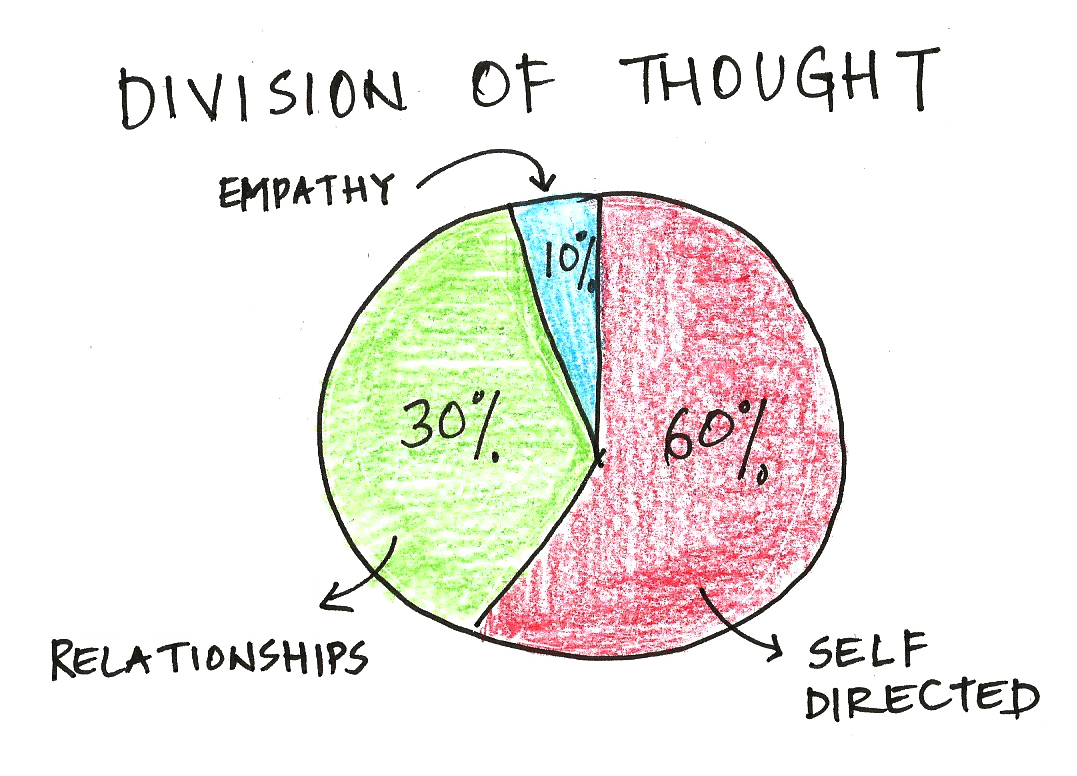
In this example, 60% of thoughts are self-directed. My goals. My problems. My feelings. Another 30% are directed towards relationships, but how they affect me. What does Julie think of me? How will boss evaluate my performance in the next review? Do my friends like me or see me as irritating?
Only 10% in this model is time spent in empathy. Empathy is the rare event where one person actually feels the emotions, problems and perspective of another person. Instead of asking what Julie thinks of me, I ask what is Julie thinking.
Within that 10%, most people then divide attention between hundreds of other people they know. As a result, you would occupy a fraction of a percentage in most peoples minds, and only a couple percentage points in a deeply bonded relationship. Even if you are in another persons thoughts, it is how your relationship affects them, not you.
What does this mean?
- Embarrassment doesn’t make a lot of sense. Since others are only focusing a small portion of there thoughts onto judging you, your self-judgement is overwhelmingly larger.
- People who appear to be mean or hurtful don’t usually do it intentionally. There are exceptions to this, but generally the hurt you feel is a side-effect, not the principle cause.
- Relationships are your job to maintain. Don’t wait to be invited to parties or for people to approach you.
Rule Two: Few Social Behaviors are Explicit
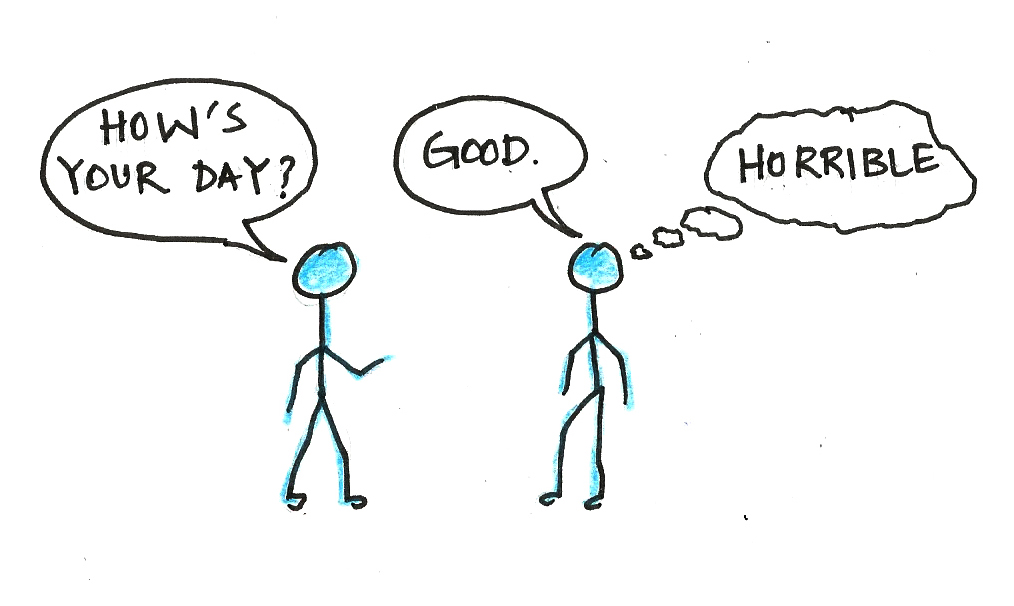
Basically this rule means that most the intentions behind our actions are hidden. If a person is feeling depressed or angry, usually the resulting behaviors distort their true feelings. If I feel you snubbed me, I might hold my tongue but ignore you later.
The old joke is that women use words like, “fine,” and, “go ahead,” when they really feel the opposite. But I’ve noticed men do this too in polite situations, although often not in the same way.
The application of this rule is that you need to focus on empathy, not just hearing a person. Demonstrate trust, build rapport and learn to probe a bit. By focusing on empathy you can usually break away these subversions and get to the heart of the issue faster.
The other application of this rule is that most the time you feel something, nobody else knows about it. So don’t get angry when people aren’t responding to you. If you deceive your thoughts with your actions, don’t get angry when you fool people.
Rule Three: Behavior is Largely Dictated by Selfish Altruism
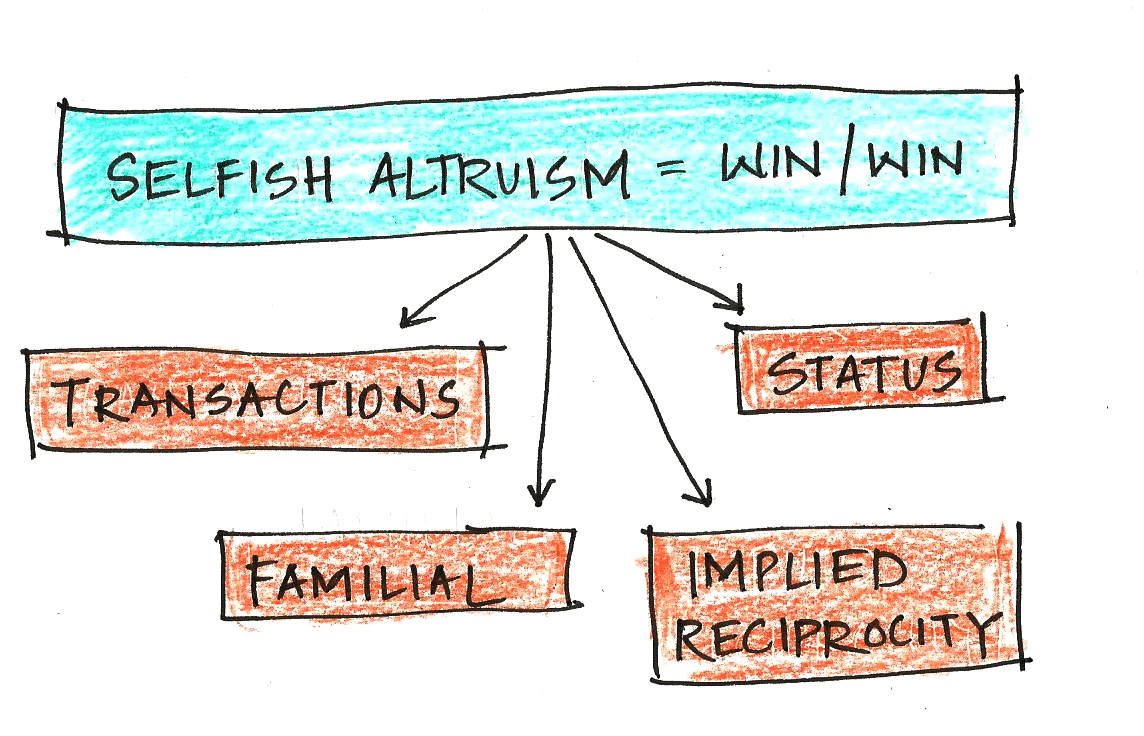
To say everyone is completely selfish is a gross exaggeration. That ignores all the acts of kindness, sacrifice and love that make the world work. But I would argue that most (not all, but most) behavior does work from the principles of selfish altruism.
Selfish altruism is basically win/win. It is where helping you directly or indirectly helps me. There are a couple main categories where this applies:
- Transactions - If I purchase a car, both myself and the dealer benefit. I get a vehicle, which I want. The dealer gets money to improve his lifestyle. This is the predominant form of selfish altruism between people who don’t have emotional bonds.
- Familial - Blood is thicker than water. We are designed to protect people who share our genes. This can sometimes shift towards extremely close friends and loved ones.
- Status - Helping someone is a sign of power. Many species of primates will offer assistance as a sign of dominance. People act similarly, offering aid to boost their self-esteem and reputation.
- Implied Reciprocity – Many relationships are based on the idea that if I help you, one day you will help me as well.
Occasionally behavior falls outside this group. Nameless heroes dying for causes that don’t help their bloodline. Volunteers devoting their time towards humanitarian missions. But these are the minority, whereas most actions can be explained by some form of selfish altruism.
How do you apply this rule? You understand the motives of people and appeal to them as if they were selfish. Find ways to help people within these four categories. Don’t expect people to offer aid outside of selfish altruism, it isn’t impossible, but it isn’t likely.
Rule Four: People Have Poor Memories
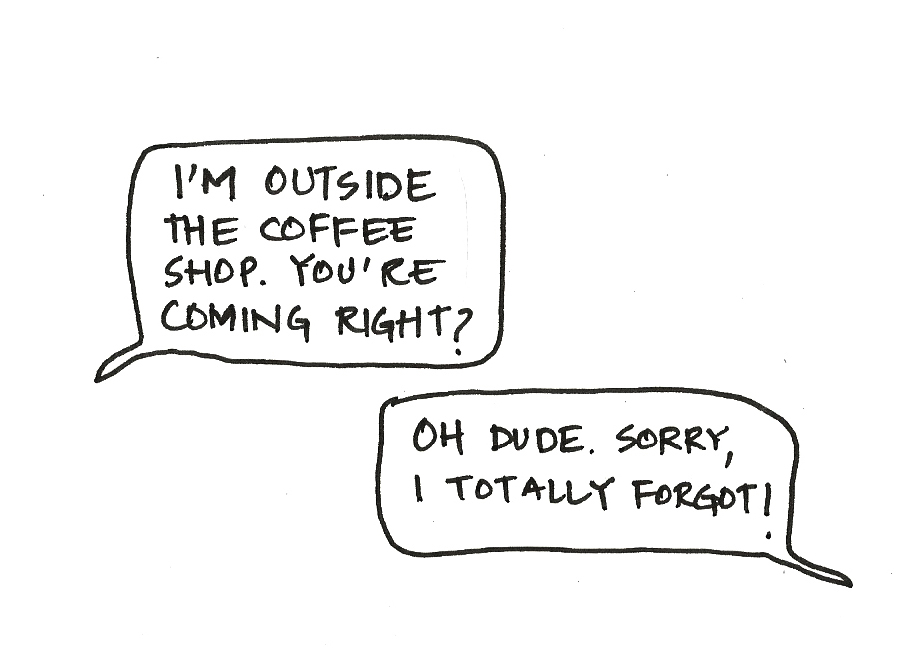
Ever been told someone’s name at a party and then forgot it later? Another rule of human behavior is that people have trouble remembering things. Especially information (as you’ll recall in rule one) that doesn’t apply to themselves. People are more likely to remember your similarities than your differences (unless they were emotionally incensed by them).
Recently I even broke this rule. I made arrangements to talk to a person I hadn’t met before on the phone. Even with my normally foolproof system of calendars and to-do lists, a few spontaneous schedule changes caused me to miss the call. I quickly apologized and made a new arrangement.
But the fact is most people don’t have organized GTD systems. People are forgetful by nature, so once again, don’t assume malice or disinterest if something is forgotten. The other side of this rule is that you can demonstrate reliability by having a good memory or system (if it doesn’t fail you).
Rule Five: Everyone is Emotional
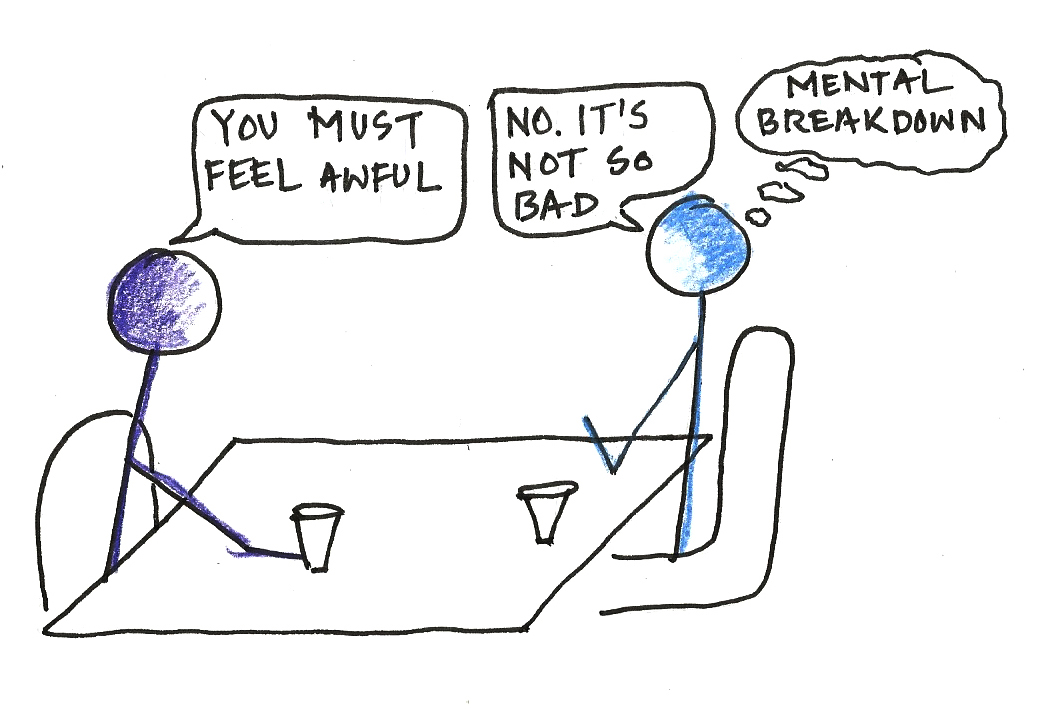
Perhaps this is an exaggeration. But the core of the message is that people tend to have stronger feelings about something than they let on. People who regularly have outbursts of anger, depression or flamboyant enthusiasm are generally frowned upon in most cultures. This especially applies to men (for women trying to figure us out).
The application of this rule is to not assume everything is fine just because someone isn’t having a nervous breakdown. We all have our individual problems, angst and upsets that are normally contained. You don’t need to call people out on their private deception, but being sensitive to those underlying currents gives you an advantage in trying to help.
The alternate application of this rule is similar to rule two. People generally assume everything is fine unless you just had a blowup.
Rule Six: People are Lonely

This is another broad generalization. But it is amazing how many people who seem to have it all, suffer from bouts of loneliness. As social animals, I believe people are especially sensitive to any threats to becoming ostracized. In Neanderthal times, exile meant death, so loneliness and the desire to be with other people is a strong one.
The application of this rule is that loneliness is fairly common, so in that sense, you really aren’t alone. I used to be bothered when I felt alone or an outsider in a social group. Although I’m still human, I’ve found recognizing this feeling to be fairly common as a way to minimize it.
Rule Seven: Did I Mention People Are Self-Absorbed?
This may sound like a reiteration of rule one, but I believe the applications extend beyond relationships and your emotional state. The fact that people tend to be too concerned about themselves to give you much attention, that people tend to be lonelier, more emotional and feel differently than they let on applies to how you view the world.
If anything this perspective should make you more proactive and independent. Once I started really learning these rules, it made far more sense that I needed to take charge. By placing your individual happiness in the hands of another person (or people), you ignore all these rules and do so at your own peril.
I like to take an optimistic, but realistic view of people. People who are generally try their best, but make mistakes and suffer from unintended self-absorption. In other words, they are basically like you.

I'm a speed-reading, vegetarian, holistic learning, productivity hacking university student.
[...] Relationships: Avoid Conflicts by Understanding Your Peers September 5th, 2007 by syndicated Blogger Scott H. Young knows that it’s difficult to understand and predict human behavior, but he also knows that by avoiding a few common mistakes, we can improve our own relationships. Young postulates that we’re inherently self-absorbed, so when people may offend or embarrass us, they’re typically not doing so intentionally. He adds that the meaning behind our actions is not immediately known to others and suggests that we take an empathic approach toward our peers, especially because humans by nature are emotional beings. His advice is to give everyone we encounter the benefit of the doubt so that we can improve our relationships with any person we meet. To me, his article paints a clear picture of human emotions and instincts. Psychology buffs, what’s your take? The Critical 7 Rules to Understand People [Scott H. Young] [...]
[...] http://www.scotthyoung.com/blog/2007/08/28/the-critical-7-rules-to-understand-people/ [...]
Bloody brilliant! I think I’ve always lived by this, but I have never thought about it enough to put it in any kind of words or form. I have often wondered why people are so easily offended, when it is obvious there was no intentional offense in what some other person tell them. I NEVER thought about it in the perspective of people being so self absorbed that they don’t realize other people are not constantly considering their feelings and points of view on things. This is one of the best articles I’ve ever found online. (I didn’t read what the others said about it, as I wanted to write down MY thoughts, so if some of them said it’s bullocks, they’re brain washed to believe in utter human kindness and selflessness and all that…
) Thanks for this, it gave me a lot to think about.
Hi,
Somewhat belated comment. I just read this and found that it is quite true. By the way, would you consider doing a post on debunking myths or rules by this so called “dating experts”? I have found a concept, that is called “being a challenge” particularly mysterious…
[...] The Critical 7 Rules To Understand People [...]
[...] Scott H Young » The Critical 7 Rules To Understand People [...]
This type of amateur pop-psychology totally bores me. Sorry.
[...] Perhaps it was because I was hip-deep in my novel, but when I read Scott H. Young’s article, The Critical 7 Rules to Understand People, I interpreted it in terms of character creation. [...]
[...] That leads me to this amazing article, which although it may seem to simplify things greatly, does a great job of summarizing the bulk of how people think, what motivates them, and how you can better understand them. Learn these and live by them. It’ll be a great help. [...]
i appriciate what u have done for us.thanks scott.but i criticise ur pie chart im a student of psychology and its not 100% sure that u mention in pie chart.I think its 50% self directed 30% relation 10%sampathy and 10% empathy
you said,
“Only 10% in this model is time spent in empathy. Empathy is the rare event where one person actually feels the emotions, problems and perspective of another person. Instead of asking what Julie thinks of me, I ask what is Julie thinking.”
Sad, but true. We should spend much more time caring about the person, rather than what the person did to me. People have no idea how hurtful the spoken word is; so much more hurtful than a physical hurt. In the grand scheme of things, we should worry more about others than ourselves, and we will be paid back immensely..
[...] Scott H Young » The Critical 7 Rules To Understand People Incredibly obvious stuff that most sensible people understand; even if they haven’t always mastered it. Things like be nice, be considerate, etc. [...]
[...] Rules for Understanding People – You can’t simplify human behavior into rules. But a few mental guidelines can help you overcome the most obvious communication errors. This is one of the ten most popular articles on this site. [...]
Loved your post Scott, You have inspired me to re-evaluate my communication skills, and not be so full of myself. We all have that choice.
Thanks!
I never believe that everyone is emotional. But your article convinced me, well explained. Thanks!
Great post for Human thoughts, thanks for your sharing
Merry Christmas & Happy New Year,
Tracy Ho
Wisdomgettingloaded
Great post Scott! If we would just remember that it’s not all about me and that me is a just small portion of this world, there would be less stress. Though small parts of the world can make big changes if we want too.
I have a smart friend who once said “I used to worry about what you thought about me, until I realized how little you think about me.”
Happy Balance
Kat
Scott, extraordinary post. It’s remarkable that you’ve distilled and systematized what many philosophers and social experts have taken great pain do in just a few concise paragraphs. Very well done.
A question for you on the leading bolded statement, “People Skills is About Being Nice, Friendly and Interesting”: How do you navigate the seeming conflict between meaningful interaction, and the “interpersonal lubricant” of sociability? What is “nice”, what is “friendly, and what is “interesting”?
My perspective for your consideration: A great many people seem to thoroughly enjoy the often loud and rambunctious interaction of pub nights, clubbing, and other so-called “social events”, even though if the typical interactions were taped and analyzed for content, the results might come up rather thin on meaningful content. I realize that “meaningful” is rather subjective, and it may just be my own social ineptitude and/or limited receptivity of others leading toward these conclusions… Yet it seems like most people are primarily concerned with experiencing a positive emotional affect around those they consider “friends” – often leading toward self-limiting behaviour that, while “fun”, is perhaps not particularly useful. I personally find the most invigorating conversation is one that can change your mind. The net effect of personal growth is positivity invigorating.
So… How can you ensure that your conversations are interesting to those participating, and promoting of personal growth, while not being tedious or offensive to others, or slipping into banal “small talk” just to keep it “nice” and “friendly”?
[...] The Critical 7 Rules to Understand People [...]
Is implied Reciprocity bad?
Thanks and
Cheers!
[...] ceux qui prfreraient la version originale, je recommande le blog de Scott Hyoung, la fois riche et clair. Lumineux mme… Pour les autres qui prfrent notre bon vieux [...]
[...] Source [...]
Thanks for the article. I have had anumber of problems in this area and all the other self-help resources blame everything on low self-esteem. NO: I was just raised to strive to expand that 10% and no one told me that everyone else lives in the 60%. ALL THE TIME. And I couldn’t understand what was happening. Thanks-will try to use this.
People like talking about themselves. I didn’t know this until a few days ago, a friend of mine told me that when I told him of my problems with doing conversations.
So I tried it, asked a question here and there about people’s lives. Annnd… it’s really quite true, and stunning, and amusing. People LOVE to rave on about themselves and theirs. All I have to do is listen, look attentive and give the occasional, ‘Hmmm’, ‘Cool’, ‘Oh wow’… and they are happy little campers.
Yes everyone on this planet is totally self-involved.
Empathy is an outcome of knowledge.
Great observation. I wonder how you are able to spot something like this, being in your twenties. It takes a lifetime, and years of experience to be able to comprehend the nature of people, and even then not everyone arrives at this conclusion. If it comes from within, and not just a conceptual understanding which is possible to grasp by reading, I salute you.
Thanks Scott,
You took some general thoughts and put a nice twist on them. I was just thinking about this today… as I had a driver yell at me for cutting him off… and I thought how as mad as he was 2 minutes later he would forget I existed.
You’re completely dead on about hidden agendas, intentions, and motives… I think about how much I am subconsciously being deceptive at times… and think how, I am probably often the victim of the same deception.
I am an overly empathetic person towards others who have scorned for the reason that I’ll never know their real reason for doing so… just as I hardly understand my own reason for sometimes scorning others.
[...] Blog How To Be Liked More at Will It Change You? The Battle for Our Minds at The Growing Life The Critical 7 Rules To Understand People at Scott H Young Present-Minded Future-Minded Goal Achievement at Refocused Living 5 Errors [...]
Hi Scott,
This article made me take a look at myself and I realized that I am very self-absorbed. It made me remember something that I did about a year ago, which makes me feel like a bit uncomfortable, to say the least.
I have also been trying to improve my social life during the last 2 years or so. In high school, I had absolutely NO friends to call my own. I feel I have come a long way, as I have successfully made friends since I started college and made conscious efforts to improve my social skills, but I still don’t have very many.
I am a person who enjoys playing a lot of video games. I used to play games on average of 8-10 hours a day. I have since stopped that, as I no longer have time to play 8-10 hours a day, but I still do play when I get the chance. The people I have been aiming for to become friends with are the “cool party people”. The people who have parties every weekend, and more importantly (to me, anyway), have all the beautiful girls with them. I wanted to hang out with these guys mainly so I could get a chance at the more beautiful girls, and also get a taste of the lifestyle that I never had a chance to explore. These people seem to have a lot of fun, so I want to be a part of it. I do not find myself attracted to the other gamer girls, simply because I generally do not find them beautiful. I want my girlfriend to be beautiful. It hurts to admit it, but I am very superficial. =(
Anyway, about the event that happened one year ago. I was in the process of trying to learn how to talk to people. I started with the people I were most familiar with – the gamers. After all, I too was a gamer (and still am at heart). My exact thoughts were at the time, “Yeah, they’re all nerds, not the people I want to hang out with, but I don’t have too many options at the moment, so I need to have an open mind.” So, I hung out with them, and successfully made some friends.
However, I remember one person in particular. I don’t remember if this was before I decided to “open my mind” or after. This person was also a gamer – and had all the stereotypical outside characteristics of one. He was skinny, very pale, and wore weird clothes. He engaged me in conversation, and I felt he was doing so because he was in the same boat as me – trying to make friends. I talked to him and listened to what he had to say, but I realized in my mind, I had already eliminated any possibility of him becoming a friend, simply because his appearance communicated to me that he was pathetic, needy, and unsocial, which are not the kind of people that I want to hang out with, because doing so would distance myself further away from the party people. If this person wore different clothing that would resemble a person who is not part of the nerdy crowd, I may not have dismissed him so easily. This is pretty good evidence that I am self-absorbed, and again, very superficial. I hate to think of myself this way. =( I want to think of myself as a very nice and empathetic person.
If I had met that person again, I would definitely try to be more open-minded. I feel like an asshole for doing that. But it also brings me to another question. Are people so naturally inclined to be superficial, like me? If so, I think that would mean that if you were to engage in a productive conversation that leads into friendship, you must first be able to present yourself as “one of them”, following their standards of fashion/grooming. Is a person naturally inclined to avoid someone else if they look superficially like someone they do not want to hang out with? Do most people look beyond superficial qualities while talking to people, or have they already made up their mind whether they want to give you a chance or not by the time they look at you?
People have said that after high school, the social game is different, but I am witnessing very many of the same trends in college. Other people seem to hang out with only people who are superficially similar. You have the gamers in one corner, the cool people in another, the black people in another corner, and the stoners aren’t even in a corner, they’re outside smoking pot. But they all have similar outward characteristics.
Either way, I will do my best to be more open-minded. I just would like to know if you think it is possible that one person, regardless of what he/she looks like, can be friends with anyone else in the world, as long as they have the inner characteristics. You seem like a very intelligent person, and I want to hear from you. I would like to be the one who will break the barriers between all these people.
- Dave
Hi,
I would like to apply your indea into my relationship with my girlfriend. I’ve been doing the best i can to show how much i love her and i appriciate her… But will someone change if he or she love that someone?
Mr. B, what you said about women only wanting the guys who don’t care about them is not true. See this quote from Hoyden About Town:
“The conversation started around the soi-disant “Nice Guys” label. There are a number of men who argue something along the lines of:
“- Women say they prefer nice guys, not arseholes.
“- I’m a nice guy, I’m just shy and awkward.
“- But I’m not getting sex.
“- And I deserve sex, cos I’m nice.
“- Therefore, women are lying.”
http://viv.id.au/blog/?p=43
See also http://www.heartless-bitches.com/rants/niceguys/niceguys.shtml
Women don’t want guys who don’t give a damn about them. They do want a shoulder to cry on. But you have to be at least vaguely interesting and valuable beyond that.
Can i find a friend anywhere that will treat our friendship with care and unselfishness?? I usually initiate this.. i listen very carefully and completely get into their mind when they are talking to me. And try and usually succeed in understanding them. Then, i wish they’d do the same for me… you know? how AMAZING would that be!!! If someone treated me that way back?/ We’d have an amazing, very intimate friendship. This is what i am very desperately longing for. But why won’t anyone really listen to me when i’m talking? Or even make the smallest effort to really understand me? When i did it for them. helloooo? I think i’m expecting too much from people. But do you, Scott, think that i will ever find a friend like this? Are they that rare? Are people really all that selfish? I’m willing to not be selfish if someone would do it for me..
eunice,
Yes, there are relationships where the focus becomes more on the other person. But these are the minority.
I think your comment proves my point, you’re writing about how you are seeking a friend to understand you. Not a bad goal, but undeniably self-focused.
-Scott
[...] of thoughts are self-directed. My goals. My problems. My feelings. Another 30% are directed towards relationships, but how they affect me. What does Julie think of me? How will boss evaluate my performance in the [...]
Hi Scott
Well done. You’ve pretty much hit the nail on this subject. I enjoy most where you mentioned that embarrassment doesn’t make any sense. I am sure many readers will find this helpful.
Ron.
it a nice write up…………
A very clear and concise article on a subject that is usually hidden within smoke and mirrors. Thanks.
I was attracted by the title, and the content was really interesting
Thanks
I think your article can be summed up as:
“Forget about yourself and take interest in others”
Probably true…Provokes a lot of interesting thought.
Some of the saddest moments of my life have involved performing an act of kindness or offering to act in benefit of another. Receiving a response of indifference or lack of acknowledgment is a difficult thing to accept.
How often have we stopped and allowed a fellow motorist to enter our traffic lane only to receive a blank look of no response altogether?
The next time that happens, I’ll remember to remind myself to not be too self absorbed.
Thank you very much for this. It’s one of my bookmarks, titled “genius guy” I haven’t read very much else you’ve written, but this helped me quite a bit.. I consider myself intelligent but simple concepts like these seem to have escaped me.. haha I had no idea the world didn’t revolve around me. I mean, I still think it does.. but at least now I understand that everyone else falsely thinks the world revolves around them..
I have recognised for most of my adult life that even bare acquaintances always offload their problems and/or secrets on me. I used to say ‘Why me?’ I now realise from your article that I must either make the right noises or pull the right faces to make people feel that I am really interested in them. More to the point perhaps we need to consciously harness the skills of empathy to get the best from our most meaningful relationships?
This is really great! I don’t usually read these things but this makes me understand people so much better. Thanks so much
Thank you for this Article. I am struggling with Anixety and this helps…to know that people are self absorbed and usually NOT thinking about me. Thanks again.
interesting. I agree with alot of it, however, it somehow may be missing some positive direction to it.
Did you ever see Miriam Adahan’s book called EMETT, or her book Awareness? They’re excellent.
Thanks for all the information in your site, its well done.
Hi Scott,
I just discovered your website today and find it very enjoyable reading. Thanks!
I especially like above your reference to Selfish Altruism…as I totally agree that people do “kind” acts for self benefit…even if it may be only for the emotional “return” of feeling that you have made someone happy(and hence they are indebted to you in kind?). There’s nothing wrong with this behaviour but it should be acknowledged so that no-one can see themselves as “more good” than another. We all do what we do for our own self-serving purpose.
Anyway, great stuff…well done!
Scott, I don’t even have to read the rest of your website to know that you’re an idiot. So stuck in your ideals that you don’t even realise how stupid half of them are.
Ad hominem. Non sequitur. I don’t believe you can sniff out one’s ideals from textual, formalized opinion… unless you’re one of those superhero psychics that can read minds and bend ethereal spoons.
Scott, although I don’t quite agree with all that you said, there were some things in there that were refreshing. It would be interesting to see how your views may change in the next few years.
Scott, awesome article! Read through it and I can’t explain how much it helped me re-perceive and re-understand human behavior. four words: breath of fresh air!
To Kayle. From what I read, I can draw a connection and say that I was kind of raised with the same rules. But I have one piece of advice, if I may: at times, it’s not just those around us who affect the way we think, but also who we were meant to be ever since we were born. Some food for thought.
[...] in englischer Sprache: Lyved – Life and living it! 7 rules to understand people 7 rules to sniff [...]
I agree completely and I don’t think it’s sad at all. We’re designed with self-interest in mind for survival. We evolve through society to care for one another but it isn’t a sad thing to admit that we’re, at our base, selfish creatures. That is not to say that we shouldn’t aspire to be more, but I think it’s alright to be “selfishly altruistic” most of the time anyway.