My headline might sound overreaching. Clearly a rule can’t define something as complex as human behavior. But despite this, I’ve found most people tend to make the same mistakes. These mistakes are frequent enough that they create conflicts later. Remembering these seven rules will help you avoid these mistakes.
People Skills is About Being Nice, Friendly and Interesting, Duh!
Most the books I’ve read on dealing with people either make two claims:
- Incredibly obvious stuff that most sensible people understand; even if they haven’t always mastered it. Things like be nice, be considerate, etc.
- Bizarre and complex theories that may explain some behavior, but is difficult to generalize.
Between these two I’ve found there seems to be a gap of information that is can be applied generally, but isn’t always obvious. These frequent mistakes tend to cause most people conflicts, social errors and emotional upsets.
The Seven
Here are the seven rules I’m talking about:
Rule One: Never blame malice for what can easily be explained by conceit.
People don’t care about you. This isn’t because people are mean or hurtful, but simply because they are mostly focused on themselves. Consider this hypothetical pie-chart showing the variety of thoughts a typical person has:
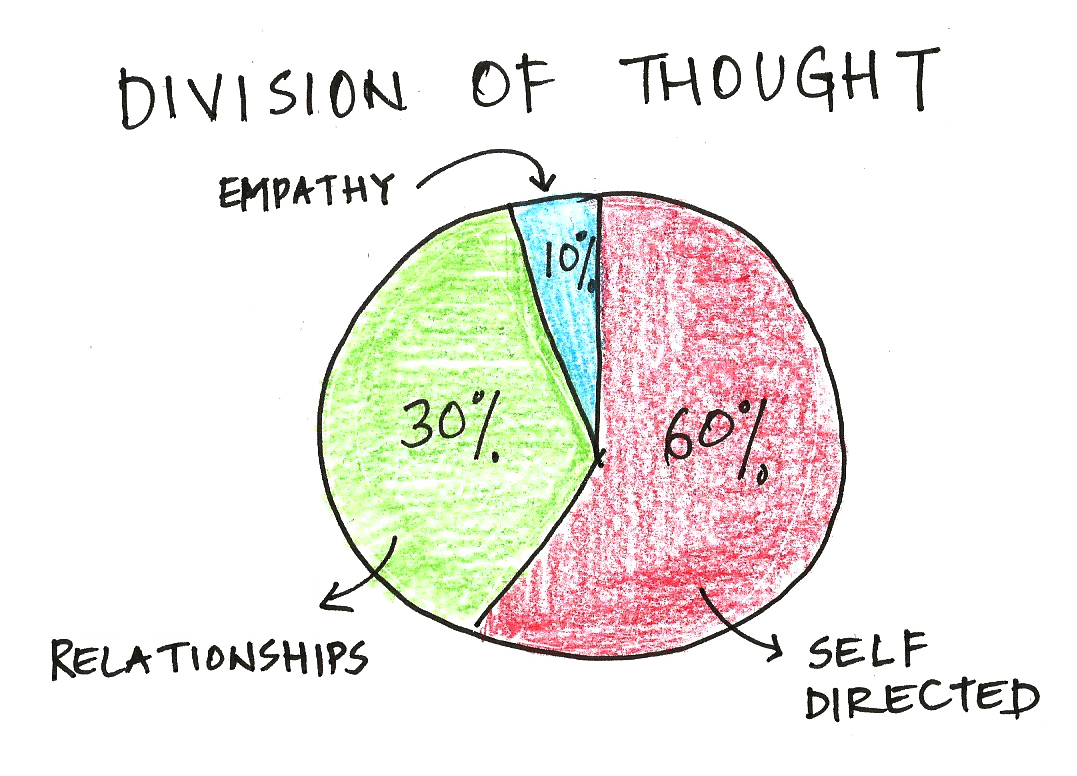
In this example, 60% of thoughts are self-directed. My goals. My problems. My feelings. Another 30% are directed towards relationships, but how they affect me. What does Julie think of me? How will boss evaluate my performance in the next review? Do my friends like me or see me as irritating?
Only 10% in this model is time spent in empathy. Empathy is the rare event where one person actually feels the emotions, problems and perspective of another person. Instead of asking what Julie thinks of me, I ask what is Julie thinking.
Within that 10%, most people then divide attention between hundreds of other people they know. As a result, you would occupy a fraction of a percentage in most peoples minds, and only a couple percentage points in a deeply bonded relationship. Even if you are in another persons thoughts, it is how your relationship affects them, not you.
What does this mean?
- Embarrassment doesn’t make a lot of sense. Since others are only focusing a small portion of there thoughts onto judging you, your self-judgement is overwhelmingly larger.
- People who appear to be mean or hurtful don’t usually do it intentionally. There are exceptions to this, but generally the hurt you feel is a side-effect, not the principle cause.
- Relationships are your job to maintain. Don’t wait to be invited to parties or for people to approach you.
Rule Two: Few Social Behaviors are Explicit
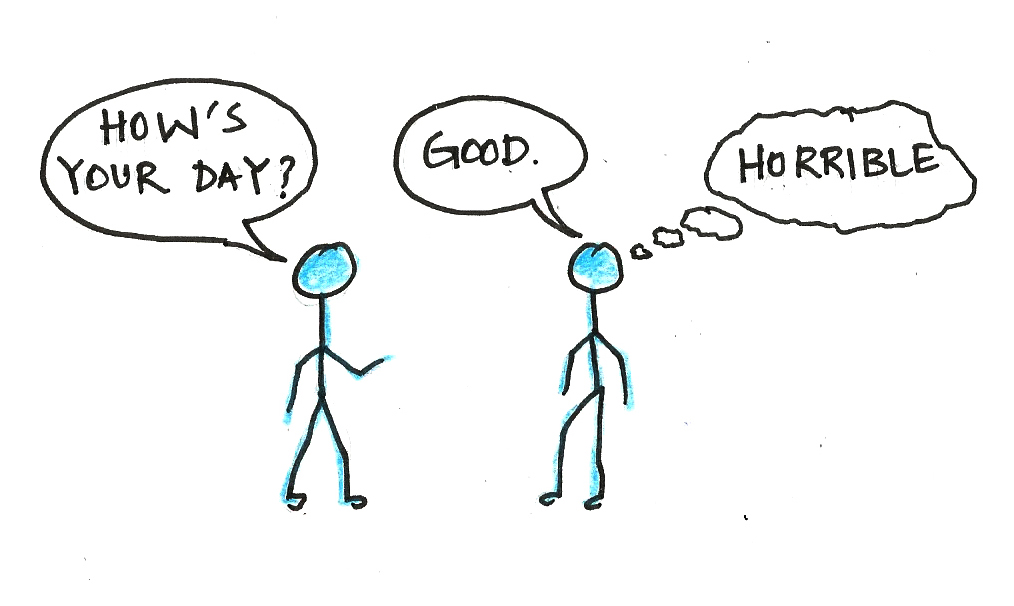
Basically this rule means that most the intentions behind our actions are hidden. If a person is feeling depressed or angry, usually the resulting behaviors distort their true feelings. If I feel you snubbed me, I might hold my tongue but ignore you later.
The old joke is that women use words like, “fine,” and, “go ahead,” when they really feel the opposite. But I’ve noticed men do this too in polite situations, although often not in the same way.
The application of this rule is that you need to focus on empathy, not just hearing a person. Demonstrate trust, build rapport and learn to probe a bit. By focusing on empathy you can usually break away these subversions and get to the heart of the issue faster.
The other application of this rule is that most the time you feel something, nobody else knows about it. So don’t get angry when people aren’t responding to you. If you deceive your thoughts with your actions, don’t get angry when you fool people.
Rule Three: Behavior is Largely Dictated by Selfish Altruism
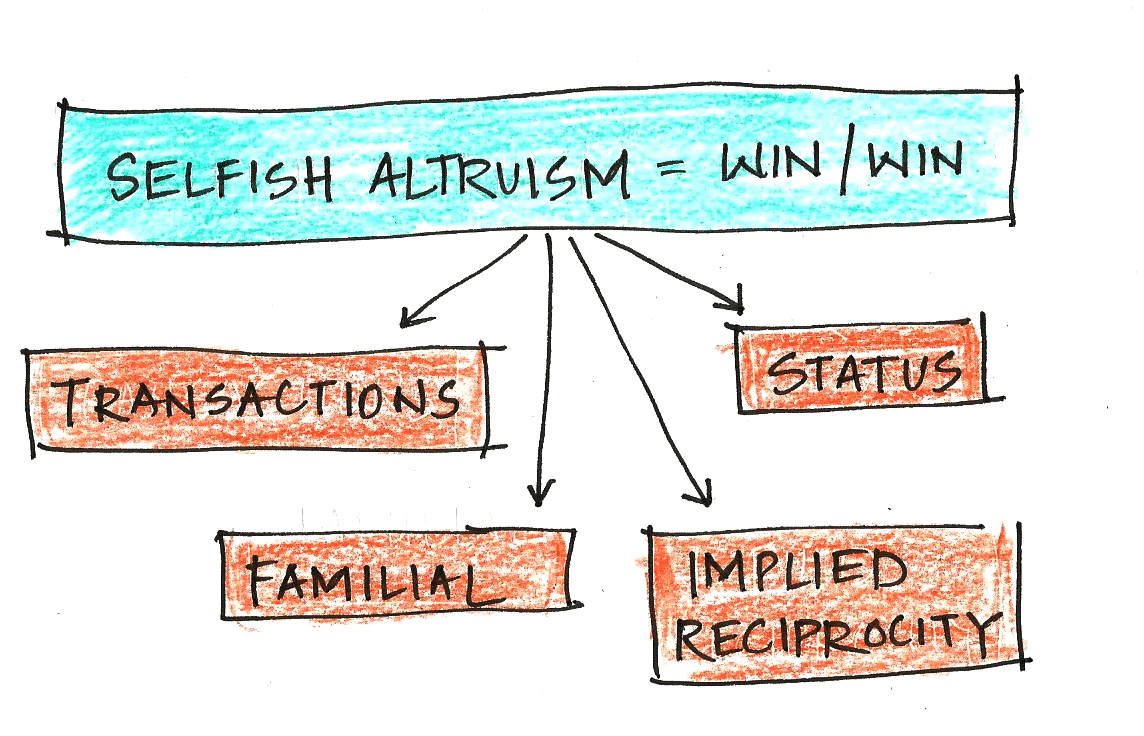
To say everyone is completely selfish is a gross exaggeration. That ignores all the acts of kindness, sacrifice and love that make the world work. But I would argue that most (not all, but most) behavior does work from the principles of selfish altruism.
Selfish altruism is basically win/win. It is where helping you directly or indirectly helps me. There are a couple main categories where this applies:
- Transactions - If I purchase a car, both myself and the dealer benefit. I get a vehicle, which I want. The dealer gets money to improve his lifestyle. This is the predominant form of selfish altruism between people who don’t have emotional bonds.
- Familial - Blood is thicker than water. We are designed to protect people who share our genes. This can sometimes shift towards extremely close friends and loved ones.
- Status - Helping someone is a sign of power. Many species of primates will offer assistance as a sign of dominance. People act similarly, offering aid to boost their self-esteem and reputation.
- Implied Reciprocity – Many relationships are based on the idea that if I help you, one day you will help me as well.
Occasionally behavior falls outside this group. Nameless heroes dying for causes that don’t help their bloodline. Volunteers devoting their time towards humanitarian missions. But these are the minority, whereas most actions can be explained by some form of selfish altruism.
How do you apply this rule? You understand the motives of people and appeal to them as if they were selfish. Find ways to help people within these four categories. Don’t expect people to offer aid outside of selfish altruism, it isn’t impossible, but it isn’t likely.
Rule Four: People Have Poor Memories
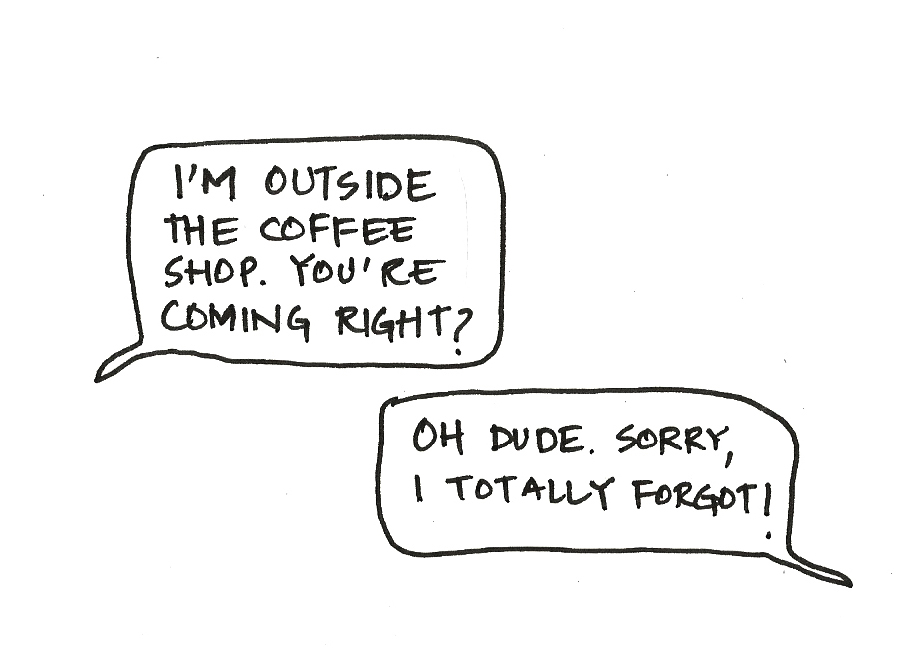
Ever been told someone’s name at a party and then forgot it later? Another rule of human behavior is that people have trouble remembering things. Especially information (as you’ll recall in rule one) that doesn’t apply to themselves. People are more likely to remember your similarities than your differences (unless they were emotionally incensed by them).
Recently I even broke this rule. I made arrangements to talk to a person I hadn’t met before on the phone. Even with my normally foolproof system of calendars and to-do lists, a few spontaneous schedule changes caused me to miss the call. I quickly apologized and made a new arrangement.
But the fact is most people don’t have organized GTD systems. People are forgetful by nature, so once again, don’t assume malice or disinterest if something is forgotten. The other side of this rule is that you can demonstrate reliability by having a good memory or system (if it doesn’t fail you).
Rule Five: Everyone is Emotional
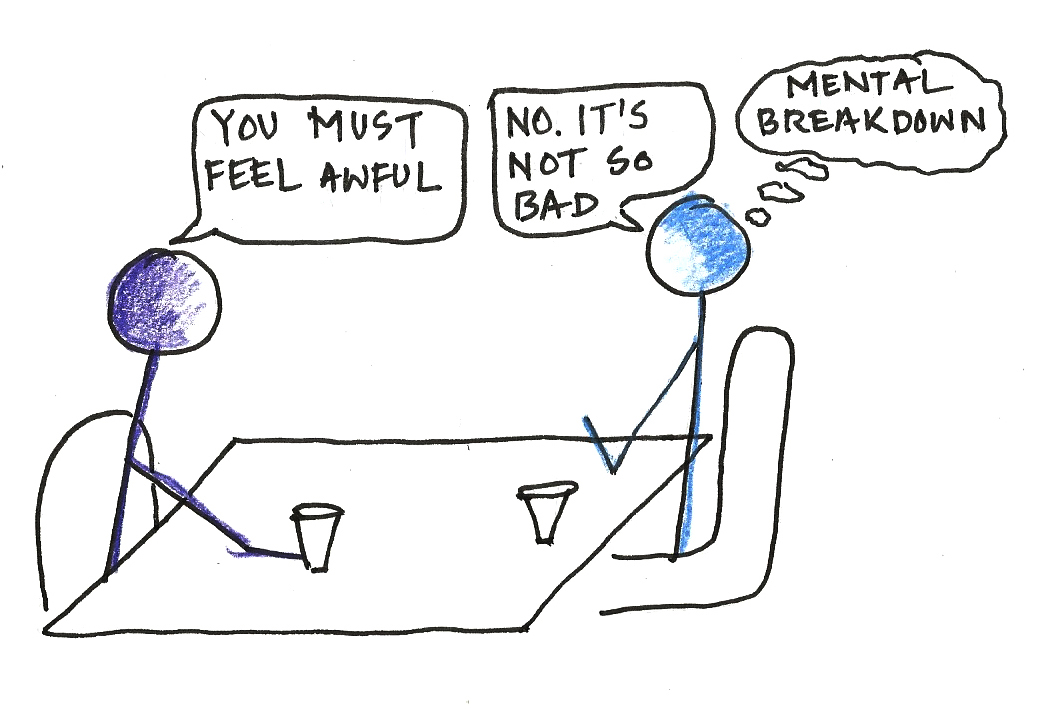
Perhaps this is an exaggeration. But the core of the message is that people tend to have stronger feelings about something than they let on. People who regularly have outbursts of anger, depression or flamboyant enthusiasm are generally frowned upon in most cultures. This especially applies to men (for women trying to figure us out).
The application of this rule is to not assume everything is fine just because someone isn’t having a nervous breakdown. We all have our individual problems, angst and upsets that are normally contained. You don’t need to call people out on their private deception, but being sensitive to those underlying currents gives you an advantage in trying to help.
The alternate application of this rule is similar to rule two. People generally assume everything is fine unless you just had a blowup.
Rule Six: People are Lonely

This is another broad generalization. But it is amazing how many people who seem to have it all, suffer from bouts of loneliness. As social animals, I believe people are especially sensitive to any threats to becoming ostracized. In Neanderthal times, exile meant death, so loneliness and the desire to be with other people is a strong one.
The application of this rule is that loneliness is fairly common, so in that sense, you really aren’t alone. I used to be bothered when I felt alone or an outsider in a social group. Although I’m still human, I’ve found recognizing this feeling to be fairly common as a way to minimize it.
Rule Seven: Did I Mention People Are Self-Absorbed?
This may sound like a reiteration of rule one, but I believe the applications extend beyond relationships and your emotional state. The fact that people tend to be too concerned about themselves to give you much attention, that people tend to be lonelier, more emotional and feel differently than they let on applies to how you view the world.
If anything this perspective should make you more proactive and independent. Once I started really learning these rules, it made far more sense that I needed to take charge. By placing your individual happiness in the hands of another person (or people), you ignore all these rules and do so at your own peril.
I like to take an optimistic, but realistic view of people. People who are generally try their best, but make mistakes and suffer from unintended self-absorption. In other words, they are basically like you.


I'm a recent university graduate, writer, programmer, traveler and avid reader of interesting things. For the last six years I've been experimenting to find out how to get more from life.
[...] up far more than perfect abilities ever would have. Afterwards, I was persuaded to sing karaoke
People don’t care; that has been a great realisation for [...]
I’ve just stumbled onto this website, by Googling ‘how to find a philosophy in life’, and I think it is excellent! I am 47 and really feel ‘lost’ – as if I don’t understand myself, others around me or where I’m going in life. I got married at 25 because it seemed the right thing to do, eventually had a daughter who is now 12, have drifted in and out of jobs, never staying longer than 4 years, and now rapidly approaching my 50th year I don’t know where I came from or where I am going.
This idea of ‘selfish altruism’ has struck a chord with me. As I have got older I feel that I am lonely ‘inside myself’, wanting people to love, need and appreciate me and feeling that I have no true friends…desperate for someone to really understand me. Realising that they too have problems, and may be thinking just about themselves, sort of explains why I feel marginalised.
The idea of ‘taking control’ and being myself in the midst of all this is scary for me, but I can see how it would help.
I have been on medication for depression for 12 years, for no reason that I can put a finger on…I need to find my own confidence.
One commentator talks about ,,,,’being the needy child in every relationship. Some people are frozen forever in emotional adolescence and turn every one else into their parents; if we haven’t forgiven our parents, we’ve never really left home!’…GOSH, THIS RINGS TRUE TO ME…. Things about my home life haunt me, and I emotionally need to let them go…
Thanks Scott…I feel your ideas have opened something up to me!
I really like this, even reading this now, i automatically just tried to apply all of the factors to myself and tried to see how they fitted into my life. I dont think there is anything wrong with being self centred to an extent, as long as you are aware of it, manage it and try to look at things from another persons point of view sometimes, you should be just fine. I think in trying how to understand people, we really just have to understand ourselves, we are all human, we come from the same blueprint so once you take an introspective look at your life, behaviours and feelings you can relate to others better. At the end of the day everyone is seeking love, survival, warmth etc and once you get down to those core fundamentals you can relate to anyone.
“Relationships are your job to maintain. Don’t wait to be invited to parties or for people to approach you.”
Inviting oneself to parties doesn’t really work, does it? This is the real dilemma here: a person who is lonely is either “not trying hard enough” but if they are and it gets them nowhere it’s because they’re “too clingy”. Showing value is kind of hard if you don’t have a social circle…
Finding friends without being introduced to them through your social circle is hard, that’s just a fact of life.
[...] The job of the freelancer is to be a honest person and do the job good even though he is thousands of kilometers away from his employer. I constantly see employers complaining that they’ve gotten bad quality translations of texts from employees freelancers. And how could they know that the translation is bad. If you have a game website and you need to translate it for the Japanese market, all of the words look the same you can’t tell if it’s good or not. And you can’t trust someone to proofread it. He might charge you for writing a whole new article if it’s of bad quality. Ok, I went in somewhere I shouldn’t but life is like that. Many people prefer lying to their employers and telling them that they have qualifications that they don’t and get the money for a job they don’t even understand. [...]
This is a few great things, but I personally still think the exact things we need to understand people is too complex to know. The uniqueness and differences in so many of these humans is something extremely difficult to understand right now unless we can tilt our perspective as a whole to others and know exactly what they are thinking. Even with this, human behavior is still very complicated to understand.
Wow, this has made the crushing loneliness and alienation I’ve experienced in the last 6 months feel like an exaggeration. It’s funny how we seem to ignore the fact that we are never the only ones hurting inside. Amazing article!
There are a lot of claims I do agree with, cause my own experiences with people have led me to similar conclusions.
I do especially agree with “Everyone is Emotional” — Taking in account that our behaviour is always constrained by emotions rather than just reasoning was good for reflecting about my own behaviour as well as for understanding and responding to those of others.
“People Have Poor Memories” — that is true and also applies to me. But I find myself having a very selective memory and also spending attention very selective. I do rarely forget arrangements which I am very excited about and do remember conversations with much details for a long time, if I was interested, but if my interest is just average or low I forget very fast or even don’t take notice.
“People Are Self-Absorbed” — Yes and I do think that it is a very severe issue in society, it causes loneliness and a very limited perception of reality because if you’re centred on your self and only relate things to yourself you are definitely alone within the centre of your own world. I’m considered about myself, cause I know I am the best one for this job and I can’t care about others if I wouldn’t care about myself. But I like to tell “Well, I am not that important and I don’t need to be important”, I just like to be happy and like to see other people being happy too. That don’t needs very much but fundamental things. Such a pity that advertisements for example draw on our selfishness to make us want things we actually don’t need and to consume much, and cheap, and without responsibility. There are reasons why we have this problems…
Hence I don’t like the model of “Selfish Altruism” very much. It’s very popular these days and it can explain human behaviour in many cases. Yet it’s still a model which is a simplification of reality to certain aspects which people think they are important. Though I won’t suggest an alternative I do think that reality is different and that philosophy have different explanations too. Like the author has said, there are exceptions and hence there are doubts.
… after going through this blog, it seems things are getting clearer and I’m realizing the deeper aspects of why I was feeling so lonely for such a long time, the fact of the matter is “no one gives a d!@n”, it is just you, you and you…
thanks Scott for making us realize this and ignoring the supposedly ‘ludicrous’ remarks that people ‘pass’ behind your back which you tend to take seriously and try to modify your behavior just to make them talk nice to you and about you…..
the comments were also more encouraging and worth of wiseness that reflects from the blog writing; I don’t know about anyone else, but I’m making a note of these and imbibe in my thinking about others’ thinking, so loneliness should be passé’ !!
Amazing article! Very insightful.
People Have Poor Memories:
I completely disagree. It’s not acceptable to forget a commitment to someone. If you’re a forgetful person, then don’t make a commitment. Lack of follow through = lack of respect, and “being forgetful” is a shitty excuse.
[...] (This is excerpted from Scott Young’s “Critical 7 Rules To Understand People”) [...]
I’ve been wondering for a while why people don’t seem to “care” about many important aspects of life. Your first point just answers it so well: Most people are only focused on themselves and their (mostly) immediate problems.
Thank you for the great read!
Remarkable article!
Stumbled upon this after a search on an english word “nuke”.
I found a translation of the article about bad habits to my native language. It was terrible, because of machine translation.
Your site seems to separate from mainstream blogs with rare insight. Thank you for writing this article!
I will return and read more, I might even buy a book
Those rules are great tools to better understand people, including one self. Just remember there is such a thing as over analyzing, witch is the process of understanding.
Some things in life is not meant to be understood, their meant to be experienced
completely agree, very well said. day in day out we have to work with ourselves and with people and obviously everyone else thinks the same! So, if the above common ground is understood, nothing like it. unless our circumstances force us to change or we think we’ve achieved whatever we wanted (very few of are us so lucky) its tough to be altruistic.
agxpr.wordpress.com
I have found everyone has stories or beliefs of how things are suppose to be. When a disagreement happens it is because each has their own story of how things are. One person wants the other to believe their view and their opposition wants the other to see that their story is the right one and should see it their way. Conflicts because of this happens even between countries at war. It is a no win situation. Everyone has their preconceived ideas they hold on to without seeing the others point of view.
Scott,
What a great breakdown of the human condition! I never really looked at it so in-depth, but after pondering your list I can’t argue with any of it, especially when I consider the actions and motivations of myself. This post was certainly enlightening when it comes to me and you have given me the courage to make my own motivations more conscious from day to day. Thanks for the post!
[...] person’s point of view, mid-conversation?” You’ll definitely learn a lot more by trying to understand the other person and you’ll keep yourself out of [...]
Wow….
It’s like reading a whole human pshcology in just seven small paragraph..
I am barney and 20 years old..
Most people think that i am too young to understand about relationship and life…..
But seriously….
I am trying …
And this is really very very helpful…….
[...] Scott H Young- The Critical 7 Rules to Understand People-Found this in Scott’s archives, definitely worth reading for people interested in improving their social skills. [...]
Dude, I read this and knew every word of it (I’m not criticizing, just agreeing), but I’ve never found anybody else who realized it.
While I hesitantly agree to the rules (definitely worthy rules of thumb, but not concrete by far), these seem to assume that everyone acts and reacts in basically the same ways, which I have not found to be true.
While unsure whether you read article comments, it would be interesting to get your take on something like Relationship Awareness Theory, which in a very simple sense classifies people by the tools they use to gain feelings of self-worth (which brings us around to the self-centeredness that you talk about).
Someone who gains feelings of self-worth through socially visible personal accomplishments will have trouble relating to someone who feels self-worth when being the social hub to connect people. They each express selfish altruism in different ways, and could cross-communicate their blowups, even if they communicate it at all.
It’s been personally valuable for me to gain an understanding of the languages and tools that people use to accomplish their altruism, and has in almost every case led to deeper, more meaningful relationships, so getting the input of someone I respect would lead to even greater understanding.
Scott,
You know what? I checked your rules, so here is the result:
rule1: I have now 60%relationship, 30%Empathy and 10%Self-Directed. The result is I lost all my goods and money, I’m broke now man!
rule2:Someone hated me I though his hidden intention was he loved me but then I suddendly got shooted on the legs, the guy was fucking serious man. I’m at the hospital now!
rule3:I employed someone recently in my Jobs, he is working for 24h for £5 and he thinks it’s a win/win, dude the guy is fucking sick I kicked him!
rule4:Dude you can’t believe me I showed my largest code for my bank security to 100 guys the guys didn’t remember my named but my bank been rubbed 100times which are them, did be carefull, people fucking have memory.
rule5:That’s test was funny, went to the cemetery, picked 2 people, shooted on them, damn! No body screamed or cried.
rule6:I have an obsessed guy among me, the fucking guy don’t stop to talk to his friends day and night, I wonder when the fuck he is alone!
rule7: This is the last one, did I understand it?
To conclure I would say, dude I can’t understand people!
As you wrote understand yourself you understand them. but how you do that if you most of the time feel LESS!or look like you give so much intention to the conversation in hope that you get them.
The only trick that works for me is when you breathe normally as you don’t care of no one around.
that selfish is good, I wish I could increase it.
[...] paints a clear picture of human emotions and instincts. Psychology buffs, what’s your take? The Critical 7 Rules to Understand People [Scott H. [...]
Well yes, people don’t care about you until they decide they like you, and my friends accept me for who I am (I ditch those who don’t) so thanks, there really is no point in caring about what other people think. Okay i will go back to my life of selfish altruism now
(as for the “familial” category, my friends are worth helping more than some people I’m related too as many of my family members are insane)
my 18-yr old son just old me that he doesn’t care about people, and that it worries him. compared to my other kids, yes, he is somewhat spoiled and can act entitled, but he genuinely wants some insight. trying to provide him with some useful guidance beyond reminding him that we’re all self-absorbed, that he is at an age where he is trying to find his place in the world, etc. anyone have any real wisdom to share? tia.
duh…..hey scott, i am 17 now and i have also started writting some of articles like you but i havent presented them to you, but your ideas are great than mine, and you inspire me alot dear scott. you impress me alot and i want to be like you.
[...] one, we know you’re human. Which means you already think about yourself 60% of the time and only think about others 10% of the [...]
Very lucky I found and read your article today because this is very good article to teach people how to be able to understand people around us to avoid any misunderstanding when we communicate each other on any topic. By reading this article I know how to more appreciate even respect every person in order to get more success of every aspect in the life. Very very good article I’ve just found here.
Kind regards,
Angela
You helped me understand about a lot of things and how to be more respectful towards people. Thank you!
Very very nice article…