
The Power of Humility: Why Confidence is Overrated
« The Critical 7 Rules To Understand People || Friday Links 07-08-31 »

Any good self-help book will tell you to be confident. Stand up straight, see past your critics and believe in yourself. I’d like to break tradition and argue the opposite. That humility is a useful tool and confidence can be overrated.
Deluded by Your Own Hype
Whipping yourself into a motivational frenzy may temporarily make you feel better, but it has hidden side effects. The major disadvantages from false confidence are:
- Inability to Learn. Too much confidence and you can’t acknowledge faults, weaknesses or ignorance. Learning needs to start from a place of ignorance, and you can’t do that when you already know what is best.
- Avoid Humbling First Steps. In this article, I wrote about how “I Suck” moments can create positive changes. The reason is that to get better in a lot of areas, you have to take a step back. A pay cut to work a job you love. Dating failures to find the right relationship. Confidence can actually pull you away from these humbling first steps.
- Arrogance Swingback Effect. Faked confidence has an emotional backlash. A tendency of people with low self-esteem is to go from thinking they are fantastic to feeling miserable, all after a minor mistake. Building a house without a foundation won’t create a stable structure. Similarly, building up your ego without the foundation of competence and skills can lead to an emotional collapse.
Humility Is Not Low Self-Esteem
Humility does not imply low self-esteem. If confidence is often faked by positive affirmations about yourself, humility is not created through negative ones. Humility is simply about focusing on the unknown rather than the known.
To illustrate this, take a look at the following diagram:
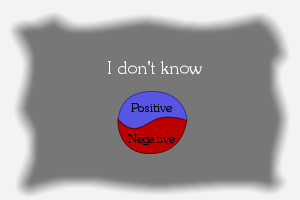
I’m separating all information into three broad categories. The things you know that make you positive, the things you know that make you negative, and the things you don’t know.
Confidence would come from focusing on the positive things you already know. In contrast, humility isn’t focusing on the negative information as it is focused on the overwhelming amount of information you don’t know.
This might sound a little vague, so let me give an example. Let’s say you are planning to start a business. There are three ways you can view the problem:
- Confident - I’ll be great. I’ve done similar ventures before and kicked ass in all of them. Yay!
- Insecure - I’ll do horrible. My grade school teacher said I would never amount to anything. Boo hoo.
- Humble - This is completely new to me and there is still a lot of information I have to learn. Hmmm…
Don’t Ask for Confidence When You Really Need Guts
Confidence, believing things will go well, is a form of delusion. Don’t try to be confident about something when what you really need is courage. Courage is the ability to go forward with something in spite of fear. It is an intellectual conquering of your lower emotional states. I’d suggest reading Steve Pavlina’s manifesto on the subject if you want to learn more.
The best description of courage I can give comes from the book, Feel the Fear… and Do it Anyways. The author describes courage as the ability to know, no matter what happens, I’ll be able to deal with it.
That may sound synonymous with confidence, so I’d like to draw the distinction. Courage is: “no matter what happens, I’ll be able to deal with it.” Confidence is: “everything is going to be great. (because I’m great)”
Social Confidence
Another argument for confidence is that it helps to fake it in social situations. Speakers who admit how nervous they are or guys who complain about their lack of dating skill aren’t likely to succeed. Is a certain amount of faked bravado necessary for social situations?
I’d say the answer is a qualified no. I do believe that faked social confidence can be effective. But the only time I believe that this is useful is when it is masking deeper insecurities. Humility that is based on deeper feelings of competence appears more genuine and is more successful than false confidence.
I believe courage, not confidence, is called for here. I’ve done speeches where I haven’t prepared as much as I should have. Too much confidence resulted in a poorer performance. Having the courage to act looks better than the confidence to boast.
How to Use Humility
The amount you don’t know is far larger than the amount you do. Humility utilizes that space by acknowledging it exists. Here are some ways you can apply humility to improve:
- People. Everyone is better than me in some way. More importantly, everyone has something to teach me if I look closely enough. Although I write fairly opinionated articles here, I focus on being more observant in my offline interactions.
- Projects. Every project I start has a million uncertainties. Instead of assuming a rigid plan, I leave flexibility to allow new opportunities to come in. Although I have longer term plans for this website, I’m also open to new possibilities.
- Passions. When I wrote this article, What Do You Want to Do With Your Life, I was basically advocating taking a more humble stance towards your life directions. Be open to everything and get curious rather than confident.
- Productivity. It requires humility to admit you’ve been doing things wrong all along. My traffic tripled in a short period after I made changes to how I wrote articles. That couldn’t of happened if I was too sure of my own methods to change.
Self-Esteem Can’t Be Faked
I think most people would agree with me that deceiving yourself isn’t useful. But I also suspect that isn’t the real motivation to want confidence. Confidence is often equated with self-esteem. Since self-esteem feels good, most people want to be confident merely by the virtue that it will make them feel good.
The problem is that real self-esteem can’t be faked by affirmations and positive thinking. I’ve tried a lot of those techniques myself and the effect is always temporary. The more you build yourself up on false pretenses, the easier it is to crash down.
How do you go about creating self-esteem? The answer is: with a lot of work. Poor self-esteem is really a manifestation of a deeper problem. That problem is you haven’t created a stable inner world that can withstand the storms of the outer one.
Creating deeper self-esteem has mostly come in myself from slowly crafting a life philosophy and understanding. It isn’t easy and I’m nowhere close to being finished. But it is the only method I know of that produces more or less permanent well-being. Whether you choose confidence or humility has little to do with your overall self-esteem.
Exercises in Humility
Where should you go with this information? I think there are a couple things you can start doing to practice humility and see better results:
- Absorb Your Next Conversation. Talk less during your next conversation and just absorb what the other person is saying. Probe them for information and really learn from them. It is amazing what people know if you stop to listen.
- Try a New Activity. Don’t be too confident in knowing your likes and dislikes. Try a completely new activity in the next few days. As a quiet introvert, I went to a Toastmasters meeting on a whim. Now I love it.
- Try a New Method. How do you study? Write? Exercise? Sleep? Socialize? Try something different.
Don’t be too sure you have all the answers or you might not find new ones.


Quint said,
August 30, 2007 at 12:58 pm
I think you are addressing an important point here. There is no technique that can cover up for a lack of self esteem. But humility can’t be faked either. Attempting to “act out” humility without the underlying character leads to people being doormats.
True humility requires self esteem. It comes from a deep confidence in who you are, and what you are capable of. It requires the courage to stand back when you could stand out.
As you said, self-esteem come slowly, built on an understanding of self and others.
Scott Young said,
August 30, 2007 at 1:36 pm
Quint,
True. Humility can’t be faked either. But I think humility is an easier jump than extreme confidence. Moving to a state of curiosity and respect is more stable than trying to make yourself feel great.
That said, it has to be a slow, internal shift. It isn’t about appearances.
-Scott
Chris said,
August 30, 2007 at 2:44 pm
I make a distinction between temporary, emotional, “psyched up” confidence and the more longterm, stable confidence that comes from a logical assessment of your abilities (and concluding they’re good).
The first type seems more likely to make you feel overconfident and deluded - you’re riding a fleeting, ‘psych up’ high.
With the second ‘logical assessment’ kind, you’re more likely to have a reasonable idea of where you stand. You may not be the best in the world, but you’re calmly certain of your ability level.
Scott Young said,
August 30, 2007 at 5:24 pm
Chris,
A commenter on this site once made the critical distinction for me. He said that general optimism is better than specific optimism. That is, feeling that everything will work out is better than believing a specific incident will work out.
I believe the same is true of confidence. Core self-esteem and confidence in your abilities to handle life situations and general skills is better than specific confidence attached to the outcomes of particular events.
I thought I’d write about humility since it is often seen as a detraction, rather than an asset in Western culture.
-Scott
Mary said,
August 30, 2007 at 8:06 pm
Scott,
I’ve heard about humility in this vein before, but you nailed the illustration better than any I’ve seen. I’d always perceived it as being meek or timid, almost. Instead, you have put a different picture in my mind….thank you.
Derrick said,
August 31, 2007 at 6:17 am
Interesting post. I think too many people confuse humility with poor self-esteem.
One thing, though. I think that confidence is essential to achieve the true humility that you talk about. I don’t really fully agree with the definition of confidence you used: “# Confident - I’ll be great. I’ve done similar ventures before and kicked ass in all of them. Yay!”. I think that’s more of arrogance. Confident people would be open to learning new things. Just my thoughts.
Kali said,
August 31, 2007 at 7:24 am
Sometimes my conceit decieves me into thinking I’m humble! But, boy is it a blow to actually be honest with myself in real life and discover, wow, I’m not so humble as I’d like to believe. But you also learn things from honesty - namely the importance of compassion, of what you were speaking of, of all that we don’t know. Reading a book last night I came across a definition of humility as “…a sense that history was around them, not within them.” I think this could be useful for me to consider before or I lose myself in emotional ra-ha moments.
DrumGit Inc. / viewpoints said,
August 31, 2007 at 11:37 am
[…] Scott H Young » The Power of Humility: Why Confidence is Overrated […]
Diego said,
September 2, 2007 at 12:26 am
Humility MUST be present to learn. May I suggest the works of Idries Shah?
Gary said,
September 2, 2007 at 9:57 pm
Well done Scott,
Good job taking on the confident ego and self promotion paradigm that people can get caught up in.
In the book Good to Great by Jim Collins he outlines some of the characteristics of great leaders in business. One of the key characteristics is humility.
I like the way you describe humility as relating to the action of allowing one to focus on the unknown. I’d suggest another element to that description. There isn’t a focus on the self (thoughts of “I” and “me”) because there isn’t a self image in the mind. There isn’t a self image of being better than anyone else, and there isn’t a self image of being less than anyone else. A person is less fake, and more real when they drop both of those false images. It also makes life a lot easier when they do.
Thanks,
Gary
links for 2007-09-04 | The Frugal Law Student said,
September 3, 2007 at 11:31 pm
[…] Scott H Young » The Power of Humility: Why Confidence is Overrated Humility is the first step to confidence. When facing a new challenge, remember to be humble and teachable. […]
mak said,
September 4, 2007 at 7:23 am
Courage: no matter what happens, I’ll be able to deal with it
Arrogance: everything is going to be great (because I’m great)
Confidence: I can do this
Humility Brings Peace « Being At Peace said,
September 22, 2007 at 9:00 am
[…] of Humility: Why Confidence is Overrated No Comments Leave a Commenttrackback addressYou must log in to post acomment. […]
Productivity Zen - Today’s Top Blog Posts on Productivity - Powered by SocialRank said,
October 1, 2007 at 3:37 am
[…] The Power of Humility: Why Confidence is Overrated […]
Jake said,
October 15, 2007 at 4:34 pm
I respectfully disagree with your article.
I think you’re blurring confidence with arrogance, or self-delusion. True confidence is neither of these things.
Have you noticed how it’s often the most talented people who doubt themselves the most? I don’t think this is a coincidence. We’re taught from an early age that modesty is admirable and that it’s impolite to sing our own praises. The result is a generation of adults who doubt themselves and accept their limits.
Furthermore, I don’t think it’s a coincidence that many of the world’s greatest achievers have utter confidence in themselves: Muhammed Ali, Lance Armstrong, Michael Johnson, Tiger Woods, Larry Ellison, Donald Trump…
I think confidence - not arrogance - is an incredible, positive power in our lives and should be encouraged and fostered at every possible opportunity. Being humble - not standing too proud, not speaking too loud - benefits no one.
Scott Young said,
October 16, 2007 at 5:35 am
Jake,
Perhaps it is different ways of looking at the same thing. Interesting points.
-Scott
Scott H Young » Friday Links 07-11-02 said,
November 2, 2007 at 10:50 am
[…] The Power of Humility - Do I change my opinions? Frequently. Here’s an example where I’ve gone back and forth. Let me state my current opinion for the record: Humble confidence is the goal. Where you are secure and unafraid to take action, but you are completely open and humble to the potential for opportunity and being wrong. I feel the latter is too easily neglected. […]
Aatash said,
December 28, 2007 at 4:48 pm
One of my favorite quotes, that kind of represents finding the balance between humility and confidence:
“Be humble, for the worst thing in the world is of the same stuff as you; be confident, for the stars are of the same stuff as you. ”
-Nicholai Velimirovic
Emily Bloss » Understanding People said,
January 19, 2008 at 6:13 am
[…] on a related note, here’s another article from Scott about humility. Being humble can open you up to so many new and different things, because you can admit you […]
Jonathan said,
May 5, 2008 at 6:40 am
That’s a great article dealing with a very important subject. Very important in this day of the me-first go-getting career forwards attitude. What would have made it even better for me would to have not tried to make a pejorative distinction between confidence and humility. Arrogance and humility, absolutely, yes, and most of the example you give of confidence are more in keeping with an American idea of confidence but an English idea of the blow-hard. I see confidence and humility in combination, in fact, describing the same thing when genuine confidence, the confidence to admit ones inner sense of humility speak for itself, is better understood.
It’s interesting that jake has stepped in with a remark that lacks humility, the “I’m right” attitude. I equate humility more with an “I’m curious” attitude. Although like jake, it’s coming across that I have a great deal of difficulty with showing humility even when I’m feeling it because “I know what I’m talking about” is a bit closer to the comfort zone of wanting to be beyond disrepute that males, like me, find easiest to fall into. I am just realising just what a social dead-beat this belief produces.
But it does take an expert and well trained mind to understand that genuine humility does not imply pandering to people nor being self-deprecating which is another get-out that people tend to prefer to humility. In effect, it allows the person applying themselves in that way to effectively become showy about not being arrogant. Humility is an interest in the welfare, well-being and persona of other people that doesn’t mean excluding oneself.
It does mean that true humility means having a courageous attitude. My own feeling is that the time when this attribute is most called for and most difficult to express is when I find myself in the company of people who I secretly think are simply better human beings than I am.
Most people who learn to wear a cloak of bravado end up being trapped in unhappy mediocrity.
It is interesting that jake’s article cites many people which may have confidence in their abilities. This is crossing a boundary on the possible interpretation of the word “confidence” which isn’t the one given in the article though. Humility doesn’t mean thinking you’re a rubbish human being. I don’t know about the others but Tiger Woods is celebrated for his sportsmanship but honoured for his humility which is often thought of as the definition of sportsmanlike behaviour, as compared to competitive behaviour. Donald Trump has said that the worst thing that can happen in a negotiation is when your potential business partner starts thinking he is inferior. It appears in his book “The way to the top” under the title “Change your altitude”, and by ‘altitude’ he means an attitude devoid of big-headedness. A man I admire, the inventor genius of the world-wide-web, the information sharing protocols on which services just like this internet page are built, describes himself as “A public servant”, now that’s humility! Imagine how much good could be achieved if certain presidents thought of their role more in this way?
Jonathan said,
May 5, 2008 at 7:04 am
I’ve Just read line from the wikipedia definition of the word “courage”, which can be said “Audacity kills”. And goes on to say “Gentleness spares”. I think the value of a word like humility is easier to sell to women, who understand it’s value, than men who’d rather be forthright because they equate it with masculinity. Equate humility to a special powerful form of courageousness and us men may find it easier to follow. You can have, as your rubric for humility “The courage to be gentle”. (you heard it hear first folks!
Scott Young said,
May 6, 2008 at 4:28 am
Jonathan,
Great comments, thanks for stopping by the site!
-Scott
Scott H Young » Self-Confidence is an Oxymoron said,
May 8, 2008 at 10:00 am
[…] have doubts that complete confidence is the answer. Yes, there may be some psychological benefits to believing […]
Henry said,
June 10, 2008 at 2:20 pm
in order to protect my future self from becoming corrupted I have decided to focus on being humble throughout this next month.
Would it bother you to sign a copy of your book and send it to Sweden?
/ Henry