After twenty years of writing, I’ve developed a feel for what my audience wants. I don’t always deliver, but I have, at the very least, a strong intuition whether an essay I write is going to have broad appeal, or mostly be read by a handful of fans.
The biggest factor that drives this distinction, in my experience, is an essay’s practicality. Since my writing isn’t pure entertainment, it has a much narrower audience if it isn’t obviously useful.
I get it. Everyone is busy. You’re here today looking for ideas and advice that may change your life. Why spend a lot of time learning about something that isn’t even practical?
I think this is a mistake.
If you care about usefulness, spending most of your time learning “advice” or “tips” is counterproductive. Instead, you’ll do better if you spend most of your time learning fundamental principles.1
Why Impractical Knowledge is More Efficient
Imagine knowledge is like a tree:
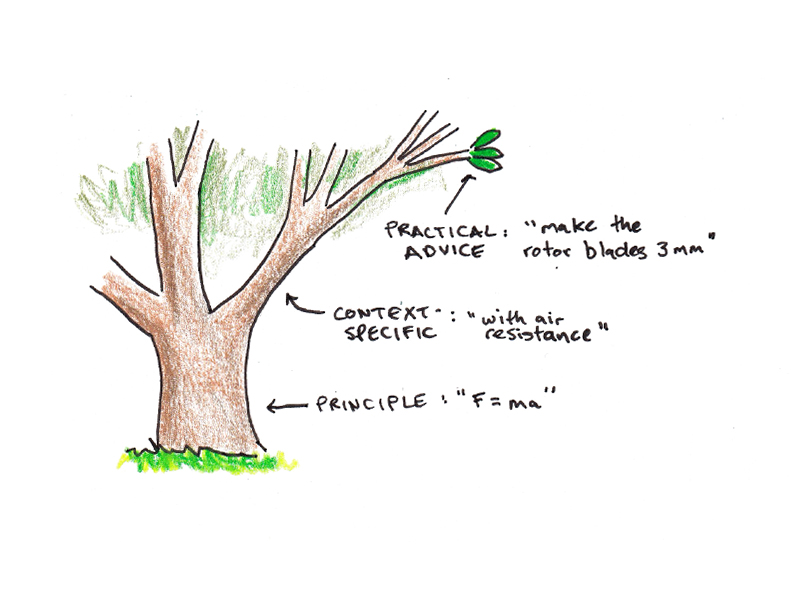
At the base of the tree are principles. These are the things that are least contingent on specific states of the world, and are most generally true. This category includes stuff like F = ma or the conservation of momentum or energy.
These principles are general, but, by themselves, they’re often insufficient for a lot of situations you care about. You need to know a lot more than just F = ma to design a good bridge or rocket ship. As we travel up the trunk, we get to branching points. These represent splits in the state of the world.
For example, it is true that heavier objects and lighter objects fall at the same speed. Yet there are domains where air resistance is practically irrelevant (e.g., lead ball vs. solid gold ball), and domains where this becomes a noticeable factor (e.g., feathers vs. rocks).
As you learn more about a specific, concrete situation you’re in, you branch more and more until you finally come to the leaves of the tree. The leaves of the tree are practical advice. They’re the kinds of “tips” you might give someone who doesn’t know much about a particular domain, deep down, and just wants to know what sorts of action they should take. This would be things like “make your propeller blades exactly this shape to minimize air resistance.”
There are far more leaves than there are trunks. And each leaf only covers an incredibly narrow subset of possible states of the world, so, to reasonably “cover” much of the space of possibilities, you need to learn tons and tons of different advice “leaves” for tons and tons of different cases.
Thus, if you want to maximize the breadth of your useful knowledge, meaning the number of concrete situations it applies to, you’re better off learning lower down the tree of knowledge, focusing on ideas and knowledge that are less dependent on specifics.
Some Examples
Let’s try this analogy with a few examples.
Consider a goal of getting in shape.
Here, the leaves would be a particular workout plan you decide to follow. Further down the branches, would be principles like progressive overload and recovery. Towards the trunk are more basic ideas like energy metabolism, muscle and cardiac physiology, and so on.
Following a specific workout plan is fine—as long as your situation is close enough to the situation that plan was developed for. But what if the workout plan was made for a serious athlete in their twenties, and you’re 55 and recovering from an injury? Then, the specific plan is unlikely to work for you, and it may even be counterproductive.
In contrast, the knowledge of more basic principles would still apply and could steer you to more applicable advice on a different branch of the tree of knowledge.
Or consider starting a business.
The leaves here are particular tactics like “buy ads on Facebook” or “cold call purchasing managers at mid-sized firms.” Again, if you’re in a domain where this advice applies, perhaps you’re receiving it from someone in a very similar business, this may be what you need to hear.
But if you’re not, these tactics may be counterproductive. Instead, you should focus on ideas closer to the trunk. A little further down the tree are basic ideas of entrepreneurship like “product-market fit”, “minimum viable product” and “market research.” And towards the base are fundamental concepts like “supply and demand.”
Or consider the topic I write most about: effective learning.
If you’re studying for an exam, advice for how to pass your particular exam would be the leaves. Further down the branches are somewhat more general ideas for tackling multiple-choice questions or organizing your studying materials. Finally, at the trunk, you get to bedrock ideas about learning like the spacing effect or retrieval practice.
The latter principles are most universal, even if they leave ambiguity for how you should deal with any particular situation.
Dealing with Some Objections
There are a few common objections to focusing on principles over practicalities:
First, there’s the objection that principles aren’t enough to constrain decision-making. This is true. Rarely does learning a deep principle give you all you need to decide the best course of action in a real-life situation. Usually there are too many other considerations at play.
But, learning principles is still more efficient. It’s just that principles need to be supplemented with more specific knowledge to get you to the correct answer.
To continue our arboreal analogy, imagine you’re trying to find a small bird in a tree. If I tell you “he’s on the third branch from the right”, it doesn’t tell you exactly where he’s located, but it does give you a good place to look. In contrast, only knowing whether or not he is on a particular leaf is only helpful if he is on that leaf—in most cases, that information doesn’t inform your search very effectively. Specific advice is only helpful if it applies to the situation you’re in.
Second, there’s the objection that the principles don’t actually describe the world. Essentially, a theoretician has come up with an elegant-sounding principle that doesn’t translate directly into useful advice.
This is an issue, but it’s more typically the case that the principles are still largely undiscovered or don’t constrain the problem enough. Going back to our tree analogy, this is like being able to see a bunch of leaves while we don’t know where of all the branches underneath the canopy are. We can guess at some, but those guesses may be wrong.
Our knowledge is correct, as far as it goes, but it may not go as far as we need it to. In domains where principles strongly determine practical advice, such as physics and engineering, there’s a strong rationale for learning the fundamental principles. In domains where principles only weakly determine the practical advice, such as entrepreneurship or second-language learning, principles are still worth learning, but they’ll have to be supplemented with a lot of situation-specific advice.
None of this negates the idea that learning principles is more efficient. It’s simply that sometimes we don’t know what the principles are, and so only practical advice can be generated.
Finally, there’s the possibility that figuring things out from fundamental principles is intractable, so we again have to go by practical advice.
Continuing our analogy, the closer to the trunk you go, the more mental work needs to be done to figure out where the branch points are and where the leaves end up.
This is also a fair critique, and it’s one reason we have hierarchical domains in the first place. But this simply means that, for really complicated domains, we occasionally need more knowledge from higher up the tree to make the principles useful. Even so, because the span of principles is so broad, they still tend to be more efficient for learning.
Applications for Real Life
Applying this idea reflexively, the idea that “learning principles is more efficient than practical advice” is itself a deeper principle. So, what are the practical consequences?
Consider the mass of practical advice books on topics like productivity, diet or personal finance. How many of these are just leaves? The new “fat-busting” diet plan that claims it will have you losing fifteen pounds in fifteen days? The specific habits your favorite author uses to write books? The budget plan for retiring by 45?
If you were only going to read one book, perhaps one practical book would be best. After all, fundamental principles don’t sufficiently constrain advice, so they won’t give you something concrete to do. Whereas maybe you happen to be in the exact situation the author describes and thus can benefit from their advice?
But if you’re going to read more than one book, don’t start with the leaves of practical advice. If the trunk of the knowledge tree is largely within an academic field, such as nutrition or psychology, read a textbook. If the trunk of the tree is within the scope of some professional practice, read a book that aims to give the basic information in an unbiased way; For Dummies books and other general readers are good examples.
Even more generally, make it a personal maxim to try to read as much as possible of the “trunks” of various domains. Then, when you do have a practical problem that requires detailed knowledge of the leaves, you may still have some work to do, but you will have already completed some of the most important learning.
 I'm a Wall Street Journal bestselling author, podcast host, computer programmer and an avid reader. Since 2006, I've published weekly essays on this website to help people like you learn and think better. My work has been featured in The New York Times, BBC, TEDx, Pocket, Business Insider and more. I don't promise I have all the answers, just a place to start.