A recent theme in my writing on both energy management and the foundations for life has been the underappreciated value of exercise. Exercise extends life, boosts cognition, improves mental health, helps you sleep better, makes it less likely you’ll get sick and more—it’s hard to find a habit to add to your routine with a higher return on investment.
Yet, the evidence is pretty clear that most people don’t exercise. Nearly half claim not even to meet the standard guidelines, and there’s good evidence that most who claim to meet the guidelines actually do not.
I say this not to scold, but to sympathize. Prior to a few years ago, I was also someone who probably thought I was getting enough exercise, but I actually wasn’t. I was busy, and I wasn’t motivated. Exercise was always on my “should-do” list, but not always achieved in practice.
Today, I feel like exercising nearly every day is relatively easy. Not automatic, I never find myself jogging spontaneously, but easy in the sense that I don’t find it harder to stick to in my schedule than other daily chores like cooking meals or cleaning up the kitchen.
And, perhaps predictably, the benefits of that shift were both substantial and as-advertised. I do have more energy, less stress and better sleep. I even lost some weight.
Given all that, I’d like to share some of what I think made the shift possible for me. This isn’t to preach or indulge in self-satisfaction, but simply to try to understand what factors might have held me back in the past on the off chance they’re holding you back too.
Behavior, Then Beliefs
Interestingly, if I had to weigh their relative importance, I think changes to my beliefs made exercise stick more than changes to my habits did.
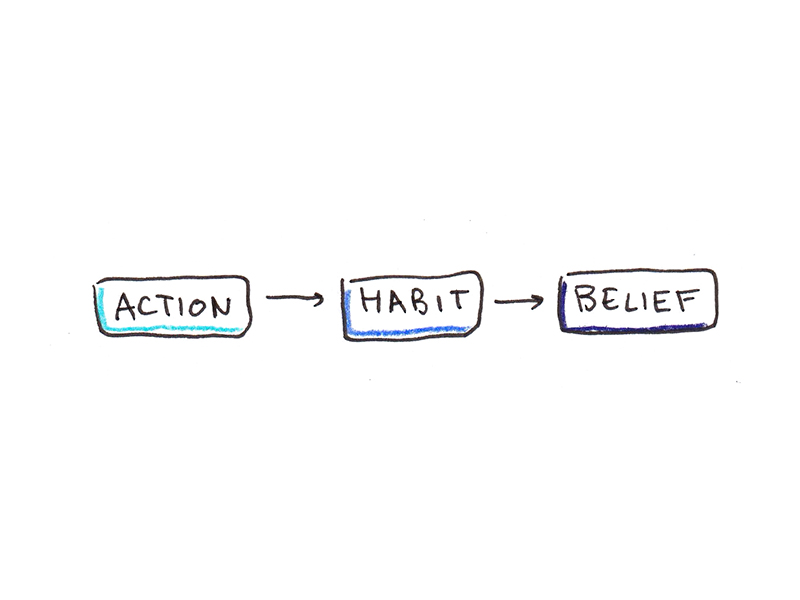
But even if mindset matters more than habits, if I look at my own case, the behavior changes came first.
I started out my recent exercise habits with a fairly rigid early-morning exercise routine, though I have largely defaulted back to afternoon or evening workouts, as was most convenient in the past. The difference now is that I actually do my workouts pretty much every day rather than just a couple times a week (at best).
One of my biggest attitude shifts was simply changing the belief of how much exercise I thought I ought to be getting. I exercise more now, in large part, because I believe I should be exercising a lot more. But I doubt I could have adopted that belief when I was getting far less exercise—it just would have made me feel guilty, and I would have rationalized it away.
For any change to stick, I think you need to change your mindset. But the mindset changes you need are generally only possible once you already have seen yourself succeed behaviorally.
Behavioral Strategies to Get Started Exercising
The basic recipe I followed for exercising regularly was simple:
- Make exercising regularly a committed priority for at least a month (preferably 2 to 3 months).
- Aim to get some exercise every day (not just X days per week).
- Start easier than seems necessary, and ramp up the intensity slowly.
The first part is simple: you can stick to almost any behavior if you focus on it. Prioritizing exercise for a month is probably the minimum, but making exercise a priority for the next three months is better if you’ve struggled with it in the past.
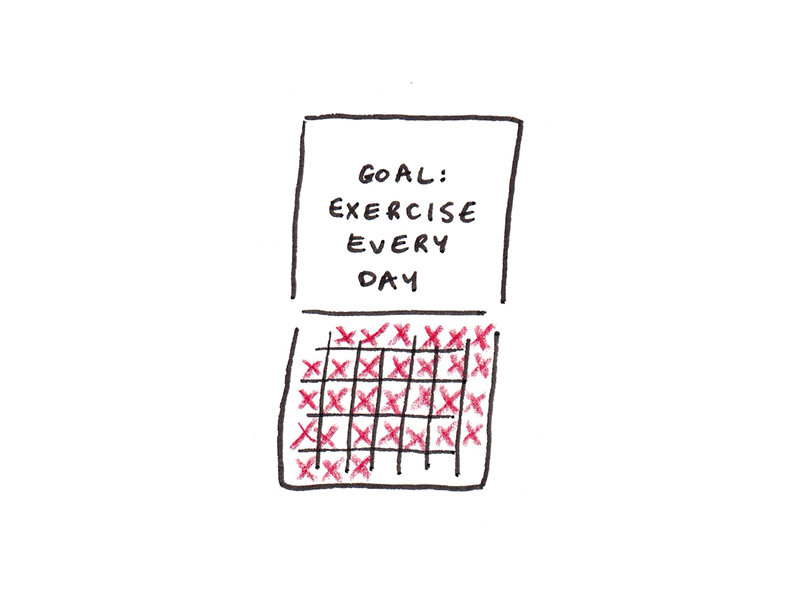
Contrary to a lot of popular wisdom, simply repeating a behavior for a month (or three) doesn’t make it automatic—but it does make it feel more normal.
The rationale for daily exercise is simply that inconsistent schedules lead to constant decision making. Every day, you are asking: should I exercise today? If the answer is always “yes” then there’s nothing to think about. Whereas if you give yourself the opportunity to skip days without a good reason, you’ll end up skipping workouts much more often.
Daily exercise forces problem solving. If you have to fit exercise in every day, it forces you to be a lot more creative about scheduling in a busy life. Maybe you can’t always do an hour-long workout at the gym, but you can fit in twenty minutes.
Finally, the slow ramp up is critical. Any change in how much or what you do to exercise is likely to leave you feeling sore or physically tired. If you really overdo it, your efforts can result in injury. By keeping early workouts well below what you feel capable of, you can prevent those physical symptoms from becoming obstacles to making the behavior stick.
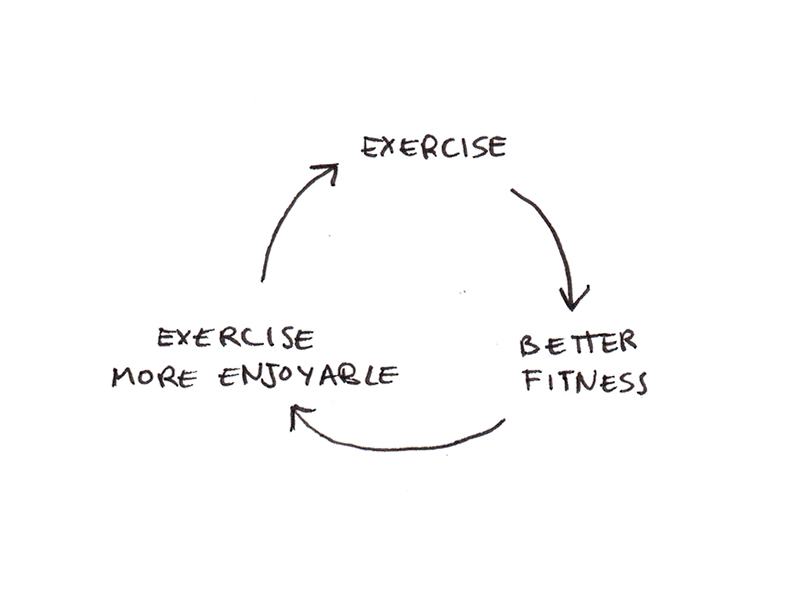
Part of the reason exercise can be a hard habit to create is that exercising feels awful when you’re out of shape. This is doubly true for more intense exercise. A lot of people know they should exercise, but starting with too much intensity means they find the whole thing so unpleasant that they can’t stick with it.
Ultimately, getting in better shape tends to make the act of exercise more intrinsically rewarding. It feels good to run when your chest isn’t pounding during a slow jog. It feels good to lift heavy weights and not have agonizing muscle pain. Some of getting over a dislike of exercise seems to be a matter of overcoming that initial change to your fitness levels.
Mindset Shifts That Mattered for Me
As mentioned previously, I think the habit-changing protocol is fairly straightforward, but that’s not what leads to long-term stickiness. My own habits have changed multiple times since I started exercising every day, and I suspect they’ll turn over again in the years to come. Life is simply too chaotic to expect the exact same routine to work perpetually.
Belief changes, in contrast, can be more durable. Here were some of the biggest mindset shifts that have helped me stick with exercise:
- Exercise is about health and mind, not about looking good. You should want to exercise (a lot) even if it never results in losing a single pound of fat or looking any better in a bathing suit. Physical appearance is a poor motivator, and emphasizing it crowds out the actually-good reasons to stay fit.
- Cardio matters; lifting weights is not enough. This may be a gendered thing, but, like a lot of guys, I used to focus on lifting weights and treated cardio as an afterthought. Strength training matters, but for different reasons. If you want to get the full benefits of exercise, you need to get your heart pumping.
- The goal is to plateau, not progress indefinitely. I used to get motivated when I’d see new results. The problem was that mindset led to feeling demotivated when I was plateauing. Now I try to view exercise more like bathing or tidying, it’s not an aim to ever-higher perfection, but a maintenance activity that is successful even if it just keeps you at the same place.
- Focus on the minimum, and the average will follow. Another trap I would fall into was an obsession with workout quality. I’d make overly complicated regimens to follow and fail to stick with them. However, when I focus on hitting a minimum target, the overall quality of my workouts tends to improve with fairly little added effort.
- It is both desirable and achievable to exercise a lot more. Perhaps the biggest mindset shift was simply the amount of exercise in my routine I considered sufficient. As mentioned previously, I used to be a fairly regular 3-4x per week gym goer, with the caveat that 3-4x per week often ended up being 1-2x, or even zero during busy or stressful weeks. Shifting to the expectation that I should exercise every day, and often for more than thirty minutes, has made exercise a consistent part of my schedule. At the same time, I don’t think this belief could have changed at all had I not first established the habits that made this new baseline feel achievable.
What worked for me may not work for you. Indeed, it’s totally plausible to come away from reading this essay with a reinforced belief of why this wouldn’t work for you; you’re probably quite different from me, and you are dealing with different challenges and obstacles.
But I do think that, however you make it work, exercise is one of the highest value-added habits most of us have available. So finding a way to motivate yourself to do so regularly is one of the better investments you can make.
 I'm a Wall Street Journal bestselling author, podcast host, computer programmer and an avid reader. Since 2006, I've published weekly essays on this website to help people like you learn and think better. My work has been featured in The New York Times, BBC, TEDx, Pocket, Business Insider and more. I don't promise I have all the answers, just a place to start.