Watch the video of this essay.
Learning requires effort. But not all effort is useful for learning.
Consider the following situation. You have some problem sets for a class you’re taking. You have two ways you can study them:
- You can solve the problems on your own.
- You can look at the solutions given by your teacher.
Which method would result in more general learning, letting you perform better on new types of problems?
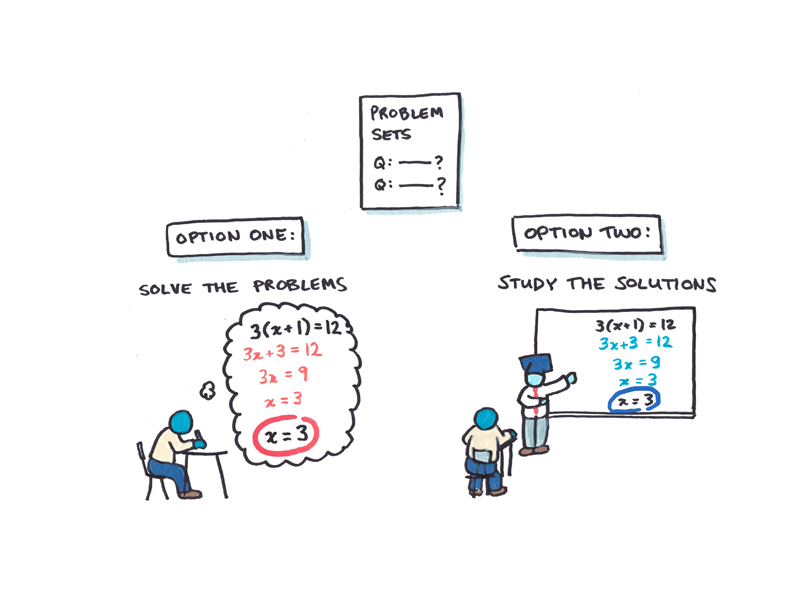
Interestingly, in many cases the answer is actually option two: looking at the solution. And this can be true even if you’re capable of solving the problems on your own.
This seems to go against what a lot of us were taught about how to study effectively: the only way to build skill is by solving hard problems. No pain, no gain, right? I sympathize with this perspective because, at least until I came to understand the science, that’s largely how I felt too.
In this essay, I want to share with you the research that changed my mind. I want to show you what goes on inside your head as you solve difficult problems, as well as give you the key to know when problem solving works (and when it underperforms).
The Puzzle
Is it possible to solve a problem without learning how you did it?
In 1982 the psychologist John Sweller was conducting an experiment on problem solving with undergraduate students.
The problems the students were given were fairly simple: given a starting number and a goal number, the aim is to go from the start to the goal. But there are only two possible moves: either multiply the number you have right now by three, or subtract twenty-nine from it.
For instance, suppose you have the number 15 and you’re told to get to 16. You could multiply it by 3, to start, which gets you to 45. And then you subtract 29, which gets you to 16. Done.
In all the problems there was a trick. Every problem Sweller gave could be solved by alternating between multiplying by three and subtracting twenty-nine some number of times. In other words, you just had to repeatedly apply those two rules and you’d always get the answer eventually.
But as Sweller later recounted:
“My undergraduates found these problems relatively easy to solve with very few failures, but there was something strange about their solutions. While all problems had to be solved by this alternation sequence … very few of the students discovered the rule … Whatever the problem solvers were doing to solve the problems, learning the alternating solution sequence rule did not play a part.”
How could students solve these problems, but not learn the method they were using to solve them?
How We Solve Problems
Just ten years before Sweller’s experiment, future Nobel laureate Herbert Simon and Allen Newell published a landmark book, Human Problem Solving. In it, the duo studied the mental processes people use to solve hard problems.
They found that when people tackle a problem they don’t know how to answer, they engage in a search process through a problem space. This is a little bit like trying to navigate a maze, except instead of going through a physical space with walls and dead-ends, you’re navigating through the possible states of the problem itself.
In Sweller’s experiment, there were only two moves—either multiply by three or subtract twenty-nine. Of course, in most problems, there are more possible moves. A Rubik’s cube has eighteen different moves, leading to a possible total of forty-three quintillion configurations. That’s part of why just twisting the cube around randomly doesn’t solve it—there are too many possibilities. Instead, we need to do something smarter.
Simon and Newell found that subjects reduced this complexity by using heuristics, or general-purpose procedures for solving problems. These heuristics are innate. We don’t need to be taught them. We apply them spontaneously, even if we aren’t aware of it.
Simon and Newell identified several of these heuristics. But there was a particular one that Sweller thought might be playing a role in his students surprising behavior: means-ends analysis.
This heuristic has a fancy name, but it’s really easy to understand. Means-ends analysis starts by looking at a goal, then looking for actions that could let you reach it. If you can’t perform that action directly, you then create a sub-goal to get to the point where you can take that action. If you repeat the process enough times, you’ll get to the solution.
Let’s make that clearer with an example. Assume you need to get from New York to Paris. What’s a way you could get to Paris? A plane. How do take a plane? You buy a ticket. How do you buy a ticket? You can buy one from the airline at the airport. How do you get to the airport? Take a taxi. You get the idea.
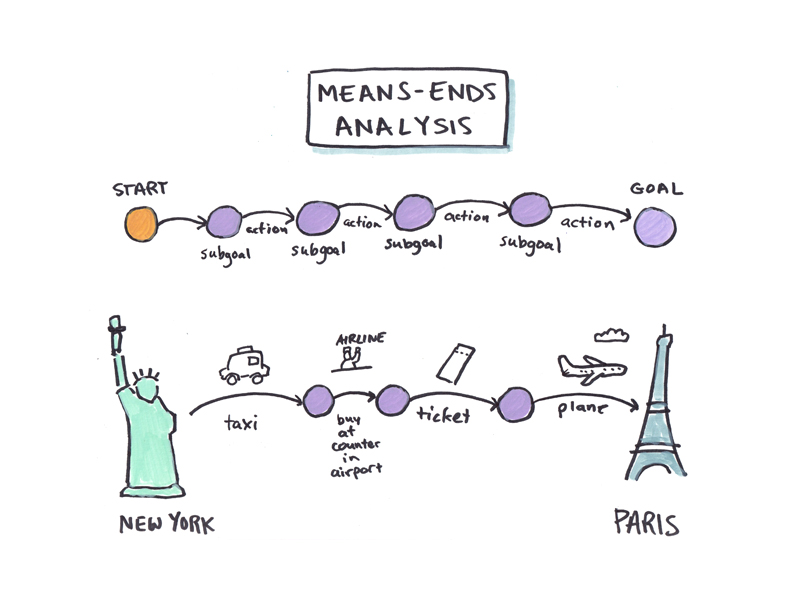
Means-ends analysis works. It’s a good strategy for solving unfamiliar problems, but it has a drawback. Thinking up all those goals and subgoals takes up a lot of mental bandwidth, what psychologists call your working memory. And, if your working memory is overloaded, you may not have much capacity left for noticing useful patterns in what you’re trying to learn.
To Sweller, this suggested an experiment. If you could suppress means-ends analysis, would you learn to solve the problems better?
Problems without Goals?
Sweller tested this in an experiment with students learning to solve trigonometry puzzles. Essentially, he asked students to solve for the missing angle or side length of a shape, much like you probably did in high school.
The classic formulation for these puzzles is to designate one angle or side-length and ask the student to find it. To do that, students typically rely on means-ends analysis. Starting from the goal, they work backward to figure out what other values they need in order to calculate the answer. This approach uses a lot of working memory, which might distract from learning the actual principles of geometry.
To suppress this, Sweller came up with “goal-free” problems. These were the same trigonometry puzzles, but, instead of finding a particular angle, students were asked to find as many angles and side lengths as they could.
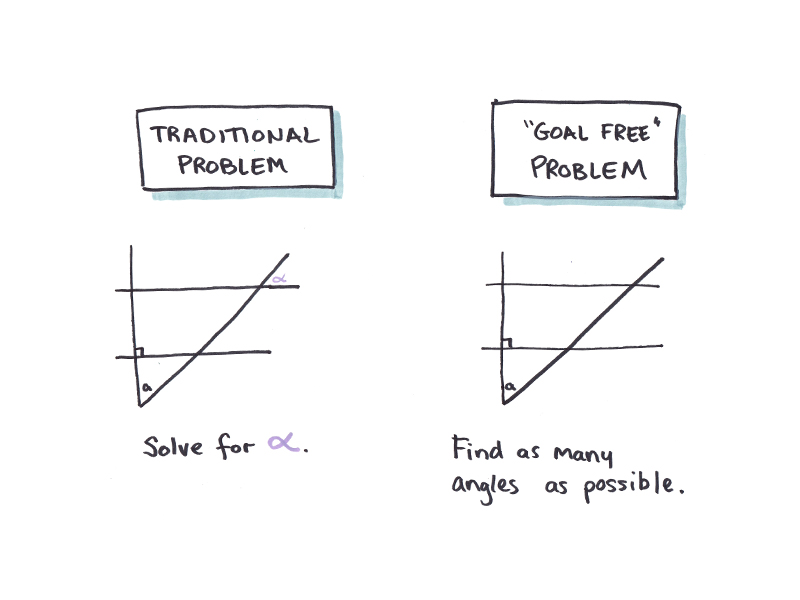
Sweller and his colleague, Elizabeth Owen, tested the students’ understanding of the puzzles by giving them a new type of trigonometry puzzle they had never seen before. The goal-free group got eight out of ten right, while the group who practiced traditional problem solving only managed three.
The Worked Example Effect
Goal-free problems helped avoid the mentally demanding means-ends analysis, but they were of limited use. The problem spaces of most real-world problems are just way too large for this approach to scale.
To deal with this, Sweller opted for a different technique: worked examples. These were written-out solutions to a problem, typically followed by a practice attempt on a very similar problem to ensure you actually studied it.
In a follow-up experiment, Sweller and colleagues tried this approach with algebra problems. Half the students were given worked examples. The other half were given the problems to solve, without solutions. To ensure that the success rate of the two groups was matched, any student from the problem-solving group who failed to solve the problem after five minutes was just given the solution. So we know that the problem solvers wouldn’t underperform simply because they never got to the answer.
When tested on similar problems, both groups performed about equally. But here’s the kicker—when a new type of problem was introduced, three-quarters of the worked-example group solved the problem, while none of the problem-solving group could.
Far from resulting in brittle memorization, studying the worked examples seemed to result in better understanding and generalization of the technique than problem solving did.
Cognitive Load Theory
These experiments, along other experimental effects, led Sweller and his colleagues to formulate cognitive load theory. This theory basically states that learning involves at least two different kinds of demands on our limited cognitive capacity.
The first, intrinsic load, is the working memory that is required for learning. Without this effort, learning doesn’t happen.
In contrast, extrinsic load is the working memory that isn’t strictly required for learning, but may be imposed by the task. We’ve already seen one type of this created by problem solving—means-ends analysis requires you to keep all those goals and subgoals in mind as you work toward the solution.
But it’s not the only kind. Extrinsic load also occurs in other cases, like when you have to visually move around materials to make sense of a diagram, or if you have irrelevant information you need to ignore.
If the total load exceeds your working memory capacity, some of it will be dropped. And if the part that was dropped was intrinsic to learning, you’ll end up learning less. Optimizing cognitive load—ensuring you’re maximizing the mental effort spent on genuine learning—is the key to learning well.
Part Two: The Reversal
Okay, I can imagine you saying, that’s a neat theory, but it’s not how you get good at difficult skills. You don’t get good at math, programming, physics or anything just by looking at the teacher’s answer—you have to think hard and do it for yourself.
Recently I published a video about the power of retrieval practice. Recall strengthens memory more than review, and students learn better when they’re forced to remember with a closed book rather than rereading a text.
Am I contradicting myself?
Well, no. Because, as it turns out, the power of goal-free problems, worked examples, and even teaching itself starts to reverse as you continue to learn.
I wrote above that people automatically use heuristics, like means-ends analysis, when they’re facing hard problems. As it turns out, this is only partly correct.
Novices Use Heuristics, Experts Retrieve Knowledge
Novices who are encountering problems for the first time solve problems this way. As we’ve seen, this is often the only way to solve them.
But experts, who have learned how to solve the problem, or one like it before, have a different process. Instead of solving a problem by working backward, they can work forward from their starting point, using the knowledge they already possess to get to the destination.
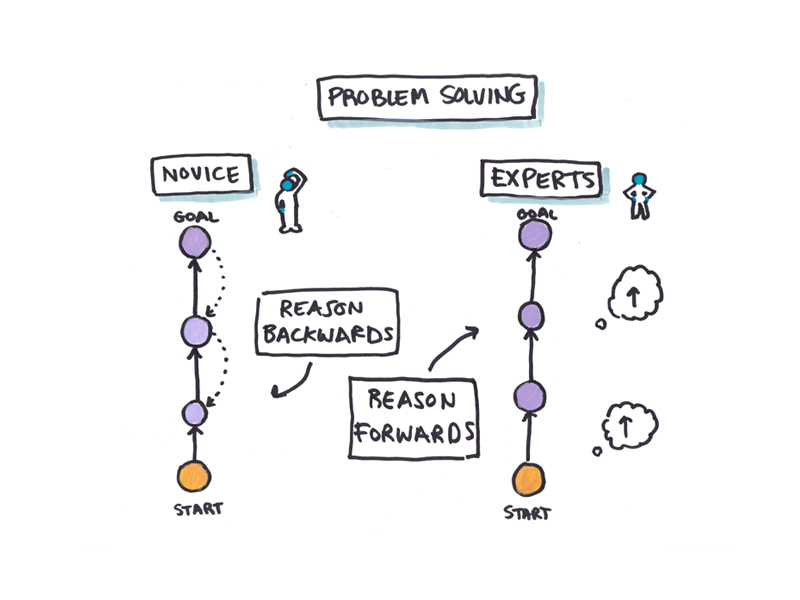
Take the example from before, of trying to go from New York to Paris. When I asked how you’d solve this problem, a lot of you probably didn’t go through the kind of backwards reasoning I described of first deciding on air travel, then buying a ticket, getting to the airport, hailing a taxi, and so on.
Instead, you’ve been on trips before, so you didn’t need to do this. Maybe you opened up your phone and went to your favorite travel website and started looking up flights.
This kind of forward reasoning doesn’t have the same heavy, extrinsic load that means-ends analysis creates. By using stored knowledge in your head, what psychologists call schemas, you can automatically recognize what sort of problem you’re dealing with and apply solutions from your starting point to get to your destination.
For experts, solving a familiar problem doesn’t require heuristic search. It simply requires retrieving the appropriate schema from memory and using that knowledge to get you to the next step.
Retrieval practice strengthens memory more than review does. As a result, under these conditions, we should expect the worked-example effect to flip. As you practice more and more, the benefits of studying the solution will get weaker, and the benefits of retrieving the schema to solve the problem yourself will go up.
But there’s more. Even the intrinsic load required to learn changes over time. Through a process known as “chunking” our effective working memory goes up as we learn within a subject. Thus, even for totally new problems, experts benefit more from solving problems than studying examples.
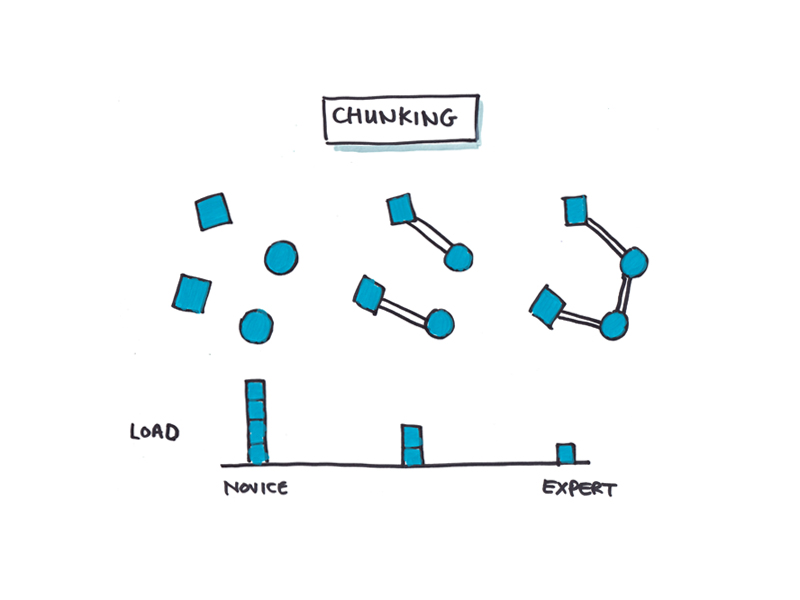
The expertise-reversal effect is a well-documented finding that shows that as we continue to learn within a field, the value of worked examples decreases until problem solving becomes the more effective strategy.
Practice and problem-solving matter for mastery. But when they matter is just as important as how much. Good instruction should focus on clear explanations and worked examples at the start, slowly fading that support to focus on independent problem solving as students progress.
Part Three: The Application
How can you apply this theory to learn better?
The simplest way is simply to realize that we need both good examples and ample practice to learn. Early on, examples are more potent. Later on, practice problems should take up more of our time. By cycling between the two, we can prevent some of the extreme failure cases that come from omitting one type of learning experience entirely.
But, some researchers have tried to do better. Cognitive load is a sliding scale, so we should find ways to smoothly transition between studying examples and fully independent problem-solving. Here are three:
1. The first strategy is to use self-explanations. In this approach, you start with fully worked examples, but you have a prompt to give an explanation for each of the steps taken. Researchers Alexander Renkl and colleagues found that this extra step of eliciting self-explanations resulted in deeper learning than worked examples alone in an experiment.
2. The second strategy is fading. With this approach, we smoothly transition from worked examples to problem solving by omitting more and more of the example and requiring the student to fill it in for themselves. Researchers found that backwards fading, where the final steps of the problem-solving process are omitted first, works best.
3. The third strategy is stepwise retrieval problems. In this case, the solution to the problem is revealed step-by-step. This gives you an opportunity to retrieve knowledge, but doesn’t require you to produce the complete solution. Researchers Gesa van den Broek and colleagues found this improved learning, although in their experiment students did take more time.
If you’re interested in using this in your own studies, I’ve made a tool that uses AI to apply these techniques automatically. Check it out here.
The Debate
The basic findings of cognitive load theory—that working memory is a major constraint in learning, that good instruction and worked examples are important, particularly to those just starting out, and that the value of independent problem-solving and practice grows as we gain more expertise—are, by now, beyond question.
However, I’d be lying if I said that these findings have always been well-received. The idea that clear guidance, instruction and practice are essential for learning has often run against deeply ingrained beliefs. Often, beliefs that run afoul of what the data actually support.
And as I mentioned at the start, this is a topic in which digging in to the original research largely changed my mind.
Effective learning is effortful. But not all efforts are equally effective. Learning well requires not only finding your own path, but also following the lead set by good examples.
 I'm a Wall Street Journal bestselling author, podcast host, computer programmer and an avid reader. Since 2006, I've published weekly essays on this website to help people like you learn and think better. My work has been featured in The New York Times, BBC, TEDx, Pocket, Business Insider and more. I don't promise I have all the answers, just a place to start.