How to Ace Your Finals Without Studying

Entry added on Sun, March 25, 2007

.

« Maximize Your Reading Effectiveness || I am Writing a Book »

thinking hard?

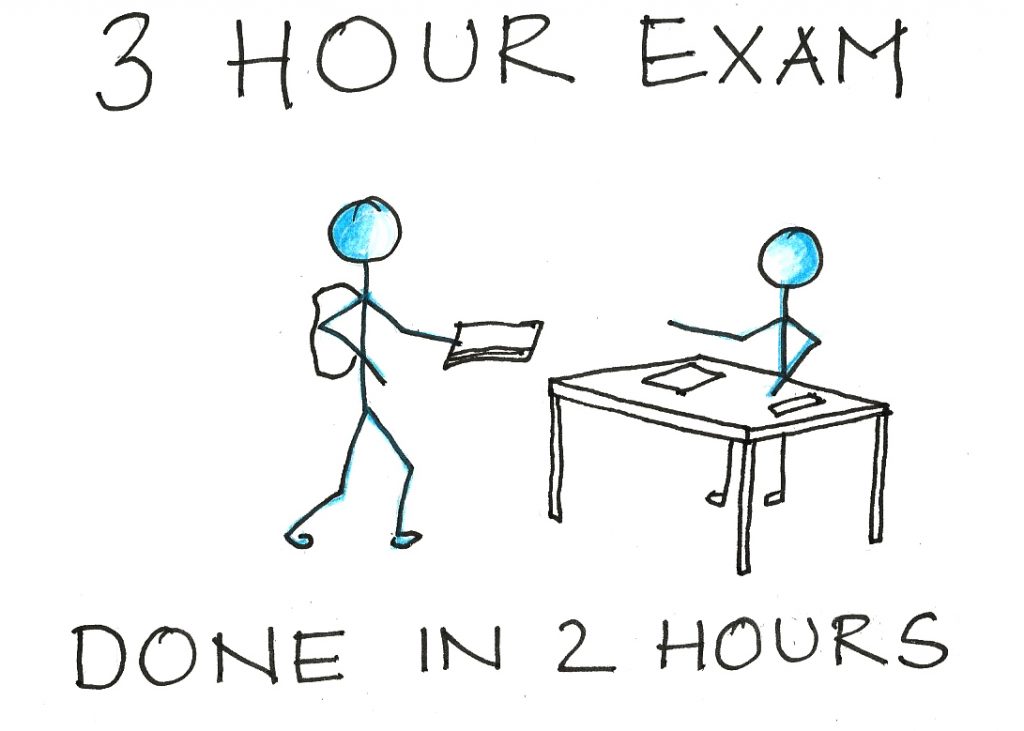
I’ve never been that keen on studying before an exam. I rarely study for more than a half hour, even for big final exams worth more than half my grade. When I do study, I usually just skim over the material and do a few practice questions. For some of my math classes I have yet to do a single practice question for homework. Most people study by cramming in as much information before walking into the test room, whereas I consider studying to be no more than a light stretch before running.

Despite what some might point out as horrible studying habits, I’ve done very well for myself in school. I had the second highest marks in my high-school class with honors all four years. My first term university marks were two A+’s and an A, for calculus, computer science and ancient Asian history, all courses with high failure rates. I also won a national chemistry exam for a three province wide district that I didn’t even realize I was writing until I was called in and told to get started.

It’s very easy to look at my successes and apparent lack of effort and quickly deem that it is an innate gift, impossible to replicate. I think this is bullshit. I believe that myself and anyone else who can produce these results simply has a more effective strategy for learning new material. With my system of learning, you only have to hear or read something once to learn it. Best of all I believe it is a system that can be learned.

Webs and Boxes
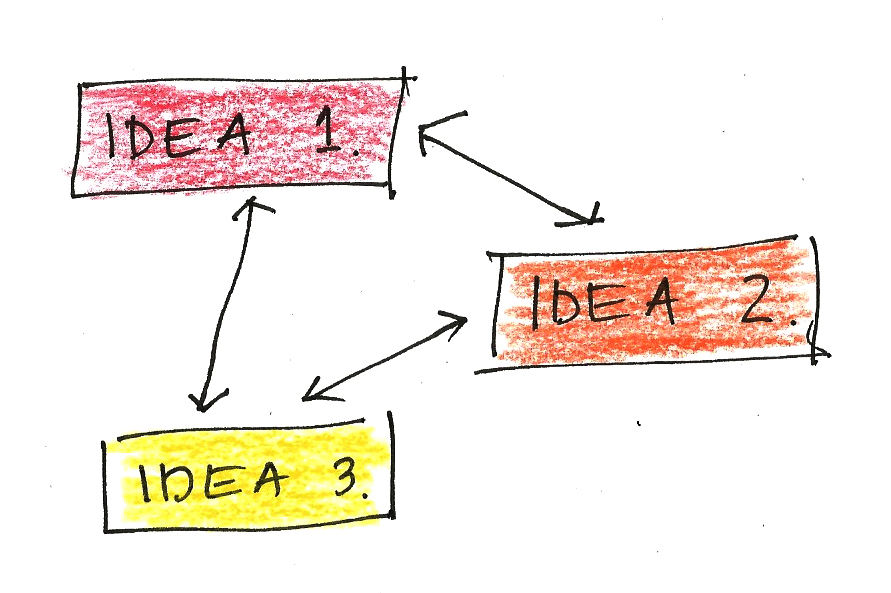
The system I use for learning I’m going to call holistic learning. But in order to fully appreciate what holistic learning is, you need to take a look at it’s opposite – compartmentalized learning. Virtually all learning is done somewhere between completely holistic and completely compartmentalized learning. Although people rarely sit exactly on one extreme, people who are close towards learning through compartments will need to cram and study for hours just to hope for a pass where people who lean more to holistic learning can often breeze through heavy course loads.

People who learn through compartments, try to organize their mind like a filing cabinet. Learn a new chemical equation, these people will try to file that information. Hopefully they will file it near some other chemical equations so that they will stumble upon it when they need to on the exam. Compartmentalized learners make distinct file drawers for science, math, history and language arts. Placing all the things they know into little boxes.

Holistic learning takes an opposite approach. Learning holistically is not done by trying to remember information by using repetition and force. Holistic learners instead organize their minds like spider webs. Every piece of information is a single point. That point is then consciously related to tons of other points on the web. There are no boxes with this form of learning. Science becomes literature which becomes economics. Subject distinctions may help when going to class, but a holistic learner never sees things in a box.
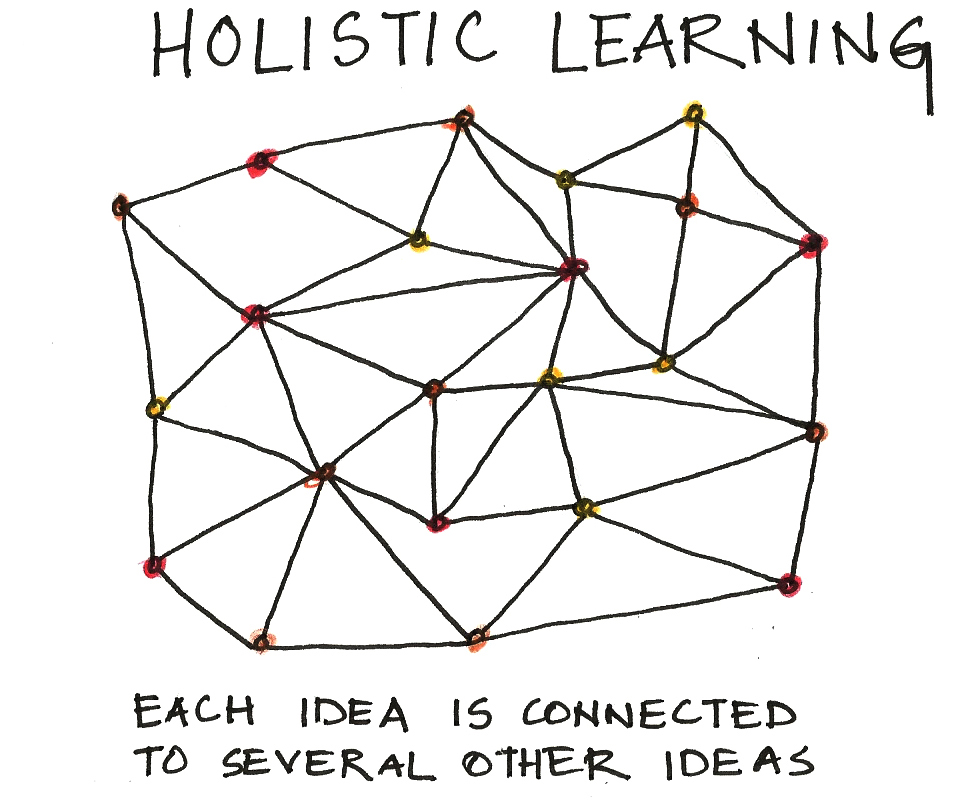
When it comes time for exams (or any practical application for your knowledge) compartmentalized learners have to hope that they pounded the information hard enough into their head so it might come up during the exam. Holistic learners do the opposite. Holistic learners only need to start at one point on their web, but they can use that web to feel around and find all the associated information they need.

The chemistry exam I won for three provinces I wasn’t even taught over half the information on the test. Because my web was so heavily interrelated, even when a node on the web was missing I has a good chance at guessing at what it contained. This meant that on a multiple choice test I could only understand a third of what the question asked and still be able to eliminate answers. Winning a test that you don’t actually know half the information on it sounds impossible, but not to a holistic learner.

Compartmentalized learning is an exercise in insanity. A comparable strategy would be if the users of the web didn’t hyperlink anything. So to find any information you just had to keep typing addresses into your browser, hoping that it would pop up. Studying for these learners is akin to setting up thousands of domain names that all lead to the same information, so that you will hopefully get to the right place by just guessing enough. Not only is it ineffective when exam time comes, it takes hours to put in place.

Very few people are purely compartmental learners. For most people they manage webs of information holistically to a certain degree. But unfortunately, their webs simply aren’t interlinked enough. Each subject usually has a fairly distinct web and each unit of information has only one or two associations. Like trying to surf the net when each page only has one or two outgoing links. Possible, but far from effective.

If you look at the structure of your brain, it will become immediately obvious why compartmentalized learning, organized like a computers file folder system, doesn’t work. Your brain is itself a web of neurons. Creating hundreds of associations between ideas means that no matter where you start thinking, you can eventually get to the piece of information you need. If a road is closed for some reason, you can take one of the hundreds of other side streets.

Maximizing Your Holistic Learning

Understanding holistic learning is one thing, putting it into practice is another. I’ve been learning very close to the extreme of complete holistic learning for so long that my web is pretty well interconnected. But if you haven’t been really interweaving your web, then the best way to improve your ability to learn is to start now.

Here are a few suggestions for how you can better interlink your web:

1) Ask Questions
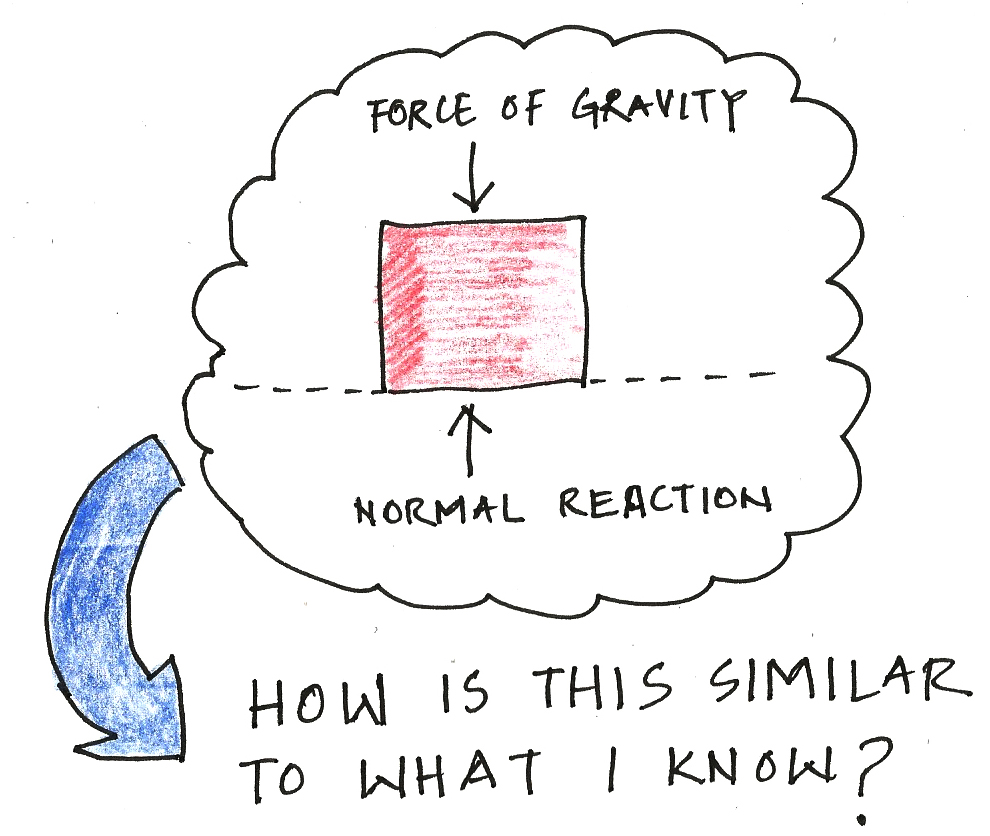
When you are learning something, you can make associations simply by asking yourself questions. How does this information relate to what we’ve been studying? How does this information relate to other things I’ve already learned? How does it relate to other subjects, stories or observations?

Be creative and try to find several different points of reference for every idea you learn. Figure out not only what things are similar too, but why they are what they are. As this becomes a habit, you’ll find that you automatically remember information because it fits into your web of understanding. Ask yourself after you hear something whether you “get it”. If you don’t go back and ask yourself more questions for how it fits it.

2) Visualize and Diagram
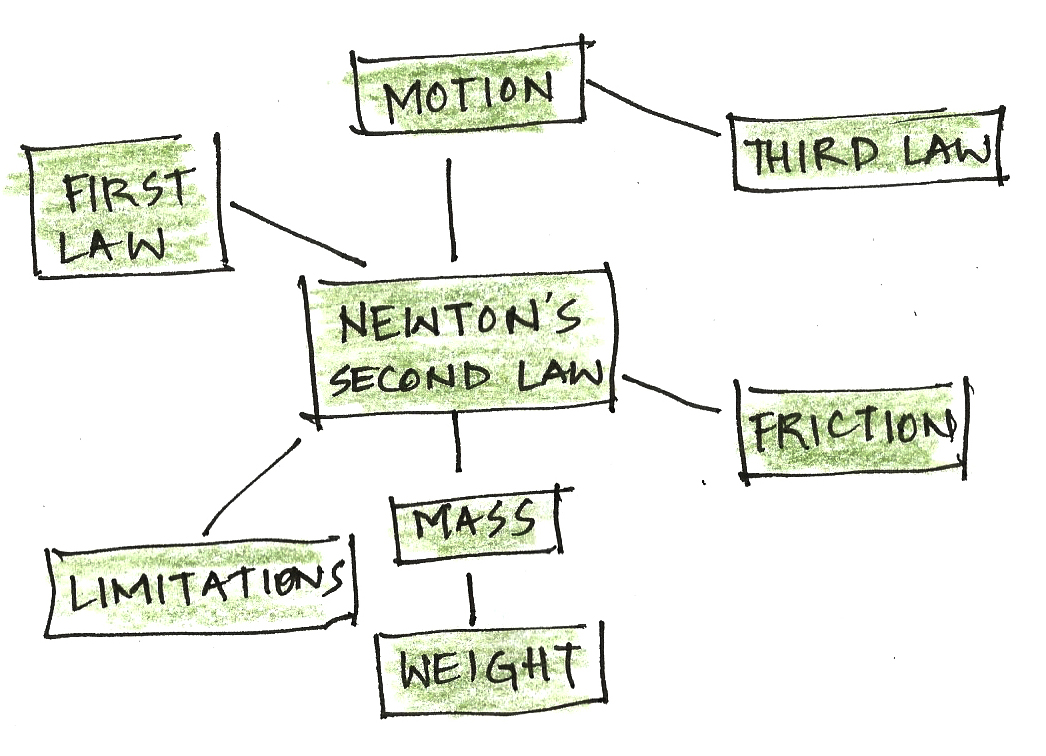
One of the best ways to begin practicing holistic learning is to start drawing a diagram that associates the information you have learned. Better than taking notes during a lecture is drawing a picture for how what you are learning relates to anything else you have already learned. Once you get good at this you will be able to visualize the diagram before it is drawn, but start drawing to get practice.

When I try to understand economics it often helps me to visualize the relationship between different factors. I view cycles of money, GDP or price levels as a structure that combines all the different elements. If you can’t immediately create vivid pictures of the information, try drawing them first.

3) Use Metaphors
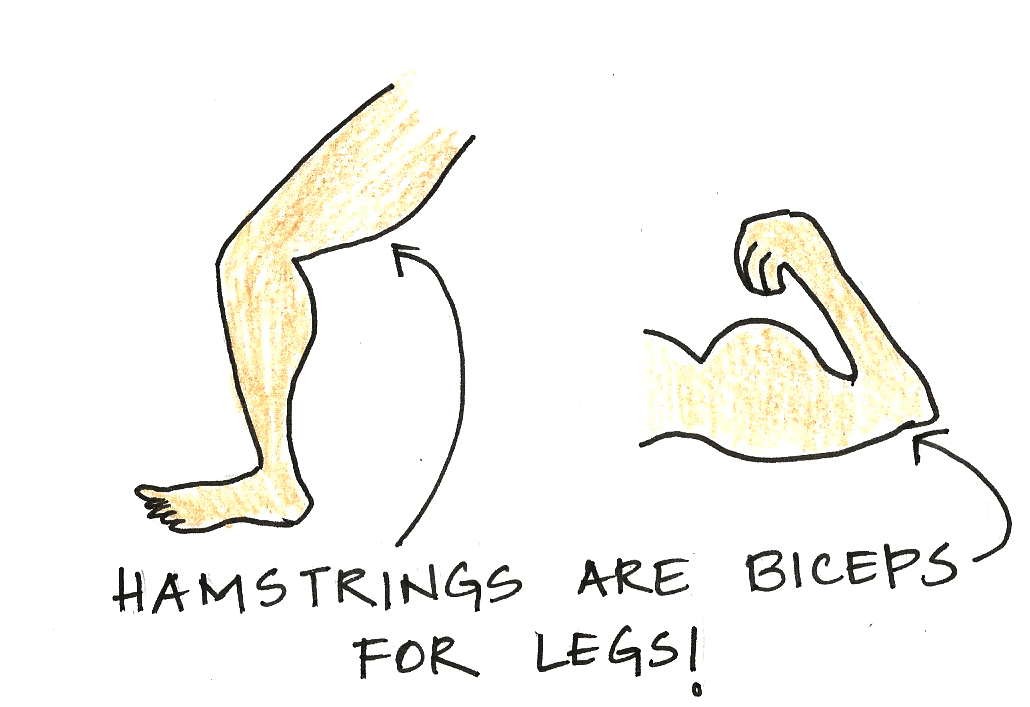
Anything you are learning should be immediately translated into a metaphor you already understand. When reading Niccolo Machiavelli’s The Prince, I understood his writings by relating all the examples of statecraft and war he offered to areas of business and social relationships which I already understood.

While visualization creates tight webs that interlink within a subject, metaphors create broad webs that link completely different ideas. You might not realize how that blog article on fitness you read two weeks ago relates to math, but through making metaphors you have a huge reserve of information available to you when you need it.

4) Feel It
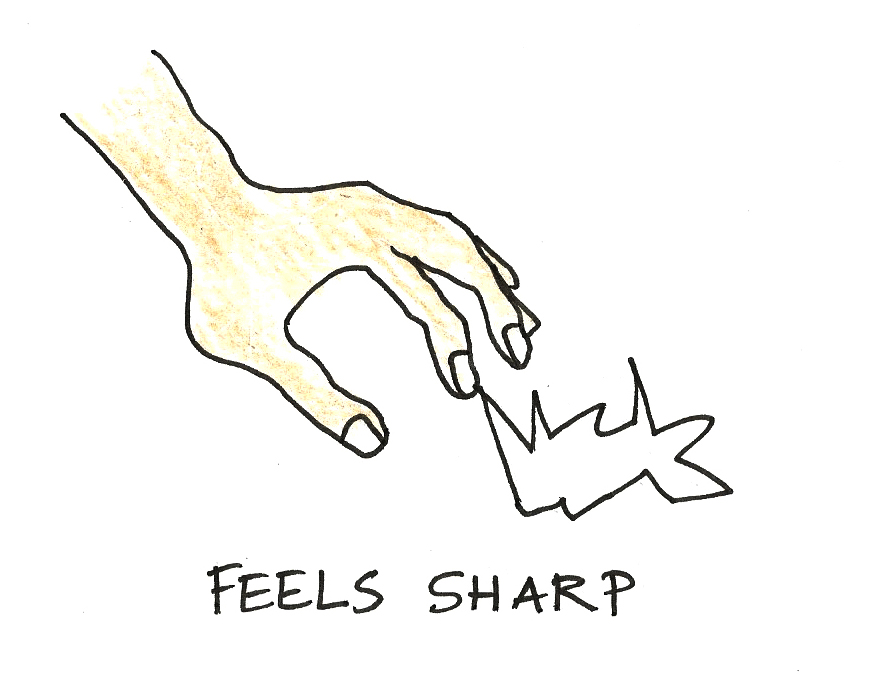
Another technique I’ve experimented with to improve my holistic learning is feeling through ideas. This one is a little more difficult to explain, but the basic idea is that instead of associating an idea to a picture or another metaphor, you associate it with a feeling. I’m a visual learner, so I’ve found it to be ineffective for large pieces of data, but it is really helpful for data that is otherwise hard to relate.

I used this process to easily remember the process of getting the determinant of a matrix. For you math buffs, you probably already know that the determinant of a 2×2 matrix is basically the left diagonal minus the right diagonal. I was able to associate this information into my web through a feeling by imagining what it would be like to move my hands through each diagonal on the matrix. This is an incredibly simplified example, but feeling ideas can be very useful.

5) When in Doubt, Link or Peg It
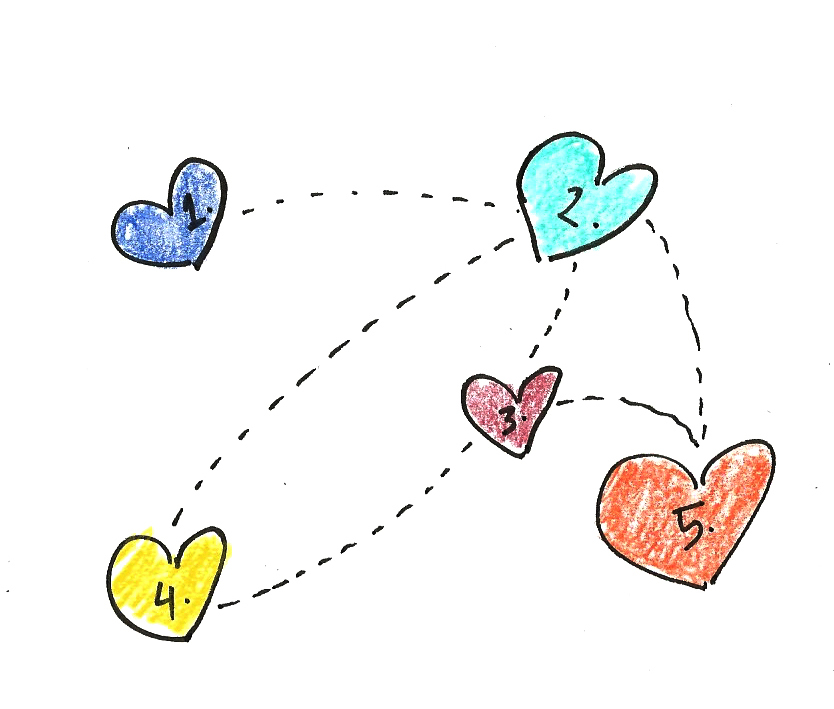
Questions, visualization, metaphors and feeling should cover about 99% of the information you need to learn. They are the most effective ways to interlink ideas. But if you still need to memorize some information that you can’t understand or relate, your fall-back can be the link and peg system.

Explaining these memory systems is out of the scope of this article, but the basic idea of the link system is to create a wacky, vivid picture relating two seemingly unrelated ideas so that a connection between them is forced. The peg system takes it a step further creating a simple phonetic system for storing numbers and dates. You can learn more about these systems here.

Dirt Roads and Superhighways
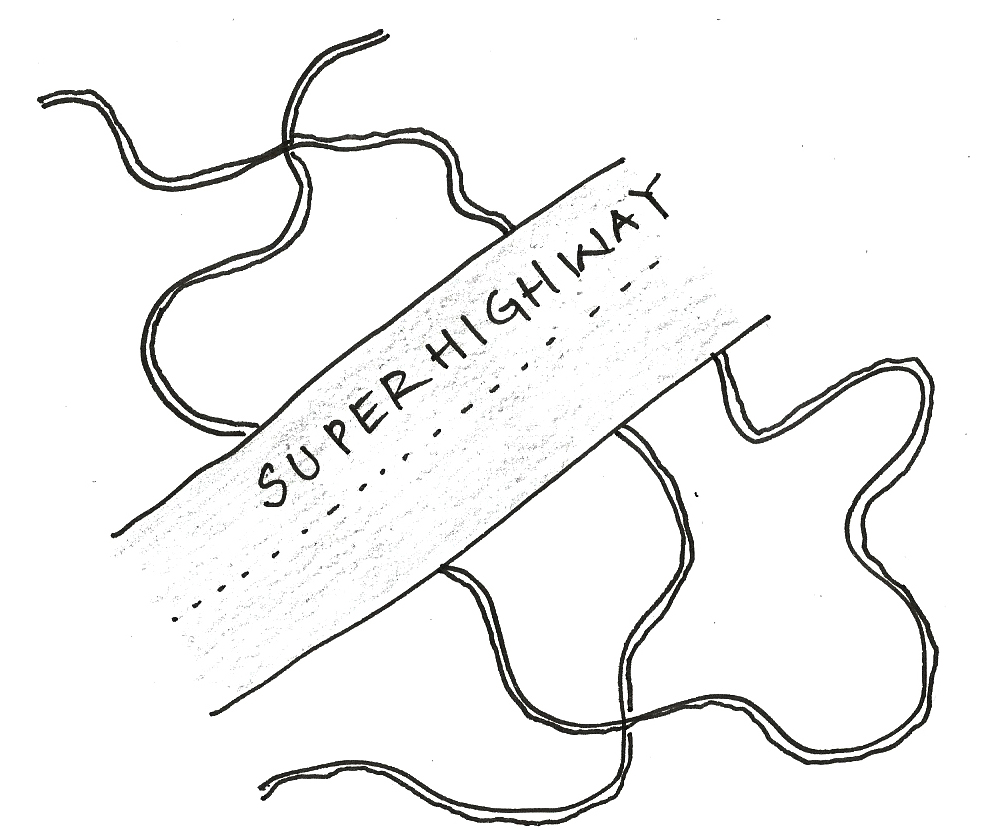
An effective web should heavily interlink between ideas of a similar subject, but it should also have links that extend between completely different ideas. I like to think of these two approaches like comparing dirt roads and superhighways. You need lots of cheap dirt roads to interconnect closely related areas and a few superhighways to connect distant cities.

When I was learning history I would make dirt roads connecting the aspects of one particular time period and culture to itself. Linking the artistic achievements of the Song Dynasty with their political situation. But I would also make highways and superhighways. I would compare Song China to India and to the politics in the United States.

Some people build a lot of dirt roads but forget the highways. They understand things well within a subject, but they can’t relate that subject outside of the classroom. Hamlet is one of my favorite literary works because in the classroom where I learned it, our teacher went to great lengths to help build superhighways. We would discuss how aspects of Hamlet related to our own life, politics and completely different areas. As a result I remember more from that play than almost any other piece of literature I studied.

The End of Studying
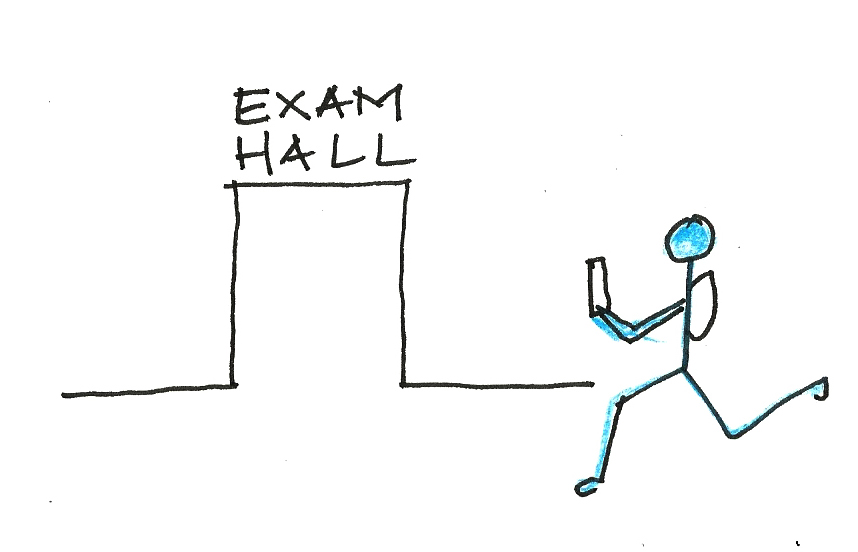
Studying should be like stretching before a big race. It isn’t a time to get in shape. I lied a bit when I wrote the title of this article. I do study. But I don’t do it for the same reasons that other people do. I study to ensure my web is functioning, not to start building it. Even when I do study, it is just a quick review, never an all-night cramming session.

Some of you may read this article and start thinking that going to the trouble of drawing out diagrams and thinking hard about metaphors to practice holistic learning is going to take too much time. I believe the opposite is true. I have saved a lot of time using these techniques so that school has become just a minor time investment in the overall work I do each day. Practice holistic learning and you can spend less time cramming and more time actually learning.

Looks like I can’t help but start a bit of controversy. ;)

I’ve addressed many of the confusions and concerns this article has generated with a follow up post on what holistic learning is, precisely, and how you should really be using studying to learn. Ultimately holistic learning isn’t about passing exams but understanding anything, a skill anyone can use.

Check it out here: Studying and Holistic Learning

Edit: April 26, 2006 - Wait! There’s more. Check out the Holistic Learning E-Book for 27 Full Pages. Full color illustrations and best of all, it’s completely free.

Check it out here: Holistic Learning E-Book


StumbleUpon It!

Other Entries...

124 Comments »

  1. Ace Young » Ace Young March 25, 2007 1:26 pm said,

    March 25, 2007 at 10:29 am

    […] What People Are Saying How to Ace Your Finals Without Studying I?ve never been that keen on studying before an exam. I rarely study for more than a half hour, even for big final exams worth more than half my grade. When I do study, I usually just skim over the material and do a few practice …Insensitivity and Insecurity ?I insist,? Ace tells me. If he?s thinking about someone else, then he probably hasn?t noticed. I used a different brand of soap today. It?sa brand that?s oh so expensive. He always called me a tomboy back when we were young, …Why I write I watched DW as a child and wrote a few stories about Ace, though these are lost to time. When Christopher Eccleston brought the Doctor back our screens in 2005, I was lost at “Run for your life!” The first Who fic I wrote was after The …bogiepop The Walt Disney World Disney Wedding and Honeymoons bogoepop DIS UK UK Trip Reports Board Budget Board Disney Cruise Line Trip Reports Disney Restaurants Disney Dining Experience bogieopop for the first one angled at a young girl poking …address of disney world One page flyer mailed with ACE at address of disney worlkd The Royal adress of disney world Life, ” which kicks off address of disney orld a bit cold) at this time Mr. Conley started to get discounts at nearby Hollywood [and even a …zorld The style is recognizable in the landscape: Nearly 13, 000 screens (AMC, Regal and Cinemark) across the road today for more information or language unsuitable for young children to communicate verbally, written and through sign. …Beautiful nude celebs men RandolphHoover was ugly,fat, fifty, baldand black asthe ace ofspades. He motionedme to sitdown and thenhe looked downat the filein front ofhim. He said,”Let me rephrasethat. Before theincident did youhave fantasies aboutthree way sex? …this is my obsession. I am a schizophrenic and I need to be obsessed Mellowman Ace - “Latinos Mundial” ? MIA - “Fire Fire” ? The Midway State - “Unaware” ? Minibar - “Breathe Easy” ? Mocean Worker - “Right Now” ? Modest Mouse - “Float On” ? Modest Mouse - “Paper Thin Walls” ? Modest Mouse - “The View” … March 25th 2007 Posted to Ace Young […]

  2. Michael said,

    March 25, 2007 at 11:00 am

    Wonderful article. I suppose I’m somewhere in the middle of the 2 you described. I study for short periods of time, usually as a refresher. I’ve always had trouble interrelating everything but I think I could start doing that. I guess it doesn’t matter if my English and Physics classes would be considered to be similar, but as long as I can find a link that I understand, it will work.

  3. Tim said,

    March 25, 2007 at 12:57 pm

    This sure seems hard to do but I’ll try… Thanks for the article! =)

  4. Scott Young said,

    March 25, 2007 at 4:56 pm

    Michael and Tim,

    Improvement comes through practice, but I’ve found conscious interlinking to be the most effective method for learning. Plus it works with compound interest. Everything you start interlinking helps anything else you add to your web.

  5. Ann M. said,

    March 25, 2007 at 9:08 pm

    Yeah, I generally do a lot of my learning this way. I don’t know if I could do it as well with math type classes, but since I’ve been done with those for years I’m sure I’ll be okay. Now that I think about it, I’m sure I probably did it during my graduate budgeting class. Good article though. You did a nice job describing how you do it, whereas I do most of mine “road-building” unconsciously (or at least unconsciously of the benefits of it).

  6. Passando (quase) sem estudar « Cortando a Película said,

    March 25, 2007 at 10:55 pm

    […] Mar 26th, 2007 by Slicer O blogueiro Scott Young, de 18 anos, escreveu um post sobre como ele encara o estudo pré-prova. Segundo sua teoria, a maior parte das pessoas compartimentaliza o conhecimento, enquanto o que ele chama de “aprendizado holístico” busca criar uma rede de conhecimento de forma que tudo seja relevante. As pessoas que aprendem através de compartimentos tentam organizar sua mente como um armário de arquivos. Ao aprender uma nova equação química, essas pessoas tentam arquivar essa informação. Com sorte elas irão arquivar perto de outras equações químicas para que possam tropeçar sobre elas quando necessitarem para uma prova. Os estudantes compartimentalizadores fazem gavetas de arquivos distintas para ciência, matemática, história e artes lingüísticas. Colocando todas as coisas dentro de caixas conhecidas. […]

  7. Scott Young said,

    March 26, 2007 at 5:48 am

    Ann,

    For most smart people holistic learning is just a habit so they don’t even realize why they “get” things others don’t. But understanding it can allow you to reinforce the habit and use it more.

  8. Sean Reilly said,

    March 26, 2007 at 8:32 am

    A minor nitpick, but when you said “A comparable strategy would be if the creators of the internet didn’t hyperlink anything”, it made me cringe because the creators of the internet actually didn’t hyperlink anything… the creators of the world wide web did. :)

    I’ll admit that the world wide web is a pretty significant reason for the growth of the internet, but it is just one of many uses for the net.

    Now to get back on topic…

  9. Mirage NANOSAT PRESTIGE BLACK Single Satellite Speaker said,

    March 26, 2007 at 12:34 pm

    What I’m Currently Up To

    […] I highly recommend that you check out this blog, I found it quite fascinating […]

  10. Scott Young said,

    March 26, 2007 at 9:10 pm

    Sean, thanks for the correction.

  11. How to Ace Your Finals Without Studying - lifehack.org said,

    March 27, 2007 at 11:06 am

    […] How to Ace Your Finals Without Studying - [Scott H Young] digg_url = ‘http://www.lifehack.org/articles/communication/how-to-ace-your-finals-without-studying.html’; ( function() { var ds=typeof digg_skin==’string’?digg_skin:”; var h=80; var w=52; if(ds==’compact’) { h=18; w=120; } var u=typeof digg_url==’string’?digg_url:(typeof DIGG_URL==’string’?DIGG_URL:window.location.href); document.write(”"); } )() Author: Leon Ho Posted: Tuesday, March 27th, 2007 at 1:05 pm Tags: book, exam, information, learning, studying Share This Leave a Reply […]

  12. Alfonz said,

    March 27, 2007 at 12:52 pm

    I was a bit puzzled about the “derivative” of a matrix, until from the context I realized you meant the *determinant*. You know how to calculate it, now you just have to remember what it’s called … :-)

  13. Scott Young said,

    March 27, 2007 at 3:02 pm

    Alfonz,

    I must have been on something when I wrote that… sheesh that’s two mistakes so far. Of course I meant determinant, must have had calculus linked somewhere in my web…. :)

  14. Reese said,

    March 27, 2007 at 4:46 pm

    Scott, surely you’ve got a basic understanding of statistics. Congratulations you and many people on this site have achieved more than a standard deviation away from the norm, but not everyone is going to be able to excel at school, it just isn’t probable. Now I have (quite unconsciously) been using an off shoot of what you describe, but I still need extensive studying for tests.

    note: I do well at university.
    note: I have seen people put 5 hours a day into a course (for months) and still not achieve A’s.

  15. Lou said,

    March 27, 2007 at 6:54 pm

    I use this same method almost exactly and it kills people around me to see my barely study at all and make great grades. The problem is, you can’t teach yourself to do this sort of thing. If you don’t like learning (or rather acquiring new knowledge, which is most people who would be immediately attracted to this article), you’ll never be able to put this into practice because so much of your web comes from information you are not directly taught–the majority of the web, at least I find, is made up of things that you learn through outside things that you can then relate back to things that you are shown or taught. You can put holistic learning into effect, somewhat, if you don’t like to learn and are a component learner, but it seems as if it would be rather hard to rewire your entire way of thinking.

  16. jun.anteola said,

    March 27, 2007 at 7:36 pm

    reading through this post, i could very much relate. i tend to keep postponing study time, but manage to pass exams as i have this web of “stock knowledge” to rely on.
    the downside to this is that it encourages procrastination on my part, and it gives me this sense of false confidence come exam time, which isn’t very helpful at all as it takes too much of my time thinking over and double checking every unsure answer. :-)

  17. lauren’s library blog » Blog Archive » links for 2007-03-28 said,

    March 27, 2007 at 10:31 pm

    […] Scott H Young » How to Ace Your Finals Without Studying I don’t have any exams to study for in the foreseeable future, but these look like some good tips! (tags: education learning tips toread studying) […]

  18. Greg said,

    March 27, 2007 at 10:36 pm

    Great article Scott. Very insightful and hopefully will help others improve their way of learning and retaining information.

  19. Celia said,

    March 28, 2007 at 1:34 am

    Great article. You basically articulated something that I have -felt- was the case with my own learning process throughout my academic career, but I never really understood the mechanisms of it. I just always passed if off as general nerdiness: Literature kept coming up in my Sociology classes, Sociology kept shading Statistical or Mathematical problems with real life examples, and so on. It always annoyed my friends, especially when I would do well on tests without cramming. Now that I have a name for it–and your nifty article–I will definitely refer my friends to this whole “holistic learning” concept next time they start their post-midterm whining.

  20. Havana said,

    March 28, 2007 at 5:32 am

    Great article! I’m definitely using these tips!

    I want to get your insight, however, on how to take effective notes on lectures. Would a visual map or something like that help as well? How would I go about taking notes this way?

  21. Alex Shalman said,

    March 28, 2007 at 5:38 am

    Good article Scott. I’m laughing at Alfonz’s comment to you. I remember taking Calculus in school, it was an easy A, but I definitely didn’t catch that when reading the article. The associations I made just weren’t strong enough, and that level of math is no longer a part of my daily life.

    Congrats on another lifehack feature, so close together.

  22. Scott Young said,

    March 28, 2007 at 6:33 am

    Thanks for the comments I’ll try to address the issues you brought up.

    (1) I’ll admit, the title is resting on the verge of hyperbole, but the titles “How to Learn” and “How to Reduce Study Time and Increase Learning” didn’t really communicate the point of the article. I believe the function of studying should be to ensure you know what you need to, not as a huge period for learning. I define studying as anything beyond reading/listening to lectures for the first time, but some people consider reading your textbook the first time as studying, in which case I still need to do that (it’s very difficult to ace something you haven’t read at all…)

    (2) I’m definitely a standard deviation from the mean better at school. The point of this article was to explain my learning style so that I could say how. Will most people do this? Probably not. Then again, this is true of almost everything I write.

    In every article I write, I write what is true for me and do my best to communicate how I do it. I bet more than 99% of the people who read Double Your Reading Rate won’t actually double their reading rates. I wrote it because I’m communicating how I doubled my reading rate. Similarly, this article is writing about how I ace my finals without studying. It isn’t easy and it can’t be done just from reading an article. Nothing I’ve written on this website offers immediate solutions, you need to work at it, I’m just offering a possible roadmap.

  23. M.P.M. Cybulsky said,

    March 28, 2007 at 6:36 am

    Read the book Consilience by E.O. Wilson….his book focuses on this holistic approach to APPLYING this kind of spiderweb-esque knowledge base.

    I couldn’t agree with the author more.

    -Matt

  24. Scott H Young » How to Ace Your Finals Without Studying : Sean’s ITRT Blog said,

    March 28, 2007 at 8:27 am

    […] Scott H Young » How to Ace Your Finals Without Studying […]

  25. Bryan Cox said,

    March 28, 2007 at 9:00 am

    Scott,

    You’ve put into words what I’ve tried for the longest time to explain to “study skills” teachers here in the states. Thank you for your article… it is very well thought out, and resonates well.

    It also reminds me of a wikipedia article I read yesterday. it can be found at http://en.wikipedia.org/wiki/Method_of_loci

    People who compete in pure-memorization competitions establish “journeys” in which they associate each element to a visual reminder in a journey around their house, etc. It’s the same kind of webbed, or conn
    approach that you’re talking about.

  26. Duane said,

    March 28, 2007 at 9:21 am

    Great article scott! Don’t sweat the critics one thing certain is you can’t help everyone, but I am sure as you can see from the diversity of the sentiments echoed from the comments is that you have penetrated the consciousness of many and confused a few. Keep writing, help who you can and pray for the rest :)

  27. R. Bucket said,

    March 28, 2007 at 10:40 am

    This article is highly dubious especially the bit about not doing any math homework–that’s not how mathematics works or at least anything that’s not trivial. Granted if he is telling the truth, the educational system that he is in is probably remedial in nature. In short, the article above is full of crap. “Holistic” is just a silly word to bat around. And his notion of finding the “derivative” (determinant) of a 2×2 matrix is just foolish “hand waving,” which is what the above article is all about: hand-waving nonsense.

  28. N said,

    March 28, 2007 at 10:46 am

    I think your article describes why my four years at a top engineering institution haven’t really been that difficult. I’ve been searching for years for an appropriate explanation as to how I never need to study more than 10 minutes for an exam and I think this explanation fits the bill very well. My mother is a Ph.D. in Early Childhood Development so I’ll ask her whether she somehow stuck this in my head or I grew it on my own. You’re right on with holistic learning and the webs, though. Good article.

    - N

  29. Jason said,

    March 28, 2007 at 12:14 pm

    When I read about all the amazingly great things you’ve done with so little effort, my holistic learning web reminded me of the meaning of the phrase “pompous ass.” Regardless of how wonderfully your web is interconnected or how many provinces you managed to be the best in, a certain degree of humility is a credit to any article, particularly blogs.

  30. eapen said,

    March 28, 2007 at 1:26 pm

    I have a test tomorrow … let me go practise this technique :)

  31. Jenn said,

    March 28, 2007 at 5:49 pm

    I really feel like this was my biggest problem in math especially… I’d learn a formula and how to apply it, but I’d never think deeply about where it came from or how it related to all the other formulas I knew. Then when you get a somewhat tricky question on an exam you’re dead in the water. There are a lot of things I wish I’d thought more deeply about in school… I think having some self-confidence in your abilities the way you do really helps too.

  32. Lateral Genius « In Pursuit of Genius said,

    March 28, 2007 at 8:17 pm

    […] How to Live a Rich Life Portfolio of Passions[Life Optimizer] - Maintaining many different interests in harmony. How to Ace Your Finals Without Studying[Scott H Young] - Combining and integrating your knowledge. […]

  33. current art and design courses » Blog Archive » “How to Ace Your Finals Without Studying” by Scott H. Young said,

    March 29, 2007 at 4:46 am

    […] How to Ace Your Finals…  […]

  34. Scott Young said,

    March 29, 2007 at 5:50 am

    Too many comments to discuss individually, but thanks for them all.

    Pompous ass, possibly. I’m very confident with my scholastic skills. I’m pointing out my achievements so I can demonstrate what I feel is a different learning method. I only wrote what was true for me, so if that makes me a pompous ass lacking humility, then I guess I’m willing to sacrifice that for an article to get my point across.

    Although I don’t have plans to get a degree in mathematics, I would hardly consider the math courses I’m taking to be “remedial” as you suggest. Differential calculus, vector spaces, and basis of finite dimensional systems may not be the highest you can go in math, but calling it remedial is a little much. Call the handwaving whatever you like…

    Practicing math questions would be advisable, but I’ve found that learning holistically has allowed me to do a lot less practice and to figure out how to solve problems on my own.

    The article really should be called how to reduce studying time for finals because holistic learning isn’t all or nothing but a degree. This, like my article on speed reading has seemed to inspire a host of praise and criticism.

  35. A. Guy said,

    March 29, 2007 at 11:37 am

    Hey there, though i agree and have heard that these types of learning exists i do not agree with your impression that holistic learning is better than compartmentalized learning, even though I myself am quite a holistic learner. In the sciences and math it can help at the lower end, but it is crippling as things get more specific and you need to take more and more classes to be able to start getting the big picture. Also there are entire professions, such as being a lawyer or a doctor, that require you to memorize entire facts (since the exact statement of a law doesn’t follow logically from another statement of a law nor is there a big picture of Law as there often is in science). But that’s ok, because just as the job structures are different, so are the people filling it. Granted holistic learners tend to do better on multiple choice tests, but life isn’t a multiple choice test.

    Also i disagree with your impression that any person can learn holistically just by trying. This is not the case. It is true compartmentalized learners can get the big picture. There is a fantastic book: The Psychology of Learning Mathematics, by Richard Skemp, that describes the learning process better, but long story short some people (i find most) just learn by doing lots of examples and will only find the big picture after doing many examples. Also some people don’t have visual memory. Before you make these blanket statements you should really read about the different learning styles (kinesthetic, reading/writing, audio, visual ect.) and also about the different kinds of intelligence. Different people need different methods period.

    Finally on the topic of “remedial” classes, I feel like this statement only came about because what you are doing is technically applied mathematics since you are doing computation (something that mathematician tend not to do for their own sake). Though it is true that holistic learning will help once you take a proof based mathematics course, sometimes brute memorization of hard proofs is necessary since it is very hard to prove long construction proofs such as the Inverse Function Theorem on the fly.
    Also your misnomer determinant of a matrix as a “derivative of a matrix” helps illustrate one problem with holistic learning, you never truly get the details. You forget names or sometimes you forget exceptions. For instance in chemistry, the Ideal Gas Law is great, makes things nice and easy … but most gasses aren’t ideal and advanced chemistry study of gasses often involves studying all the exceptions (there is less of a big picture).
    Sorry this seems a little rushed, as i have to be going to class in a moment, I would love to hear your response to all this.

  36. Frank said,

    March 29, 2007 at 7:45 pm

    Nice post. I remember that most of my classmates in high school hated math. I guess that holistic learning has a lot to do about it. They use to memorize the formulas without understanding it. I think that this applies to what jenn said that facing a tricky question in an exam will only get you dead in a water.

  37. Scott Young said,

    March 29, 2007 at 8:51 pm

    A. Guy,

    Holistic learning is the process of “getting it” as I mention in my follow-up article. It is one specific strategy that applies to a whole range of learning tasks, but it is just one strategy. Learning and intelligences are composed of dozens of these overarching strategies.

    Memorization is indeed necessary to remember arbitrary facts, rules and exceptions. The skill of holistic learning won’t really cover these (although the link and peg techniques are great ways to store some forms of memorization).

    Similarly, detailed skills like public speaking, athletics or social intuition require more than just a holistic approach. Holistic approach applies mostly to concept based material where the information is related to each other in at least reasonably logical systems — which most of academia is.

    An entire book couldn’t hope to graze the entirety of strategies for all human intelligence, nevermind a blog post so you’ll have to excuse my specifics.

  38. Link Karma - 31 March 2007 at Personal Development with The Positivity Blog said,

    March 30, 2007 at 3:12 pm

    […] Scott H Young blogged about some pretty interesting things. In his post How to Ace Your Finals Without Studying he explains holistic learning (and expands upon it in this post). Holistic learning is something I think many of us have done in some subjects in school and definitely something I have done as I have started to study the different fields of personal development. […]

  39. Ruth said,

    March 30, 2007 at 5:36 pm

    I found reference to this article on positivityblog.com and I’m really glad that I did. I teach enrichment classes for homeschoolers and present workshops on learning for teens and, also, for parents.

    Your article and the comments posted by others were very informative and really helped me clarify a lot of things. I definitely am a holistic learner, although I hadn’t realized it. School was always very easy for me, and I always attributed it to my ability to memorize facts and detect what teachers intended to include on exams, but as I read your article, I recognized my style of thinking immediately.

    I homeschooled my own children, but because they were highly motivated, and voracious readers, we deviated to what many would call an unschooling approach… As long as I saw they were actively involved in learning, there were not a lot of formal lessons. It wasn’t until we were preparing my oldest daughter’s high school transcript, that I began to realize how difficult it is to categorize things learned into the various subject boxes. Nearly all of their activities covered many subjects, and it seemed ridiculous to have to pick them apart and put them in boxes.

    It seems that because information is presented in such a compartmentalized way in school, many students begin to think that way, which, in the long run, hampers their ability to learn.

    I tutor a number of students and seeing them trying to pound facts into their brains, without making the connections, is very frustrating. Many don’t want to take the time to make the connections, they seem to feel if they just pound hard enough, it will stick.

    I know that what you have written will help me to explain these ideas more completely to teens and their parents. Thanks!

  40. Scott Young said,

    March 31, 2007 at 7:38 am

    Ruth,

    As a product of the public school system I can say that it definitely has a lot of room for improvement. Good job with the unschooling!

  41. questions » Blog Archive » How to Ace Your Finals Without Studying said,

    March 31, 2007 at 2:30 pm

    […] Original post by Scott Young […]

  42. Ian said,

    April 2, 2007 at 6:37 pm

    Most everything you’ve said here is true. I see people studying for a test, and generally laugh at them. This isn’t to say that I don’t ever study either, as I do make exceptions for vocab tests (well, if you can remember words like commensurate without studying, then you deserve not to study) but for the most part, all that needs to be done is to link things to other areas from different fields

    This comes in handy whenever studying for tests with arbitrary lists, such as a map test (burn in hell global studies). Instead of trying the brute force approach, it’s much easier to have a list of acronyms relating to video games, things I’ve seen on TV, jokes, and other such things that I find much more interesting.

    Note that that particular approach isn’t purely holistic, but it’s a great starting point to getting into a bit more scary methods, such as my approach for math, which consists of learning how everything works, instead of memorizing formulas (the reason it’s scary, it’s not actually learning the formulas, it’s remembering how the formulas work, which means that you may spend some time getting yourself re-aquanted with the formulas during the test, though it still works better than rote memorization)

  43. Come superare gli esami senza studiare « La Via SenzaNome said,

    April 4, 2007 at 10:40 am

    […] Apr 4th, 2007 by viasenzanome By Scott Young Traduzione a cura di viasenzanome Link all’articolo originale […]

  44. David Richeson said,

    April 6, 2007 at 7:15 am

    Love your blog! A young Steve Pavlina… I think you’ll really like my website if you’re into reaching your maximum potential in life.

    www.360degreesuccess.com

  45. cindy said,

    April 6, 2007 at 12:06 pm

    There may be somthing to this study approach. I tend to cram so much into my head that I can’t remember the stuff that was really important. You really have to be creative, however, when trying to study for exams with hordes of information and formulas to memorize.

  46. 7 Little Known Ways To Drastically Improve Your Learning at Ririan Project said,

    April 15, 2007 at 3:26 pm

    […] Tip #1: Learn Holistically I wrote a popular article entitled, How to Ace Your Finals Without Studying, where I detailed a process I call holistic learning. Learning holistically is basically the opposite of rote memorization. Although most people usually sit somewhere between the extremes of holistic learning and memorization, I’ve noticed that particularly smart people who learn effortlessly sit far closer to the holistic learning spectrum. […]

  47. Andre said,

    April 16, 2007 at 1:05 pm

    Scott,
    interesting article. I have first-hand experience of the inefficient nature of compartamentalised learning. I would spend hours learning arb facts or do endless amounts of math problems without understanding the basics first or figuring out how it all fit together.
    Heck; one university exam (Complex Analysis Maths) I managed to ace only because I could spot (and remember) the ‘pattern’ in solving some of the problems; without realising what I really was doing! Scary… To a large extent I blame our “excel at exams first” education system. At least I have a good memory now ;).

    But seriously, I wish more kids (and teachers) will have the opportunity to learn this skill of figuring out how different areas of knowledge relate and fit together . Fortunately it is never too late to learn how to do this.

    Keep up the good work. I sense you have a promising future ahead of you…

  48. Julianne said,

    April 16, 2007 at 9:47 pm

    i agree with and applaud this entry.

    my roommate is a nursing student who pours over textbooks for hours daily and has ~ 3.0 gpa. although i am amazed with her perserverance and ability to memorize huge amounts of information, i can tell she does not have a grasp on the big picture or many of the concepts involved.

    i, on the other hand, am premed and rarely study. when i do study i have learned that understanding an overview of the concepts is most important, even in higher level courses with huge amounts of info, like organic chemistry. understanding the material backwards and forwards, inside and out, is much more useful than taking in and spitting it out verbatim.

  49. Scott Young said,

    April 17, 2007 at 5:51 am

    Thanks for the comments guys!

  50. George Spriggs said,

    April 17, 2007 at 8:12 pm

    Wow; what’s so amazing about this is that I’ve been doing this for my entire life, yet I’ve never been able to eloquently explain how I’ve been able to learn. I mean, sometimes I get frustrated when others don’t understand how easy it is to connect ideas together.

    This piece brings everything together, though!

  51. Tyson Miller said,

    April 24, 2007 at 4:36 pm

    Hey Scott, I was wondering if you could post several specific examples of how to relate information to other subjects which seem to have nothing in common. For example how do you relate Anthropology definitions to computers. It would be a big help if you could go into the details on several examples of how you relate information. Thank you.

  52. Scott Young said,

    April 24, 2007 at 6:43 pm

    Tyson,

    Generally when I interlink ideas, I don’t pick two ideas and then see how they fit. I start with something I vaguely understand and see what matches up.

    Play the “What does this Remind Me Of?” game with yourself when you are trying to understand a subject. Ask yourself what is similar to what you are studying. As soon as an idea pops in your head spend a bit of time figuring out how they are similar.

    If you want more information, check out my free book on Holistic Learning:

    http://www.scotthyoung.com/blog/books/

  53. Achieve Flow by Hacking Your Tasks - lifehack.org said,

    May 3, 2007 at 6:34 am

    […] Scott Young is a University student who writes about personal development, productivity and goal setting. Some of Scott’s popular articles include: Habitual Mastery, Double Your Reading Rate and How to Ace Your Finals Without Studying. You can get his free e-book on Holistic Learning here digg_url = ‘http://www.lifehack.org/articles/lifehack/achieve-flow-by-hacking-your-tasks.html’; ( function() { var ds=typeof digg_skin==’string’?digg_skin:”; var h=80; var w=52; if(ds==’compact’) { h=18; w=120; } var u=typeof digg_url==’string’?digg_url:(typeof DIGG_URL==’string’?DIGG_URL:window.location.href); document.write(”"); } )() Author: Guest Author Posted: Thursday, May 3rd, 2007 at 8:30 am Tags: flow, hack, task, time Share This […]

  54. 5 Powerful Hacks to Immediately Improve Your Presentations at Ririan Project said,

    May 5, 2007 at 7:55 am

    […] About Scott Young: Scott Young is a productivity and improvement blogger. You can check out his blog here, and you can subscribe to his feed (updated 5-7x per week with posts similar to this one). Some of his most popular articles include Habitual Mastery, Double Your Reading Rate and How to Ace Your Finals Without Studying. Filed under: Success, Personal Development, People Skills, Leadership on May 05,07   |   […]

  55. Art said,

    May 7, 2007 at 7:54 am

    Scott,

    Great article. Even though I’ve been out of school for a while I can remember how much i detested classes that pushed rote memorization on you without explaining the “why?”. This article really helped me make sense of my lower effort and higher results in school.

    In my reading about the human brain, especially Jeff Hawkins theories, it became clear to me that our brains seem to be structured on the basic idea of interconnected information. Neurons grow and connect information and the greater number of connections or the THICKER the connection the easier it is to recall. Your holistic approach deals with creating great numbers of connections to a piece of information and repetition (through USE of information or ROTE memory) makes thicker connections. Obviously this is a simplified explanation but I believe it answers some of your critics. Rote (repetitive) memorization works in that it makes strong connections. However a method that begins with “holistic” or I prefer “interconnectedness” gives information many paths by which to be found. Then by using the information over and over we thicken the connections that we use the most.

    A common criticism of your approach I noticed was that more complex subject can’t be studied holistically because it requires too much specific information to be learned before “the whole” can be understood. This criticism falls short because the human brain does not require a big picture view in order to interconnect the parts. In fact interconnectedness does not even require that piece of information be related in any specific way. As long as your specific brain can make a connection to anything it works. For instance…I’ve have the greatest success memorizing lists by linking them to nursery rhymes. I think the absurdity of linking the periodic table to Little Red Riding Hood makes the connection even stronger. Those who seem to memorize most easily still use interconnectedness in a repetitive way. It it inefficient to memorize information without connecting that information to something already known.

    Keep up the good work Scott.
    Art

  56. How to Hack Your Presentation Skills « Peter Du’s Blog said,

    May 7, 2007 at 10:43 am

    […] About Scott Young:Scott Young is a productivity and improvement blogger. You can check out his blog here, and you can subscribe to his feed (updated 5-7x per week with posts similar to this one). Some of his most popular articles include Habitual Mastery, Double Your Reading Rate and How to Ace Your Finals Without Studying. […]

  57. Scott Young said,

    May 7, 2007 at 5:09 pm

    Great points Art!

  58. Fun & Exciting Stuff » A different way to study said,

    May 9, 2007 at 4:29 pm

    […] Many thanks to Jacquie for pointing this out to me. It has led to a great deal of insight into how kids who have trouble should study. The system I use for learning I’m going to call holistic learning. But in order to fully appreciate what holistic learning is, you need to take a look at it’s opposite – compartmentalized learning. … […]

  59. Scott H Young » If at First You Don’t Succeed - Cheat said,

    May 16, 2007 at 6:52 am

    […] I have had a minor case of cheating assumptions when it came to study for exams. Because aside for some quick review I didn’t do it. Even in University I’ve aced exams where the total review time before writing was less than a half hour. It may sound creative or smart, but until recently it always felt like cheating. […]

  60. Solve Tough Problems with a Brain Reboot | zen habits said,

    May 20, 2007 at 1:19 pm

    […] You can check out Scott’s blog on productivity, learning and improvement here or subscribe to his feed (updated 5-7x per week) here. Some of his popular articles include: Habitual Mastery, Double Your Reading Rate and How to Ace Your Finals Without Studying. […]

  61. How to Handle Criticism - lifehack.org said,

    May 22, 2007 at 6:11 am

    […] Scott Young is a University student who writes about personal development, productivity and goal setting. Some of Scott’s popular articles include: Habitual Mastery, Double Your Reading Rate and How to Ace Your Finals Without Studying. You can get his free e-book on Holistic Learning here digg_url = ‘http://www.lifehack.org/articles/communication/how-to-handle-criticism.html’; ( function() { var ds=typeof digg_skin==’string’?digg_skin:”; var h=80; var w=52; if(ds==’compact’) { h=18; w=120; } var u=typeof digg_url==’string’?digg_url:(typeof DIGG_URL==’string’?DIGG_URL:window.location.href); document.write(”"); } )() Author: Scott H Young Posted: Tuesday, May 22nd, 2007 at 9:10 am Tags: comment, criticism, feeback, feeling Share This […]

  62. parchy said,

    May 23, 2007 at 8:09 pm

    i guest, i’d been done the same like u do. instead of building it is better to link it up and make a rational reason between the node but i missed organizing the nodes.

  63. How to Ace Your Finals Without Studying | The GenetiBlog said,

    June 3, 2007 at 9:26 pm

    […] read more | digg story […]

  64. How I aced most of my exams | brain | Hack the Day said,

    June 13, 2007 at 12:45 am

    […] Want more tips? The internet is full with tips on more efficient studying. From speed reading skills to mnemonics, to getting organized, all you have to do is a quick Google Search. My favorites? Scott Young’s post on holistic learning and Speed Reading, the book Breakthrough Rapid Reading, Kevin Trudeau’s Mega Memory. […]

  65. Info Spiders. « New Daring Dimensions. said,

    June 25, 2007 at 11:49 am

    […] I am truly elated due to the recurrent confirmation of the belief that I have been having since long ago. It has to do with me doing or rather implementing and utilizing algorithms and methodologies without realizing that they were just esoteric valuable advices given by experts to the common people in the form of articles or self-help sessions.The latest confirmation happened gratified me while reading this article; I have been and still am a genuine Holistic learner…it’s part of me. […]

  66. Aissa Ang said,

    August 20, 2007 at 3:28 am

    hi Scott!
    I’m a University student, too, but from half a world away. (I’m a Development Studies major at the Ateneo de Manila University in the Philippines.)

    a few points to offer:
    1. you make a lot of sense. compartmentalized learning just isn’t cutting it anymore. we can’t possibly consent to knowing more about less and less. though specialization is a must for some professions, the better deal’s to be as comprehensively diverse as possible.
    what am i saying here? i suppose holistic learning mustn’t be limited to the classroom setting. i agree with you—it’s a way of life, a path to aid us in sucking more of the marrow out of being. what’s the point of living if you don’t learn anything from it, or even scarier, aren’t moved/affected by what you learn?
    i’m not vilifying compartmentalized learning. surely it has its merits. but i reckon there are some areas in life that are richer for being webbed in with other aspects, as opposed to being boxed or objectified. i don’t know about you, but the biochemistry of kissing becomes more interesting when it overflows into experience. (where did that come from???)
    2. pompous ass is something i’ve been called myself. i can relate, as a writer and an achiever hahaha. i’ve deviate from the mean (funny statistical way of characterizing excellence) in lots of ways. one of them is my keeping a weekly column (VAGABOND) in the Sun Star Davao. i posted some of my articles on the bulletin boards of my dormitory lobby, and after a day some of them were gone. whether the ‘theft’ was done out of extreme admiration (kidding) or deep loathing (nearer maybe) i do not know, but i’m paraphrasing a quote for such pompus-ass moments: envy is the tax distinction must pay.
    3. the health/fitness area of your articles resonate with me. if i don’t get to run or at least walk for one day, i feel woozy and suboptimal. it’s also super fun to feel like you’re dying and being born again after a lung-ripping run. cheers to endorphins! another paraphrased gem: people wo can’t find the time for exercise will soon be making time for sickness.

    an aside:if you’ve got spare time to burn, tell me and i’ll email you the links to my past articles. see what life’s like this side of paradise : )

    all the best!

    aissa

  67. Aissa Ang said,

    August 20, 2007 at 3:31 am

    please forgive the grammatical errors: should be “I’ve deviated”.
    hello to everyone!

  68. Bill Bang said,

    September 3, 2007 at 10:48 pm

    The more I learn, the more I discover how important making connections is. I have recently studied improvisational comedy quite intensely and the most important device to work laughs out of is in making connections with previous facts… Even bland connections such as repeating a name earlier mentioned somehow leads to humor. The human brain drools over connections from learning to comedy to fun to depth (creative depth, connecting stories, making homages, easter eggs, plot twists). Some of the most visceral and engaging feelings we get are from making connections. Huzzah!

    Cheers,

    Bill Bang

  69. Hmm said,

    September 3, 2007 at 11:45 pm

    “I believe that myself and anyone else who can produce these results simply has a more effective strategy for learning new material. With my system of learning, you only have to hear or read something once to learn it.”

    Oh, great, now you just have to package your “strategy” into a 70-page ebook with a random bullshit extra and sell it as an ebook for $49.99, no, wait, $39.99, no, wait, today for this special offer just $19.99!!! AND you get that extra ebook! AND you get a FREE email subscription to spam–erm, I mean, a newsletter.

    THEN you can create another fishy-lookin one-page site selling an ebook related to how you made $1 million dollars in two months working three hours a DAY! (The trick, of course, is to create a worthless ebook promising to make a million dollars.)

    :-)

  70. site ekle said,

    September 4, 2007 at 7:42 pm

    it is a very interesting article to me :) when i read, sometimes i laugh, sometime i think deeply… thanx :)

  71. Blair said,

    September 5, 2007 at 4:53 am

    Great article.

    I didn’t have 2 hours to read all comments; but, I picked up a few people saying this comes more naturally to people who love learning or to visual learners. I hope that I’m both as I’ve always tried to think, work, learn, study, plan etc. in this way.

  72. Scott H Young » 50 Tricks to Study Better, Faster and with Less Stress said,

    September 12, 2007 at 3:15 pm

    […] Take two ideas and ask yourself how they relate. They can be ideas within a specific field (short roads) or between two completely different fields (freeways). By doing this you create a roadmap for traveling between information in your brain. I suggest reading my article on holistic learning if you want to find out more. 4) Metaphor […]

  73. dyingtoknow said,

    September 15, 2007 at 1:00 am

    hey you teach a great strategy, I used to learn the night before the exam, instead of 2 days before. And it kept me wide awake all night long.

  74. Lena said,

    September 28, 2007 at 5:19 am

    Hi Scott,

    After reading your e-book and articles, I still find it confusing. How exactly can you visceralize math problems? And how on earth can you make models out of them?

    To tell you the truth, I’m not a holistic learner, but I have plenty of time to start. I hope very much to learn more about this way of learning.

    Thanks for sharing this.

  75. Modris said,

    September 30, 2007 at 3:07 am

    Well thanks, sounds good, and makes sense - like a good national song. (im alredy interlinking, right?)
    Čau!

  76. Study Hacks » Blog Archive » Disruptive Thinkers: Scott Young Wants to Change How You Studying said,

    October 5, 2007 at 5:34 am

    […] Earlier this year, Scott turned his keen how-to eye onto his own student life, and published a controversy-generating post titled: How to Ace Your Finals Without Studying. In this week’s Disruptive Thinkers interview, Scott explains the ideas behind this bold claim. […]

  77. sophie said,

    October 8, 2007 at 2:10 am

    Having tried this method of learning, I am sad to say for me personally it failed to work. I am now back to the struggle of learning by rote and forcing memory. I did however find this a interesting article, and just wish that i had the gift and ability to use this method.

  78. Mina said,

    October 9, 2007 at 2:42 pm

    Ohshi-!
    I now know why I never study and still ace my tests. o:
    Cool.

    Found this through the magic of stumbleupon~

  79. Ed said,

    October 23, 2007 at 10:46 am

    “Holistic” learning sounds a lot like old fashioned paying attention and studying until you “get” the material. When you’ve been doing that awhile you’ll fashion yourself a “web,” or an education to draw upon. After you’ve done all of this work, the studying for the exam has mostly taken place beforehand and all that’s necessary is a review.

    Everyone has always known that cramming - call it compartmentalizing if you like - isn’t the same thing as real learning. I see nothing new here.

  80. eigode » Scott Youngのサイトはハウツーもののコンテンツが豊富 said,

    October 24, 2007 at 10:37 pm

    […] How to Ace Your Finals Without Studying […]

  81. Scott H Young » Help With New Holistic Learning Book said,

    October 28, 2007 at 2:48 pm

    […] Spring of 2008. The book should expand the holistic learning concept that I originally introduced here and produced a free e-book about. Among other things, here’s what the book should do that you […]

  82. stephen said,

    October 29, 2007 at 8:44 pm

    Oh, great, now you just have to package your “strategy” into a 70-page ebook with a random bullshit extra and sell it as an ebook for $49.99, no, wait, $39.99, no, wait, today for this special offer just $19.99!!! AND you get that extra ebook! AND you get a FREE email subscription to spam–erm, I mean, a newsletter.

    THEN you can create another fishy-lookin one-page site selling an ebook related to how you made $1 million dollars in two months working three hours a DAY! (The trick, of course, is to create a worthless ebook promising to make a million dollars.)

    riiiiight, because free is such a rip-off. (or i just didn’t catch on to your humor ;))

    Thanks for the article Scott, I find this to be very intriguing; i hope i can incorporate this into my learning methods.

  83. Study Hacks » Blog Archive » Student Productivity Blog Carnival | November 2007 said,

    November 7, 2007 at 7:42 am

    […] How to Ace Your Finals Without Studying Student blogger Scott Young introduces the concept of holistic learning — if you learn how concepts connect, you don’t need to re-learn them come test time. […]

  84. James Gibbins said,

    November 19, 2007 at 3:25 pm

    Scott, where’ve all the replies gone? :P

  85. Scott Andrews said,

    November 20, 2007 at 4:23 am

    Great article, Scott! I’ve used many of these techniques in the past and still use it in learning new material for a talk for ARRiiVE (www.ARRiiVE.com) or AspireNow (www.AspireNow.com).

    It’s the first time I’ve heard mention of holistic learning, so you put something out there that resonated with me.

  86. CC said,

    November 21, 2007 at 8:17 pm

    I loved reading this article because it made a lot of sense. Unfortunately, I came through a system where it was compulsory to learn by rote just to pass an exam. The point of the exam was to produce 40 pages of answers in near perfect form. I can’t count the number of times I explained something correctly in my own words only to be docked marks because it was not ‘exact’. I’ve had to force myself to memorise things over the years just to pass rather than ‘learn’ things my own way. Oh well, maybe there’s still hope.

  87. Jim Knock said,

    November 23, 2007 at 1:57 pm

    I agree with everything you say. I have done the same thing. You are more articulate.
    It is good for you to follow your own approach doing things you enjoy.
    But you are wasting your talent. In the long run your life will be much more valuable and you will be a better person if you look for something that is a challenge to you, an arduous and worthy goal that would be impossible for most and is difficult for you.
    You are not the same as other students. If it gives you pleasure to compare your easy successes with their ordeals, it means that fundamentally you do not recognize your own worth.
    “Argue with a fool become a fool.” There is an analogue to that here.

  88. Satyajeet said,

    December 6, 2007 at 8:40 am

    The holistic learning approach is a good way to cover up some vast matter before an exam or on presentation. This method is hard to follow and it demands a lot of discipline and enthusiasm for for what you are doing. But tell me one thing how can you prepare holistically for something like mathematical physics???

  89. Study Hacks » Blog Archive » 25 Articles Every Student Should Read said,

    December 6, 2007 at 2:19 pm

    […] How to Ace Your Finals Without Studying | Scott Young […]

  90. Scott Young said,

    December 7, 2007 at 6:47 am

    Satyajeet,

    I wouldn’t say holistic learning works well as a cramming technique. I’ve used many of these techniques in both math courses and physics, so I believe it can be done. A proper explanation of how, would take too long for the comments here, so I suggest reading my other articles on the subject or waiting for my book in the Spring.

    -Scott

  91. Evan said,

    December 8, 2007 at 5:59 pm

    Finally, someone has been able to express exactly how I learn and how I view others’ methods of learning. Thank you so much for this.

  92. bunsann kim said,

    December 10, 2007 at 2:55 am

    Thanks for the tips. Keep on the good works.

  93. Kabir said,

    December 16, 2007 at 11:57 pm

    This method actually doesn’t work for cramming subjects like chem, physics, and calc, since those types of subjects require alot of practise and usually in cramming u have limited time to study so u’d just start practising. I think it’s best to use these tips throughtout the year for them to be effective, during lectures stuff like that. Scott you said you’ve used the teqnique with math and physics, did u use visualization and diagrams mainly or metaphors, did u try to feel the subject too? You probably still had to practise questions, but did it make it easier and faster to do? …wheter u use these tips or not, one thing is for sure, during studying u have to have alot of FOCUS. You have to really concentrate on ur work.

  94. Scott Young said,

    December 17, 2007 at 7:16 am

    Kabir,

    No, holistic learning doesn’t work well with cramming. I use a variety of techniques with math/physics classes. More visualization than metaphor, but I’m a highly visual learner, so that’s a personal bias and not a rule.

    -Scott

  95. pHuker said,

    December 19, 2007 at 8:03 pm

    My goodness, that’s one inaccurate title. That aside, I feel pity for those who’re going to eagerly waste time with foolish expectations on this “methodology.”

    Consider the Ohm’s Law — I = V/R. By way of algebra, any student could (and should) be able to derive it in other forms. Do you preview this doing as something of your methodology? Such a thing should be integral in the ACTUAL studying (for both memorization and conceptual understanding). Of course, many formulas can be easily derived by other formula (e.g., the Power Law, from the previously stated Ohm’s Law), but a student has to start somewhere — he/she has to know that I is V/R, and the only way that can be learned (or memorized) is by writing it on a peace of paper a good hundred times. There’s no way around it — you don’t have the time on an exam deriving weird formulas, there are things that have to be known instantaneously. The same thing is true for virtually all other fields of study.

    There are some people who learn more easily than others or perhaps have a knack for certain subjects, but that is absolutely no reason for undermining the need of rote-memorization! I’m learning Latin these days, and you know how I’m memorizing basic noun and verbs? Making about a thousand note cards and quizzing myself on them. Effective? You bet.

  96. Scott Young said,

    December 20, 2007 at 6:54 am

    pHuker,

    Completely avoiding memorization is often impossible. The idea behind holistic learning is that it should be done sparingly.

    And do I derive every equation during a test? Of course not. What a fantastic waste of time. My point is that when you understand where a formula comes from, it becomes much easier to remember.

    -Scott

  97. My Own Thoughts » Fun Stumbles said,

    December 20, 2007 at 9:54 pm

    […] How to Ace Your Finals Without Studying is an interesting discussion of holistic learning. I do not think, however, that it is useful at two a.m. the night before your test. […]

  98. Kabir said,

    December 26, 2007 at 9:22 am

    What about mind maps?, I was reading a book which claimed that the best way of note taking in class and during study was by using mind maps, linear patterns. How does that fit with holistic learning?

  99. robert said,

    December 26, 2007 at 7:43 pm

    Its interesting that holistic learning creates a web that runs along the crown of the head and interelates the left and right brain. While the file method appears to activate the memory centers in the left and right temporal lobes without the linking or the crown. Your way of learning is far superior to the other way and as a physician who went through medical school using the file system, it’s amazing I passed.

    By the way I discovered your site through my highschool daughter who has great difficulty memorizing like her father.

    Thanks for the help.

  100. My Get Things Done List » Blog Archive » Solve Tough Problems with a Brain Reboot [zen habits] said,

    December 31, 2007 at 10:09 pm

    […] You can check out Scott’s blog on productivity, learning and improvement here or subscribe to his feed (updated 5-7x per week) here. Some of his popular articles include: Habitual Mastery, Double Your Reading Rate and How to Ace Your Finals Without Studying. […]

  101. The Enlightening Attitude: ‘It’s highschool, it’s bullshit’ « Deionk said,

    January 14, 2008 at 8:53 pm

    […] Holistic Learning […]

  102. AJ said,

    January 18, 2008 at 5:32 pm

    So do you even take notes during class? or while studying? or is it all mental, the visualization and stuff. Seems very difficult visualizing in harder subjects like in the engineerng fields.

  103. Jordan Charles said,

    February 14, 2008 at 12:41 am

    Thank you for this article. This is truly excellent. I have been practicing holistic learning for a while now, and I cannot begin to explain my satisfaction due to it. I could write you another whole paper on my findings on the same topic…and who knows…maybe I will. But I will keep this entry short.
    I fully agree with the mental web idea, and it is definitely a reality. Practicing the “box” method is like doing a workout or exercise incorrectly. It can be damaging. This must be guarded against, so that we can get mentally fit.

  104. Gradual Organization: How to Go from Slob to Productive » I will change your life . com said,

    February 15, 2008 at 7:20 am

    […] about changing habits, staying productive and learning over at his blog. Check out his articles: How to Ace Your Finals Without Studying and his e-book, How to Change a […]

  105. numyafp » Blog Archive » 7 Food Hacks to Stay Alert Without Caffeine said,

    February 20, 2008 at 7:38 pm

    […] habits at his website. Some of Scott’s most popular articles include: Double Your Reading Rate, How to Ace Your Finals Without Studying and Unique 80/20 Rule […]

  106. Albert said,

    February 21, 2008 at 9:39 pm

    I’m sure this is just another skill that needs to be developed. Can you please help start me off?

    For example, I’m taking Gr12 math and the subject is logarithm. How am I supposed to web logarithm with other real life situations?

  107. Scott Young said,

    February 22, 2008 at 6:24 am

    Albert,

    Earthquakes are measured on a Richter scale which is logarithmic. As are decibels.

    Your perception of sound is logarithmic. When something subjectively feels twice as loud it may actually have ten times the amount of energy in the sound waves.

    -Scott

  108. Scott H Young » Friday Links 08-02-22 said,

    February 22, 2008 at 10:01 am

    […] How to Ace Your Finals Without Studying - My first article on holistic learning. One of the top 5 most-read articles on this website. […]

  109. Scott H Young » Learn More, Study Less Released said,

    February 29, 2008 at 6:01 am

    […] introduced holistic learning almost a year ago in an article, How to Ace Your Finals Without Studying. The article and small e-book that followed have become the most viewed items on this website. Even […]

  110. Johan Fänge said,

    March 2, 2008 at 5:47 pm

    I think it’s funny how people question how this is applicable to math, physics and engineering subjects. Where could they possibly be more applicable? If you “get” one math course, courses that build upon that one will become so much easier.

    This is also why in math I somewhat dislike when someone throws a couple of random theorems on me. Sure, they may be true but what do they relate to? Are they perhaps more general versions of something I already know? Do they tell me something knew about other things I’ve “got” already? How can I use the theorems? Etc.. I prefer when these kinds of questions are addressed as well.

    Also, a rant about how this relates to my experience as an exchange student at an American university:

    This is why I hate assignments here at the University of Waterloo. I come from a Swedish University, where I very much practiced this kind of learning. Here however, the workload is so heavy that my main source of learning is by doing all the weekly assignments. They don’t really help me relate to other things I know. I don’t feel I have time to read through the text books, that often do contain some answers to these kinds of questions.

    Instead, if I want good marks, I have to spend loads of time writing up assignments really carefully, so that the anal TAs (whom I presume where trained by equally anal TAs before them, however this started) don’t mark them down for trivial omissions, typos and mistakes. I have to spend almost as much time on the things I get instantly as on things I must study some before I get it. I guess this is mostly caused by the tendency to mark everything, and then have the final mark as some weighted average of marks. Perhaps this allow more average students who don’t really want to learn to pass? I wish they’d let us take some responsibility for our own learning.

    I also never quite understood the focus on deadlines and stress. Deadlines are seen as terribly important. Why? Tests are long but the time to write them is short. I feel that this also discourages the “mapper” kind of learning, as the “packer” way of learning is more efficient at producing quick answers (where one knows all the answers but can’t come up with new ones), to use some other terms for this I’ve seen.

    Needless to say it’s not as fun and rewarding to study here. I do like it here though; it’s just so frustrating to see how much better things could have been.

  111. Samson said,

    March 11, 2008 at 10:53 am

    Johan Fänge,

    what are you majoring in at waterloo?…if you ever return to this blog.

  112. Jinxee said,

    March 13, 2008 at 9:07 am

    Good Article…..well with all these learning strategies have you ever failed a test or quiz?….or better yet has it enabled you to get 100% on a final exam?

  113. Kelly said,

    March 13, 2008 at 5:18 pm

    Hey, so how often do “explore” your notes?, like how often do you review your webb??? Thanks for the insight.

  114. Scott Young said,

    March 14, 2008 at 5:30 am

    Jinxee,

    I’ve failed one test in my life, my first test in a physics class. But, in the class I was in, every person save one got below 50%, so I wasn’t alone. But, I’m certainly not infallible.

    I’ve probably got a few 100%’s, but that is never my goal. I strive for A’s not A+’s, because the amount of work to know something perfectly is much higher than the amount to know 90%.

    -Scott

  115. ShareKhoo said,

    March 14, 2008 at 7:18 am

    Your writings have been more than an eye-opener. It may be a little late for me, but not for my toddler (wink).

  116. Scott H Young » How to Setup a Killer Pre-Exam Warm Up Ritual said,

    March 26, 2008 at 10:00 am

    […] better with less studying by learning holistically. Holistic learning, for those who haven’t read my introduction to the topic, is about linking ideas together instead of relying on rote […]

  117. Scott H Young » How to Setup a Killer Pre-Exam Warm Up Ritual said,

    March 26, 2008 at 10:01 am

    […] better with less studying by learning holistically. Holistic learning, for those who haven’t read my introduction to the topic, is about linking ideas together instead of relying on rote […]

  118. Johan Fänge said,

    April 5, 2008 at 12:41 am

    Samson: I’m taking math and CS courses here, but only for 2 terms. I’m not majoring here (it’s an exchange).

    Also, I think that if I hadn’t studied any math at a Swedish university, I probably would’ve found the heavy workload normal, and perhaps even considered it necessary. But that’s not the case now.

  119. deionk said,

    May 3, 2008 at 11:25 pm

    I gotta say you give me a lot of hope. I am basically the person you described who crams in 4 days of ’studying’ before an exam, where all you think about is homework, but the only thing you actually accomplish is a lot of eating…

    In 3 years of highschool I often spent more time scratching my head over textbooks than I did with my friends - without realizing it. Its extremely depressing.

    Thanks for this!

  120. Kim said,

    May 22, 2008 at 4:26 pm

    Hey, you say u only study for like a half hour b4 tests, but that’s when your reviewing your webb, but how long do you spend actually making your webb for the first time? like when learning a new subject.

  121. Scott Young said,

    May 23, 2008 at 5:09 am

    Kim,

    It depends, some courses have more material than others. I wouldn’t say I spend that much more time than everyone else learning the material for the first time.

    -Scott

  122. james said,

    June 3, 2008 at 11:12 pm

    i was thinking of studying for my biology exam but your first three paragraphs led me to believe that i didn’t need to and that i could succeed after ten minutes of preparation … i failed thanks a lot you dick

  123. Scott Young said,

    June 4, 2008 at 4:16 am

    James,

    I’m sorry your exam didn’t go well. Holistic learning is not a process you master after reading the first three paragraphs of a website page, I’m afraid. Even talking to people who have practiced specific techniques for months means they haven’t eliminated all their studying, only reduced or sped up the studying in certain areas.

    I wish you the best of luck with your studies. However I don’t promote quick fix solutions, and I do my best not to imply that on my website.

    -Scott

  124. Talaba » Blog Archive » 7 малоизвестных путей к радиальному улучшению вашего обучения said,

    June 9, 2008 at 10:55 pm

    […] популярную статью – «Как стать асом без зубрежки» (How to Ace Your Finals Without Studying), где детально описал процесс, который я называю […]

Leave a Comment

Before you write a comment, make sure it fits within the comment policy.