The Little Book of Productivity
« 7 Reasons Why the Gym is Better Than Therapy || Friday Links 08-08-29 »

I’ve written a lot of articles about productivity over the last two years. Since I set the goal of making myself more productive several years ago, I’ve read dozens of books and thousands of articles on the topic. If you’re trying to become more productive, it can be a bit daunting to get started. Just on this website, I’d estimate there are about 300 articles aimed at tackling the idea through one perspective or another.
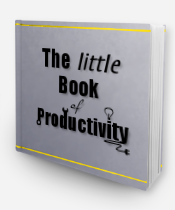
Because of this vast spread of ideas, I’ve written an ebook that combines the most important ideas into one source. The Little Book of Productivity is exactly that, an ebook containing ninety-nine ideas designed to make you more productive. Some of the ideas will be familiar to readers who have read every article I’ve written. Others are completely new, ideas I haven’t had a chance to write into an article.
I don’t usually write lists of tips. Although I love reading a good list of tips, that isn’t my style of writing. As a result, each idea in The Little Book of Productivity, is exactly that: an idea. A mini-article exploring a useful principle of productivity.
The ebook is split into seven chapters, and I’m giving the first one, “Beating Procrastination”, away for free.
The full book has all seven chapters and ninety-nine ideas to make you more productive. You can get the ebook here, for $9.95. As always, I’ve put a 120-day return policy for the book, so there is no risk in giving the ideas a try.
Here’s a taste of the full book, with just one idea from the preview chapter:
Schedule Calibration
Let’s play a trust exercise. You’re going to stand up and then fall backwards. Don’t worry, I’ll catch you.
What? You fell backwards and hit the floor. That must have hurt. It’s not really my fault, see I wrote this months before you’re reading it. And we aren’t even in the same location.
It would be understandable if you didn’t trust me after my little prank. It would be hard to rely on me in the future if you can’t trust me. While it’s easy to understand why a lack of trust damages a relationship, it can be harder to see how a lack of trust keeps you procrastinating.
When you don’t trust your to-do list, it’s easy to procrastinate. When you finish everything on your list, and proceed to add more, that’s violating trust. Before you started working, you had motivated yourself by saying you would be finished when the list was over. Adding more tasks breaks that trust, so you can’t motivate yourself again.
Schedule calibration is when you have full trust in your to-do list. When it says you have a lot of work to do, you get all of it done. When it says you are finished, you stop. By keeping that trust, you avoid bad habits of both overwork and laziness.

Download Free Chapter — “Beating Procrastination”
Glen Allsopp said,
August 27, 2008 at 12:32 pm
Congratulations on getting this out there. Any chance of an affiliate program?
Scott Young said,
August 27, 2008 at 1:09 pm
Glen,
Yes, the same affiliate program as with all of my e-books is also available for this one. 50% commission:
https://www.e-junkie.com/affiliates/?cl=11268&ev=cb24800eff
I should have included a mention in the post.
Best,
-Scott
Mike said,
August 27, 2008 at 10:13 pm
WOW. You are the biggest rip-off artist I have ever seen. All you do is copy other peoples work. Terrible.
Scott Young said,
August 28, 2008 at 6:03 am
Mike,
I can’t claim my ideas are 100% original. In the field of productivity/self-development, nothing is.
However, I always strive to reference and cite my sources when I have am reusing a specific idea. Sometimes this is difficult because popular ideas diffuse to a point where the original source is unclear.
As for this e-book, most of the ideas are, if not in entirety, my ideas and my way of explaining a concept.
-Scott
Valentino Aluigi said,
August 31, 2008 at 2:00 pm
Hi Scott, this is the first time a buy one of your books, but I’m a long time fan.
I decided to buy it because I found the free chapters already worth the full price!
Regards,
Valentino
Scott Young said,
September 1, 2008 at 9:51 am
Thanks Valentino!
Study Hacks » Blog Archive » Book Review: The Little Book of Productivity said,
September 10, 2008 at 9:49 am
[…] Young recently released a new eBook titled The Little Book of Productivity. The idea is simple: The volume of available information concerning “productivity” is […]
Adrian said,
September 10, 2008 at 11:35 am
Hi Scott. It’s great that you made the ebook! I think something like what you’ve put out is timely and relevant.
I wouldn’t worry about coughing up fully original content. David Allen’s GTD is a Descartes and Drucker rip off (check it out, it’s mind blowing). What is most important is character and soul - and I think you have it.
Keep on keeping on!
~A.
Scott Young said,
September 10, 2008 at 3:09 pm
Adrian,
I think the last truly original and relevant, broad ideas for living were laid out by the Greeks and other ancient cultures a few thousand years ago. What most authors today strive to do is to find fresh ways to connect fundamental ideas with new people.
I think if you look far enough almost every idea can be rooted in others. There is no purely original creative idea, everything is just a mutation of another.
Scott H Young » The 10 Best Productivity Articles said,
September 11, 2008 at 10:01 am
[…] along with which of the ten articles they liked best and why, will get a free copy of my e-book, The Little Book of Productivity. All you need to do is write the review on your blog and link back to this article, and your […]
Brian Hausser said,
September 14, 2008 at 5:14 pm
I am thoroughly angered and disgusted by you. You should be ashamed of yourself for repackaging other peoples ideas. They are trying to make a living off of their ideas, but you have to steal them, rename them, and call them “mostly” yours. They are MOSTLY NOT yours, but you are good at thievery and plagiarizing. I’ll give you that.
With hope,
Brian
Scott Young said,
September 15, 2008 at 10:56 am
Brian,
I appreciate your comments and concerns. I always strive to reference works which I draw direct ideas from. For example, when I discuss energy management, I reference the work of Tony Schwartz and Jim Loehr, since they have contributed a large amount of ideas and I’m happy to refer people to their book. Ditto for Tim Ferris, Dave Allen and Steve Pavlina.
Occasionally I will make mistakes and not realize an idea I have has a direct source in something I’ve read. Even more often, another author has previously come to the same conclusion that I have about an idea, even though I have not read their work. Since my writing is all based on personal observation, this will definitely happen.
The fact of the matter is, we’re dealing with ideas that are based on common observation and human experience. I try to cite when I get into specifics as much as possible, but common sense isn’t patentable. As Adrian wrote, Dave Allen’s work could be derived from earlier work from Peter Drucker. However, Getting Things Done, was a huge bestseller because he was able to repackage those ideas in a way that truly connected with other people.
Ideas that are basic and core to human experience aren’t “owned” by anyone. I do my best to reference the trigger for any ideas I have, but I refuse to stop writing about what I experience and what I’ve learned from personal observation.
-Scott
Brian Hausser said,
September 21, 2008 at 10:21 pm
cold-blooded
Scott H Young » Help Support Entrepreneurship: The Curry BizCamp said,
September 29, 2008 at 5:51 pm
[…] $15 - Can get a free copy of The Little Book of Productivity […]
Paul said,
October 24, 2008 at 8:01 pm
hey bud,
awesome job on creating an e-book, i know it takes a whole bunch of work, but great job on getting it out there.
The 10 Best Productivity Articles | Fresh Wisdom said,
October 27, 2008 at 5:16 am
[…] along with which of the ten articles they liked best and why, will get a free copy of my e-book, The Little Book of Productivity. All you need to do is write the review on your blog and link back to this article, and your […]
Scott H Young » How to Know When to Take a Break said,
November 18, 2008 at 10:00 am
[…] great, assuming you have a light to medium workload. It’s the approach I use built into my Weekly/Daily Goals system, because it’s simple and most of the time it does it’s […]