Physical exercise is a foundation for living a good life. It’s something all of us benefit from doing. Whether or not we particularly like running or lifting weights.
We often fail to exercise enough. The physical labor needed to get by in modern life is below what we need to be optimally healthy. So, unless we actively enjoy a sport, the tendency is to move less than we should.
Not only do we move less than we should, we also move less than we think we do. In one of my favorite studies, researchers found that when asked whether they met the recommended guidelines for physical activity (150 minutes of moderate or 75 minutes of vigorous physical activity per week), a majority of respondents said yes. But, when their activity was measured using wrist-based accelerometers, fewer than ten percent actually did.
Given this, the reality is that, for most people, the best amount of exercise to get is the amount they can practically sustain. Running every day is great, but if you can’t do that, walking is good too, and it’s a lot better than doing nothing.
Even if, practically speaking, the best exercise routine is the one you can comfortably stick with, I find this hand-waviness unsatisfying. Clearly, exercise is important. But how important?
Quantity matters. Something that improves your life by 0.1% is maybe a rounding error—you could make the case for it, but it isn’t a big deal. Something that improves your life by 50% or 100% is very important. To ignore such a big potential improvement is insanely wasteful.
Fortunately, we can do a lot better than hand-waving. We can determine not only how much exercise is optimal for health, but also give some sense of what would be ideal for you personally—given how much you actually enjoy exercising.
What’s the Optimal Amount of Exercise for Health?
Arem and colleagues pooled together data from over 600,000 people and found the following curve showing the relationship between amount of exercise and all-cause mortality:
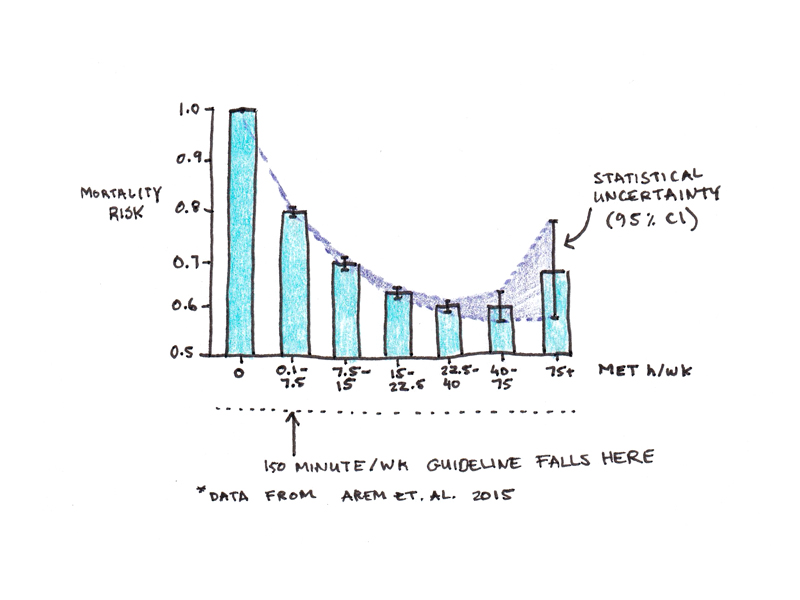
There are a few things to note about this curve:
First, it shows diminishing returns. That means going from zero to one hour of exercise per week is much more advantageous than going from one hour to two hours of exercise per week. Getting more exercise matters most when you do it the least.
Second, benefits appear to plateau. At around five times the standard guidelines, the benefits of additional exercise appear to be completely flat. Meaning if you’re getting 750 minutes of moderate (or 375 minutes of vigorous) physical activity per week, adding more exercise isn’t associated with better health outcomes.
This is a lot of exercise. If we consider vigorous exercise to be running and moderate exercise to be a brisk walk (or, more likely if you’re getting this amount of exercise, a jog), this is the equivalent of running nearly an hour every day, or briskly walking for nearly two hours every day. Chances are, if you’re getting this much exercise, you’re doing it for reasons other than health.
Third, there’s some uncertainty as to whether the benefits merely flatten or if they actually become negative beyond this point. Directionally, it looks like the curve may bend backwards. In other words, once you reach the training volume of ultramarathoners and beyond, your health may actually get worse.
However, this is a bit misleading. There are so few people at such an extreme that the confidence intervals become broad, and we have less certainty in the measurement. It may be that exercising that much is unhealthy for you. But, as the study authors point out, we don’t actually know if this is true. All of this is to say is that even amounts of exercise that look extreme to a normal person aren’t clearly worse for health than the optimum amount, and it’s probably still healthier than the amount most of us typically get.
So, based on these data, the absolute best amount of exercise for human health is probably in the range of 3-5x the standard guidelines.
But is the Optimal for Health Actually Best for You?
The problem with this analysis is that it ignores tradeoffs. Unless you’re Bryan Johnson, you value things other than living as long as possible. How do you compare the value of an extra month of life to, say, greater professional success, deeper friendships or watching more sunsets?
I don’t pretend to be able to resolve the incommensurability of values in a human life. But we can make the analysis tractable if we ask a different question: how much do you value the time spent exercising, compared to the average value of the time/activities that exercise would replace?
Since a major reason to exercise is to live longer, we can consider this as a kind of trade-off. You exercise now, giving up something else you would have done in that time. But, as a consequence, you now live longer (on average), so you regain some of that time over the course of your life.
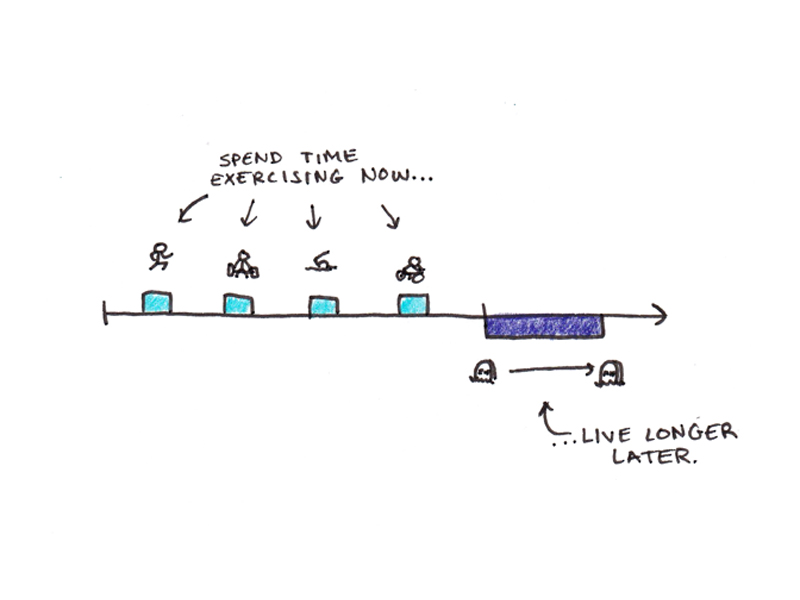
Considering this role of trade-offs, a better analysis would look at how much “life” you gain for each incremental bit of added physical activity, and then subtract from it however much less the exercise was worth to you than the next best use of your time.
This is a little tricky. Arem used hazard ratios, not “years of life gained”, so without knowing the baseline survival rates of the population studied, we can’t easily estimate it. Luckily, an earlier paper by Moore and colleagues did this calculation for us, albeit using a more limited data set.
With a little math1, we can convert Arem’s hazard ratios into years of extra life gained, using the Moore paper as an anchor:
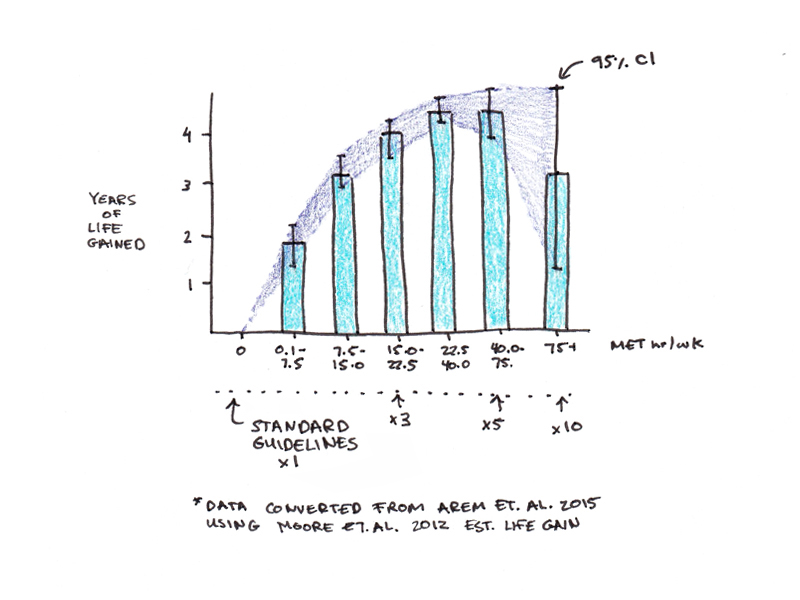
We need to convert this into a graph that shows the additional benefit for additional exercise:2
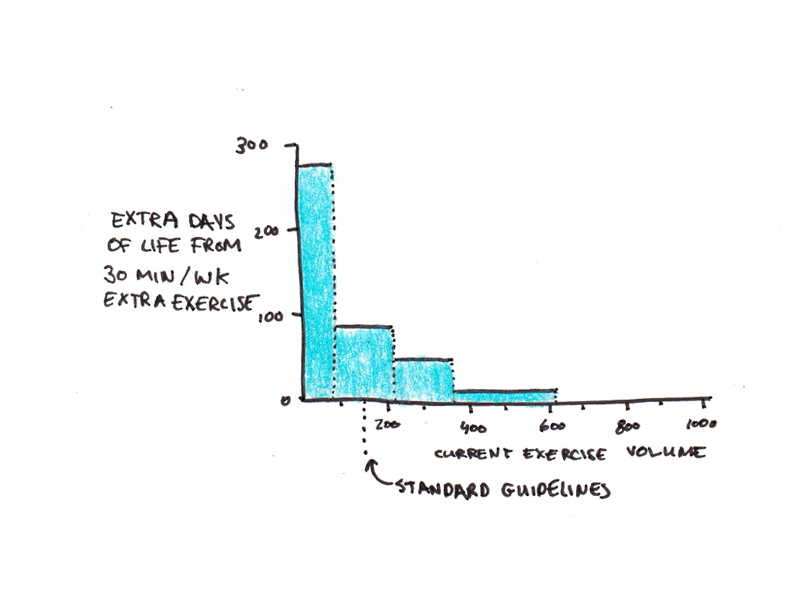
On this graph, we can superimpose the “costs” of exercise. Evaluating the costs is tricky, because it depends on how much you intrinsically value (or hate) the experience of exercise.
You could imagine that exercise is purely instrumental—a means to an end. If someone waved a magic wand that let you get the benefits of exercise, but rendered you completely unconscious for the duration of the experience with no memories, you’d be indifferent to it.
In this scenario, exercise is pure experiential waste that we only do for the benefits. Under this assumption, the optimal point of exercise is between 225 and 375 minutes per week.
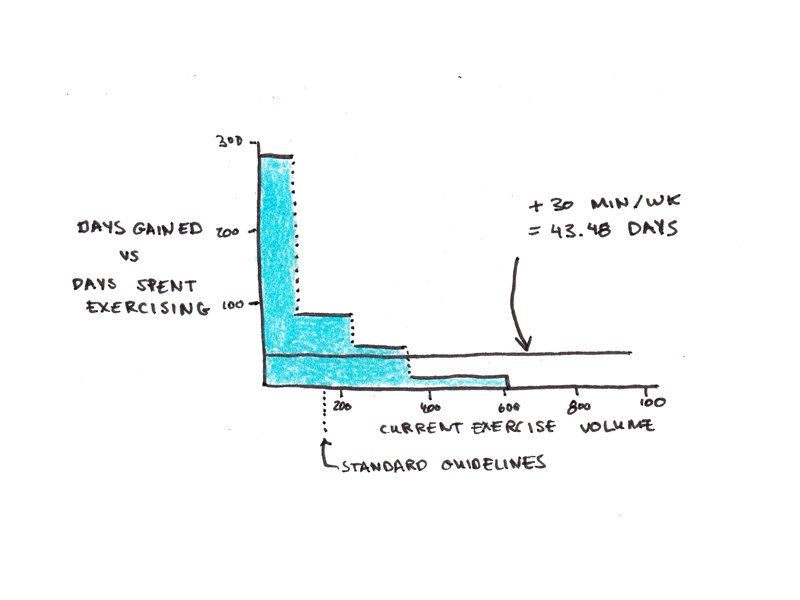
You can also scale this by how much you hate or enjoy exercise. Below, I’ve drawn graphs which consider the possibility that your time spent exercising is 80% as intrinsically valuable as your next-best alternative, in which case the optimal point is between 375 and 625 minutes per week.
I’ve also considered the opposite case, where exercise has negative intrinsic value, such that you’d rather give up an hour of time in your life to avoid thirty minutes of exercise. In this case, the optimal point lies between 75 and 225 minutes per week (although closer to the latter).
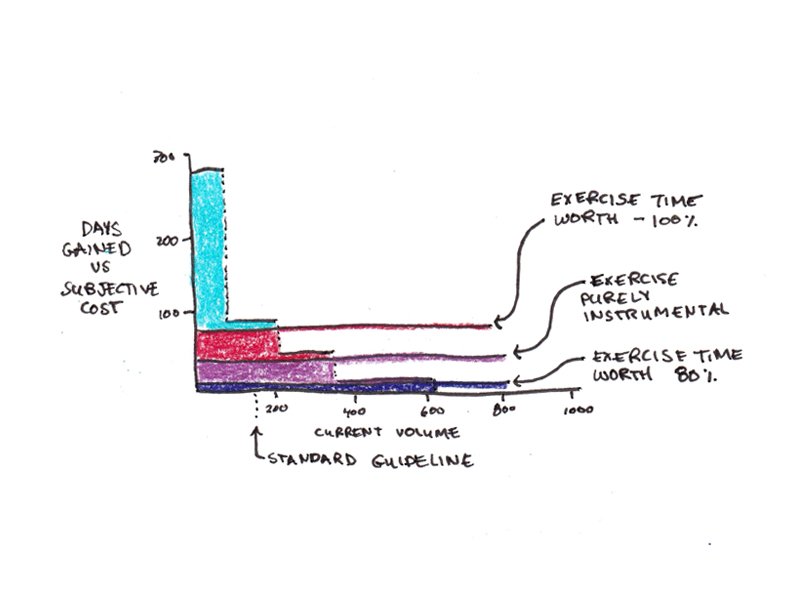
What we can see from this analysis is that the amount of exercise people typically get is only “rational” if we imagine that they really, really hate exercise. For instance, going from zero to a little bit of exercise is associated with roughly six times the increase in lifespan compared to the time cost of the exercise itself. That means you’d have to prefer losing nearly three and a half hours of your total lifespan for every thirty minutes spent exercising for this to be a rational choice!
I don’t know about you, but that seems pretty strong to me. Even for activities I hate, like getting a cavity filled at the dentist, I’m not sure I would actively give up much more than twice the amount of equivalent life experiences.
An additional wrinkle is that I’m assuming your exercise is moderate intensity. For a lot of people this is equivalent to brisk walking or a slow jog. For vigorous activity, the standard efficiency is roughly twice that, so this applies a fortiori. 3
What if You Want to Live Slow and Die Young?
One quibble might be that this analysis weights present moments equally with ones experienced in the far future. I think it’s a justifiable assumption.
When we consider financial decisions, we often use a discount rate to reduce the value of money in the far future. But I’m not sure that’s justified here, for a few reasons:
- Money has less value in the future due to opportunity cost. Money invested now will compound, meaning the same income is worth more today than a year from now. There is no comparable mechanism with regards to lifespan.
- Exercise has benefits beyond longevity. Exercise improves mood, cognition, sleep, stress and even your sex life. Many of those benefits occur in the near future, so a fuller analysis would need to account for these benefits that ought not to be discounted much.
- Philosophically speaking, it’s not clear that future moments we experience are genuinely worth less than present ones. After all, when the future comes, we will experience it just the same.
Of course, it’s obvious that the fact that many of the benefits of exercising accrue in the far future while the costs of exercising are immediate does impact people’s decision making, as it does with other prudent behaviors like saving for retirement, not drinking or smoking excessively and so on. But that imprudence is usually irrational.4
If Exercise Matters So Much, Why Do We Struggle With It?
Exercise is a good example here, but it’s hardly unique. Life is full of actions that can dramatically increase the quality (or quantity) of our lives compared to their costs, but which we often have a hard time adopting or sustaining.
We often blame lack of information, weakness of willpower, or personal preferences as reasons we fail to capture all this low-hanging fruit.
But I tend to think the problem is more than that. Cognitively speaking, exercise belongs to a class of problems that we do not have good built-in mechanisms for solving. And thus, to successfully stick to an exercise routine year after year and reap the benefits requires constructing systems, habits, beliefs and attitudes that make up for where our instincts fail us.
There are many ways to cultivate such systems, but the basic ingredient in all of them is a certain degree of committed focus, at least for a time. Spend a little bit of time creating the system, refining and stabilizing it, and it will continue to deliver benefits throughout your entire life.
This was the goal of my year-long Foundations project, where I spent each month focusing on one of twelve different foundations for life, including fitness. The idea was that, with a combination of carefully chosen habits and deep research, I could build systems that would yield the benefits of better fitness, relationships, productivity, reading and more.
Footnotes
- Moore et al. provides the estimate of 4.5 years of lifespan gained with a hazard ratio of 0.59. To convert hazard ratios into lifespan gained, I used the equation Y(V) = 4.5 * (-ln(HR(V))/-ln(HR(.59)) with Y being years of life added, V being the volume of exercise and, HR(V) being the hazard ratio with the associated amount of exercise.
- This is complicated somewhat by the fact that Arem and colleagues used binned data. To simplify things, I used the midpoint of each bin as a fixed point, and then considered the gain in lifespan expected from going from the each level to the next level as a linear function. You can see my calculations here.
- There’s some emerging evidence that harder workouts may matter even more than the 2x claim above. If this is true, then the efficiency for running, HIIT, sports or other activities that put you in the upper range of your heart rate range might be even more efficient. Indeed, given this, you’d have to have an extreme dislike of them to not want to do at least a little every week.
- One legitimate reason for including a discount rate is risk. Time given up in the present is certain. Time gained in the future is only an average and is not guaranteed. Still, this essay is getting long enough already, so I’ll leave adding in discount rates as an exercise for the reader.
 I'm a Wall Street Journal bestselling author, podcast host, computer programmer and an avid reader. Since 2006, I've published weekly essays on this website to help people like you learn and think better. My work has been featured in The New York Times, BBC, TEDx, Pocket, Business Insider and more. I don't promise I have all the answers, just a place to start.