

This is a free chapter from my new e-book, Learn More, Study Less. You can download a free preview of the e-book, or buy your copy. This chapter is on Flow-Based Notetaking, and is also available in the .pdf preview version. This is one of eleven chapters from Part II of the book, which focuses on techniques to improve how you learn.
I’m not a fan of taking detailed and intricate notes. I’m a believer in the “learn it once” principle, which means you should be listening and processing the information as your professor or instructor is saying it–not just transcribing it on a piece of paper to learn later.
One technique I use during classes where there is a lot of information is flow-based notetaking. The goal with flow-based notetaking is that it should provide a surface for connecting and linking ideas as they are reaching you. The linear, bullet-point style of notes that most people use is out for a more fluid (although messier) format.
With flow-based note-taking you start by only writing out the major ideas. This means using a few words at most instead of entire sentences. This can reduce readability later, but it enhances learning during the lecture. Facts, dates, details and descriptions are reduced to just a few words, not lengthy paragraphs.
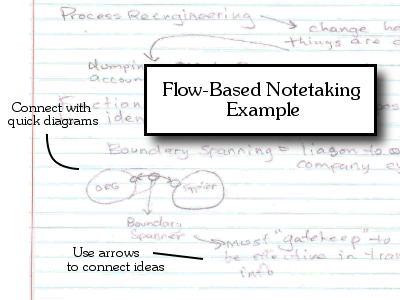
Once you get an idea written down, your next step is drawing a few arrows to connect it to other ideas. Instead of an ordered hierarchy of ideas, you want to represent the ideas as being interrelated components. This process more closely mirrors the actual holistic learning strategy, where ideas are linked into a web.
I tend to use flow-based notetaking as a method for using other techniques as well. Metaphor, diagraming and information compression are methods that can be used in conjunction with flow-based notetaking to enhance your understanding. This way you can write out major ideas and connect them to small pictures, diagrams or references to other subjects.
Remember that notes are only an intermediate step towards understanding. Having a beautiful set of perfectly written notes is useless if you don’t understand the subject you are trying to learn. Flow-based notetaking, is a messier approach to taking notes, but one I believe is more effective at helping to understand the material.
Hybrid Flow-Based Notetaking
Flow-based notetaking involves a trade-off between recording and exploration. With regular, linear notetaking, you can create an almost perfect record of what was said in a class. This method is useful if you need to review that information multiple times in order to learn it properly.
With flow-based notetaking you are sacrificing some later readability, for current understanding. By reducing the content of your notes and adding links or diagrams, the material can be learned more holistically. However, if the class has a high information density or you plan to review notes thoroughly later, there are hybrid strategies you can pursue.
Flow-Based Afternotes
The first hybrid strategy for flow-based notetaking is to take regular notes first and then recopy them into a flow-based format. If you are having trouble keeping up with the pace in a class, this strategy can give you more time to properly digest the information. Although it takes longer than a purely flow-based or linear notetaking style, it gives both readability and understanding.
I suggest starting with flow-based afternotes for the first month of trying this new notetaking style. This will ensure that you have a copy of your clearly organized notes in case you need to study them later.
Flow-Based Commenting
Some classes have an extremely high information density. When the amount of facts can’t be compressed and you are writing frantically just to get everything on paper, flow-based notetaking is almost impossible. Flow-based notetaking assumes that you can record all the critical information in a class in less time than it takes to teach. Most good teachers will give plenty explanation room and examples. During that time you can create the connections, metaphors and diagrams you need to learn holistically.
However, in cases when information density goes faster than you can record, flow-based commenting is an alternative strategy. Basically it involves writing down the key information and inserting links into your notes when there is a break. If a professor puts up a few dozen formulas you need to record, you could write all these down first. Following that, you could add more connections when the professor starts giving examples of how the formulas are used.
Recognizing Critical Information
The key ability with flow-based notetaking is to know what is important. What is the core information taught here? If you write down everything said in a lecture with equal emphasis, then you’ll spend your entire class transcribing instead of thinking. Instinctively writing down every word written on an overhead transparency or Powerpoint slide is useless if you don’t actually think about what you are writing.
With flow-based notetaking I cut down the amount of information I transcribe and emphasize on connecting and sorting that information in a way I understand.
Here is a quick scan of some of my notes taken from a class:
The full version includes more visual examples of flow-based notetaking, along with featuring other techniques such as metaphor, visceralization, model debugging, information compression, pegging, linking and speed reading. Get your copy along with 6 bonus documents for 39.95.

 I'm a Wall Street Journal bestselling author, podcast host, computer programmer and an avid reader. Since 2006, I've published weekly essays on this website to help people like you learn and think better. My work has been featured in The New York Times, BBC, TEDx, Pocket, Business Insider and more. I don't promise I have all the answers, just a place to start.